
Is Your HVAC Tech Charging You Fairly for Igniter Replacement?

Certified furnace igniter replacement cost typically falls between $100 and $250 for most homeowners, but what you actually get quoted can vary wildly.
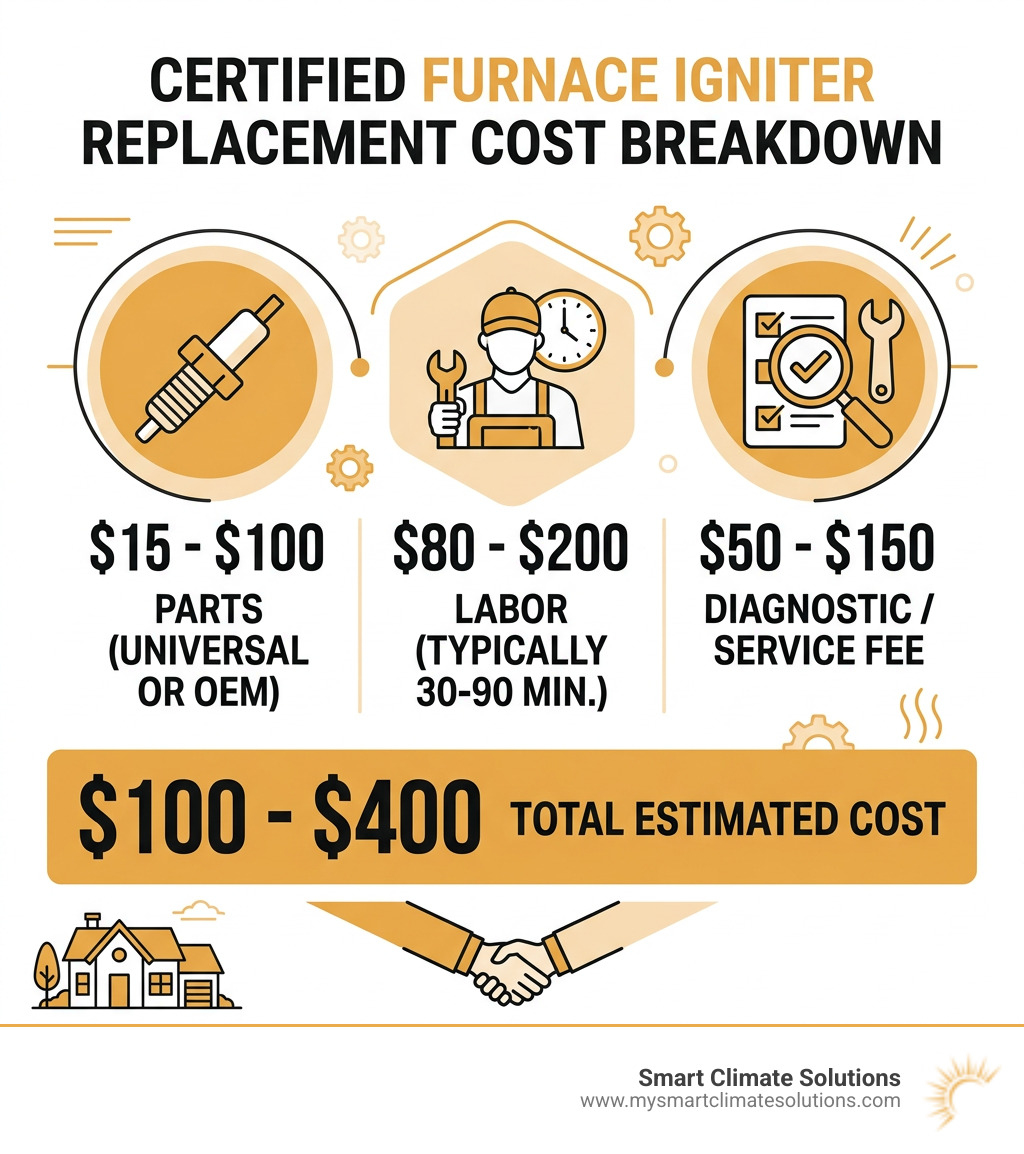
Here is a quick breakdown so you can judge any quote at a glance:
| Cost Component | Typical Range |
|---|---|
| Igniter part (universal/aftermarket) | $15 - $35 |
| Igniter part (OEM) | $20 - $100 |
| Labor | $80 - $200 |
| Diagnostic/service fee | $50 - $150 |
| Total (professional) | $100 - $400 |
| DIY total (part only) | $15 - $100 |
A few things drive that wide range:
- Part type: Universal parts cost less; OEM parts cost more
- Labor time: Most jobs take 30 to 90 minutes
- Timing: Emergency or after-hours calls can double the rate
- Location: Urban and high cost-of-living areas charge more
The national average lands around $175, with most straightforward replacements coming in under $250 when handled during normal business hours.
So when your HVAC tech quotes you $400 or more for what is essentially a small ceramic part and under an hour of work, it is fair to ask questions.
I am Bill Scott, General Manager of Smart Climate Solutions, and with over 20 years in the HVAC industry serving Pittsburgh, PA homeowners, I have seen how confusing certified furnace igniter replacement cost estimates can be and how often homeowners end up overpaying. Keep reading and I will walk you through exactly what drives these costs and how to make sure you are getting a fair deal.
Breaking Down the Certified Furnace Igniter Replacement Cost
When you receive a bill for a furnace repair, it can feel like you are paying for a luxury cruise rather than a small engine part. To understand the certified furnace igniter replacement cost, we need to peel back the layers of a standard HVAC invoice. Most reputable companies in the Pittsburgh area, from the South Hills to Washington, PA, use a combination of flat-rate pricing and hourly labor.
The first thing you will see is the service fee or diagnostic charge. This usually ranges from $50 to $150. This fee covers the technician's time to drive to your home in Steubenville or Weirton, use their specialized tools to find the problem, and provide an expert opinion. Some companies will waive this fee if you agree to the repair, while others keep it separate to cover their overhead.
Next is the labor rate. Professional HVAC contractors typically charge between $75 and $150 per hour. Replacing an igniter is not a day-long project; in most cases, a skilled technician can swap the part in 15 to 45 minutes. However, you are often billed for a minimum of one hour to account for the setup, safety testing, and cleanup.
Finally, there is the part markup. While you might see a hot surface igniter (HSI) online for $20, a service company will likely charge you $50 to $100 for that same part. This markup is not just "greed" - it covers the cost of stocking the part on the truck, providing a warranty on the component, and ensuring it is the exact match for your specific furnace model.
| Repair Path | Estimated Cost | Time Investment | Risk Level |
|---|---|---|---|
| DIY Replacement | $15 - $50 | 1 - 2 hours | High (Gas/Electric) |
| Standard Professional | $150 - $250 | 30 - 60 mins | Low (Guaranteed) |
| Emergency/After-Hours | $300 - $500 | 30 - 60 mins | Low (Guaranteed) |
If you want to dig deeper into these numbers, you can check out our detailed breakdown on the cost to fix furnace igniter to see how it compares to other common furnace issues.
Factors That Inflate Your Repair Bill
Not every igniter replacement is created equal. Several variables can push your certified furnace igniter replacement cost toward the higher end of the spectrum.
One major factor is the design of your furnace. If your unit is tucked away in a tight crawl space in Burgettstown or a cramped attic in St. Clairsville, the technician has to work harder to access the burner assembly. Difficulty of access can add significantly to the labor time. Furthermore, if your furnace is an older model with discontinued parts, the technician may have to source a specific OEM (Original Equipment Manufacturer) part that carries a premium price tag.
Another factor is the "bundle" effect. Often, when an igniter fails, it is a symptom of a larger problem. A technician might find that your flame sensor is also coated in carbon or that your inducer motor is drawing too much power. If they recommend replacing these parts simultaneously, your $200 repair can quickly climb to $500 or more.
Understanding Certified Furnace Igniter Replacement Cost for OEM vs Universal Parts
When it comes to the part itself, you generally have two choices: OEM or Universal.
- OEM Parts: These are made by the manufacturer (like Trane or Carrier) specifically for your model. They are guaranteed to fit and function exactly as intended. These parts often cost $50 to $150. Using OEM parts is often required to keep your manufacturer warranty valid.
- Universal Igniters: These are designed to fit a wide range of brands. They are much cheaper, usually $15 to $40. While they work well in a pinch, they may not last as long as the original equipment.
The material of the igniter also matters. Older furnaces use Silicon Carbide igniters, which are brittle and prone to cracking. Many modern replacements use Silicon Nitride. These are much more durable and can withstand higher temperatures and more frequent cycles. While a Silicon Nitride upgrade might cost $20 to $50 more upfront, it can last twice as long, saving you money on future service calls.
To ensure you are not overpaying for these parts, it is helpful to consult a guide to Pittsburgh furnace repairs to understand local market rates for specific brands.
How Location and Timing Affect Certified Furnace Igniter Replacement Cost
In the HVAC world, timing is everything. If your furnace quits on a sunny Tuesday afternoon in October, you will likely pay the standard rate. However, if your igniter snaps at 2:00 AM on a sub-zero Saturday in January, expect to pay an emergency premium.
Emergency service rates in the Pittsburgh and Tri-State area can be double or even triple the standard hourly rate. Some companies charge a flat "after-hours" fee of $100 to $200 just to show up. When you add that to the cost of the part and the labor, a simple igniter replacement can suddenly cost $400 to $600.
Your specific location also plays a role. Technicians traveling from Pittsburgh to outlying areas like Weirton, WV, or Washington, PA, may include a travel surcharge or a higher trip fee to account for the time spent on the road.
Signs Your Igniter is Failing and How to Test It
How do you know the igniter is actually the problem? Before you commit to the certified furnace igniter replacement cost, look for these common symptoms:
- The "Click-Click-No-Fire" Routine: You hear the furnace kick on, the inducer fan starts spinning, and you hear a series of clicks, but the burners never light. After a few tries, the furnace shuts down (locks out).
- Cold Air Blowing: If the blower motor is running but the air coming out of your vents is room temperature, the ignition sequence likely failed.
- Visual Damage: If you are comfortable opening the cabinet (with the power off!), you can often see the igniter. A bad hot surface igniter will often have a visible crack or a small white "burn" spot on the dark gray element.
- Frequent Tripped Breakers: Occasionally, a shorted igniter can trip the furnace's circuit breaker or blow a fuse on the control board.
If you have a multimeter, you can perform a continuity test. A functioning Silicon Carbide igniter should show a resistance between 40 and 90 ohms. If the multimeter shows "OL" (Open Line) or infinite resistance, the element is broken and must be replaced.
Regular maintenance can often catch these issues before they leave you in the cold. You can learn more about preventative steps in our article on furnace tune-ups.
DIY vs Professional Replacement: Is It Worth the Risk?
With the part costing as little as $20 online, many homeowners are tempted to skip the certified furnace igniter replacement cost and do it themselves. While it is one of the "easier" furnace repairs, it is not without significant risks.
The Case for DIY:
- Savings: You can save $150 to $300 in labor and markups.
- Speed: If you can find the part at a local hardware store, you might have heat back in an hour.
The Risks of DIY:
- Fragility: Igniter elements are extremely delicate. If you touch the gray part with your bare fingers, the oils from your skin will create a "hot spot" that causes the igniter to shatter the first time it heats up.
- Gas Safety: You are working near gas lines and burners. An improper installation could lead to delayed ignition (a small "boom" when the gas finally lights) or even a gas leak.
- Warranty Issues: Many manufacturers will void your entire furnace warranty if they find evidence of non-certified repairs.
- Electrical Shock: Furnaces use high-voltage connections. One slip of the screwdriver can be dangerous.
For more information on the benefits of professional maintenance and energy safety, check out the resources at ENERGY STAR.
When to Call a Pro for Your Certified Furnace Igniter Replacement
While a handy homeowner can swap a basic igniter, there are times when you absolutely need a certified technician.
If your furnace has a sealed combustion chamber, opening it incorrectly can ruin the pressure seal, preventing the furnace from running at all. If the wiring looks charred or melted, the problem is likely deeper than just a bad igniter - you might have a failing control board or a transformer issue.
Furthermore, a professional does more than just swap a part. We perform a full safety check, including testing for carbon monoxide leaks and ensuring the gas pressure is set correctly. This "peace of mind" is often worth the extra cost. If you are struggling with repair costs, there are programs available for assistance with furnace repairs that can help local families stay warm.
Frequently Asked Questions about Furnace Igniters
How long does a furnace igniter typically last?
On average, a hot surface igniter lasts between 3 and 7 years. Spark-based igniters can last longer, often 10 years or more. Their lifespan depends heavily on how often your furnace "cycles." If your thermostat is set to a very tight range, the furnace will turn on and off more frequently, wearing out the igniter faster.
Can a dirty air filter cause my igniter to fail?
Yes! This is a connection many homeowners miss. When an air filter is clogged, the furnace cannot move enough air over the heat exchanger. This causes the internal temperature to skyrocket. The igniter, which is located near the burners, gets subjected to extreme "heat stress" that can cause the ceramic to crack prematurely.
Is it safe to run a furnace with a cracked igniter?
Generally, the furnace's safety sensors will detect that the gas did not light and will shut the system down. However, repeatedly trying to start a furnace with a bad igniter can wear out the gas valve or lead to a buildup of unburned gas in the heat exchanger. If you suspect the igniter is bad, turn off the furnace at the thermostat and call for service.
Conclusion
Understanding the certified furnace igniter replacement cost is the best way to protect yourself from being overcharged. While the part itself is inexpensive, you are paying for the expertise, safety, and speed of a professional technician who can ensure your home stays warm throughout a brutal Pittsburgh winter.
At Smart Climate Solutions, we pride ourselves on transparent pricing and reliable service across Western Pennsylvania, Eastern Ohio, and the Northern Panhandle of West Virginia. We have over 20 years of experience diagnosing these issues correctly the first time, so you are not paying for parts you do not need.
If your furnace is clicking, blowing cold air, or simply refusing to start, do not wait for the pipes to freeze. Schedule your professional HVAC service and repair today and let us get your heat back on at a price that is fair and honest.


.png)
