

Why Commercial Ductwork Installation Matters for Your Business
Your commercial HVAC system is the heart of your building, but the ductwork is the vital circulatory system. Just like arteries and veins carry blood, this network of channels delivers conditioned air to every corner of your facility. For businesses in Pittsburgh, PA, where weather swings from hot and humid summers to frigid winters, an efficient duct network is not just about comfort-it is a cornerstone of operational efficiency, employee well-being, and your bottom line.
Ductwork installers are specialized HVAC professionals who design, fabricate, and install this critical system. Here's what you need to know:
Key Facts About Professional Ductwork Installers:
- What They Do: Design custom duct systems using Manual J/D/S calculations, fabricate sheet metal, install and seal all ductwork, test and balance airflow, and ensure compliance with local building codes.
- Licensing Required: Yes - DIY ductwork replacement is illegal and unsafe in most states without proper HVAC certification.
- Average Project Cost: $3,000 to $15,000+ for commercial installations. This varies widely based on building size, system complexity, and accessibility.
- Project Timeline: 1-4 days for most small to mid-sized commercial projects, but can be longer depending on the scope.
- When to Call: Rising energy bills, uneven temperatures, poor air quality, musty odors, visible duct damage, or systems over 15-20 years old.
Think about what happens when arteries get clogged; the heart has to work much harder for diminished results. The same is true for your HVAC system. According to government programs like ENERGY STAR, outdated or poorly installed ductwork can increase your utility costs by 30% or more by allowing heated or cooled air to escape into ceilings, crawlspaces, and wall cavities. This forces your HVAC unit to run longer and harder to maintain temperature, shortening its lifespan and driving up expenses.
Beyond costs, leaky ducts create significant health and productivity issues. They can pull in dust, insulation fibers, allergens, and even mold spores from unconditioned spaces and circulate them throughout your workspace. This contributes to poor indoor air quality, which can impact employee health, trigger allergies, and lead to what is known as "Sick Building Syndrome." In a place like Pittsburgh, summer humidity drawn in through leaky return ducts can create a perfect breeding ground for mold within your air system.
This guide breaks down everything facility managers and business owners need to know about commercial ductwork installation. We'll cover the types of ductwork available, warning signs that indicate replacement is needed, realistic budget expectations, and how to find qualified installers in the Pittsburgh area.
I'm Bill Scott, and over my 20+ years in the HVAC industry, I've overseen countless commercial ductwork projects for businesses across Southwestern PA. I've worked directly with ductwork installers to ensure systems are designed and installed correctly the first time. This experience has shown me that the difference between a struggling HVAC system and an efficient one often comes down to the quality of the ductwork installation. I have seen how simple mistakes-like improper sealing or poor sizing-can cripple a brand-new, high-efficiency HVAC unit, wasting a company's investment.
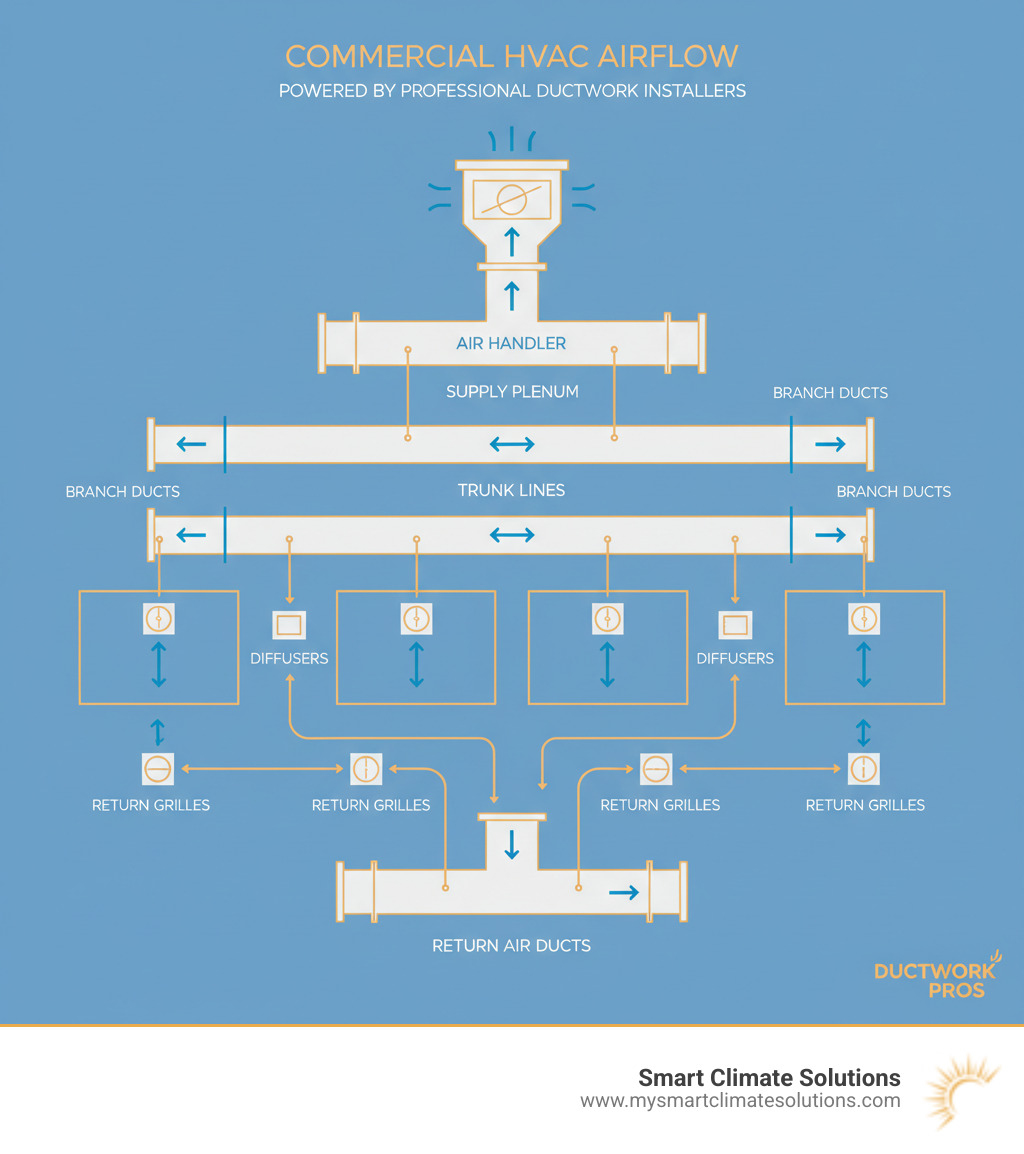
For organizations operating across the Pittsburgh metro-South Hills, Burgettstown, Washington, Steubenville, St. Clairsville, and Weirton-right-sized, well-sealed ducts deliver measurable results. Expect steadier temperatures across zones, quieter offices, less dust and odor transfer, and fewer emergency service calls during heat waves and cold snaps. Modern duct designs can also support future renovations and tenant fit-outs without tearing out the entire system, protecting your capital plan.
A quick baseline audit by qualified ductwork installers typically includes a visual inspection, pressure testing, thermal imaging, and airflow readings at key registers. With those data points, we can model expected energy savings, prioritize fixes, and determine whether repair, partial replacement, or a full redesign will deliver the strongest return on investment for your building.
The Blueprint of Breathable Air: Commercial Ductwork Types
Choosing the right material is the foundation of a long-lasting and efficient system. Each type has specific applications in a commercial setting, from large open warehouses to partitioned office spaces. When you're working with ductwork installers, understanding these options helps you make informed decisions about your building's air distribution system. A professional will often recommend a hybrid approach, using different types for different parts of the system to maximize performance and cost-effectiveness.
Sheet Metal Ducts
If ductwork had a hall of fame, sheet metal ducts would be the first inductees. Made from galvanized steel or aluminum, these rigid ducts are the workhorses of commercial HVAC systems. Their fabrication is a craft in itself, requiring skilled technicians to cut, bend, and shape flat metal sheets into the precise rectangular or spiral-round ducts needed for your building.
Sheet metal ducts are highly durable and can last for 30 years or more with proper maintenance. Their non-porous surface is naturally resistant to mold and pests, making them ideal for maintaining healthy indoor air quality. Furthermore, their smooth interior surfaces allow air to flow with minimal friction, maximizing efficiency. When your system needs cleaning-a critical maintenance task-sheet metal is by far the easiest material to clean thoroughly.
The trade-offs? Without proper insulation, these ducts can transmit the sound of the air handler and airflow, which might be disruptive in quiet office spaces. To counter this, installers can use external duct wrap or internal acoustic liners. They are also heavier and more labor-intensive to install, especially in tight, retrofitted spaces, leading to a higher initial cost. But for large commercial spaces, industrial facilities, restaurants, and the main trunk lines of any system, the durability and fire resistance of sheet metal make it the superior choice.
Fiberboard Ducts
Fiberboard ducts take a different approach. Constructed from compressed fiberglass insulation and faced with a foil-scrim-kraft (FSK) laminate, these ducts come with insulation built right in. The FSK facing acts as a tough, protective outer jacket and a vapor barrier, which is crucial for performance.
This built-in insulation provides excellent thermal efficiency, preventing heat loss or gain as conditioned air travels to its destination. Fiberboard also naturally dampens sound, making these ducts a popular choice in offices, libraries, and retail spaces where a quiet environment is a priority. They are significantly lighter than sheet metal, which can simplify and speed up installation in certain scenarios, potentially lowering labor costs.
The primary downside is durability and moisture sensitivity. Fiberboard can be damaged during construction or maintenance and can deteriorate if exposed to moisture, which could lead to mold growth or the release of fibers into the air stream. For this reason, professional ductwork installers avoid using it in humid environments like basements, near commercial kitchens, or in any area prone to condensation. Installation requires meticulous care, using special tools and approved sealing tapes to ensure all seams are airtight.
Flexible Ducts
Flexible ducts-or "flex ducts" as they're known in the trade-are the problem solvers of the ductwork world. These tube-shaped ducts consist of a wire coil helix forming the structure, wrapped in a durable polymer or metalized plastic, and surrounded by a thick blanket of insulation.
Their superpower is adaptability. Need to steer around a structural beam, make a tight turn, or connect a main duct line to a ceiling diffuser in an awkward spot? Flex duct handles these challenges with ease. It's lightweight, quick to install, and comes pre-insulated, making it a favorite for final connections.
However, flex duct has significant limitations and is often installed incorrectly by amateurs. It has a shorter lifespan (10-15 years) than rigid options and is easily damaged by kinks, tears, or compression. The most critical factor is proper installation. The duct must be pulled taut; if left to sag or snake, the internal ridges create massive turbulence and can reduce airflow by over 50%. Sharp bends must be avoided in favor of gentle curves. Because of its ribbed interior, it is also much more difficult to clean than rigid ductwork. For these reasons, its use should be strategic and limited. The sweet spot for flex duct is in short, straight runs connecting main ducts to air registers, especially in complex ceiling spaces where obstructions make rigid connections impractical.
Here's how these options compare:
| Ductwork Type | Durability | Mold Resistance | Sound Dampening | Best Use Cases |
|---|---|---|---|---|
| Sheet Metal | Excellent (30+ years) | Excellent | Poor (without insulation) | Main trunk lines, large facilities, industrial spaces |
| Fiberboard | Good (15-20 years) | Fair (moisture-sensitive) | Excellent | Offices, retail, low-moisture areas |
| Flexible | Fair (10-15 years) | Good | Good | Short runs, tight spaces, connections to registers |
Your building will almost certainly require a combination of these materials. A typical high-performance commercial installation uses durable sheet metal for the main supply and return trunk lines, with either smaller rigid branches or, where necessary, short and properly installed runs of flex duct for the final connections to diffusers. This hybrid strategy balances durability, efficiency, and cost. The right ductwork installers will assess your specific building layout, budget, and performance requirements to design and recommend the optimal mix for your facility.
Beyond material choice, system performance hinges on details that are easy to overlook: sealing with mastic and UL 181 tape, selecting the correct insulation R-values for supply and return runs, supporting ducts at proper intervals, and using smooth transitions to keep static pressure in check. Reputable installers follow SMACNA fabrication standards, test for leakage, and balance each zone after installation. In the Pittsburgh area, permitting and inspections confirm compliance with IMC-based local codes, so partnering with a contractor who manages design, fabrication, and code coordination helps avoid delays and costly rework.



.png)
