

When Your Furnace Pilot Light Goes Out: What Every Pittsburgh Homeowner Needs to Know
Furnace pilot light out issues are among the most common heating emergencies that Pittsburgh homeowners face, especially during our cold winters. If you're dealing with this problem right now, here's what you need to know immediately:
Quick Action Guide:
- Check for a gas smell - If you smell gas, leave your home immediately and call your gas company's emergency line
- Turn off your thermostat to prevent the furnace from attempting to cycle
- Wait 5-10 minutes for any residual gas to dissipate before investigating
- Locate your pilot light - usually at the bottom of your furnace behind an access panel
- Look for a small blue flame - if it's not burning, your pilot light is out
When to Call a Professional:
- You smell gas
- The pilot won't stay lit after relighting
- You're uncomfortable working with gas appliances
- Your furnace is more than 10 years old and having repeated issues
It's a frustrating situation - you wake up to a cold house, the furnace is silent, and you're left wondering what went wrong. In older Pittsburgh homes, where furnaces manufactured before 2010 still rely on standing pilot lights, this scenario is particularly common during our harsh winters when your heating system is working overtime.
Why does this happen? The most common culprits include a dirty or faulty thermocouple (the safety device that detects your pilot flame), a clogged pilot orifice restricting gas flow, drafts from basement windows or doors, or issues with your natural gas supply. Understanding these causes helps you determine whether it's a quick fix or time to call in the experts.
I'm Bill Scott, general manager of Smart Climate Solutions, and over my 20 years in the HVAC industry serving Pittsburgh and Southwestern PA, I've helped thousands of homeowners troubleshoot furnace pilot light out emergencies - often responding within 30 minutes to restore heat when families need it most. This guide will walk you through exactly what to check, how to safely relight your pilot, and when it's time to let professionals handle the problem.
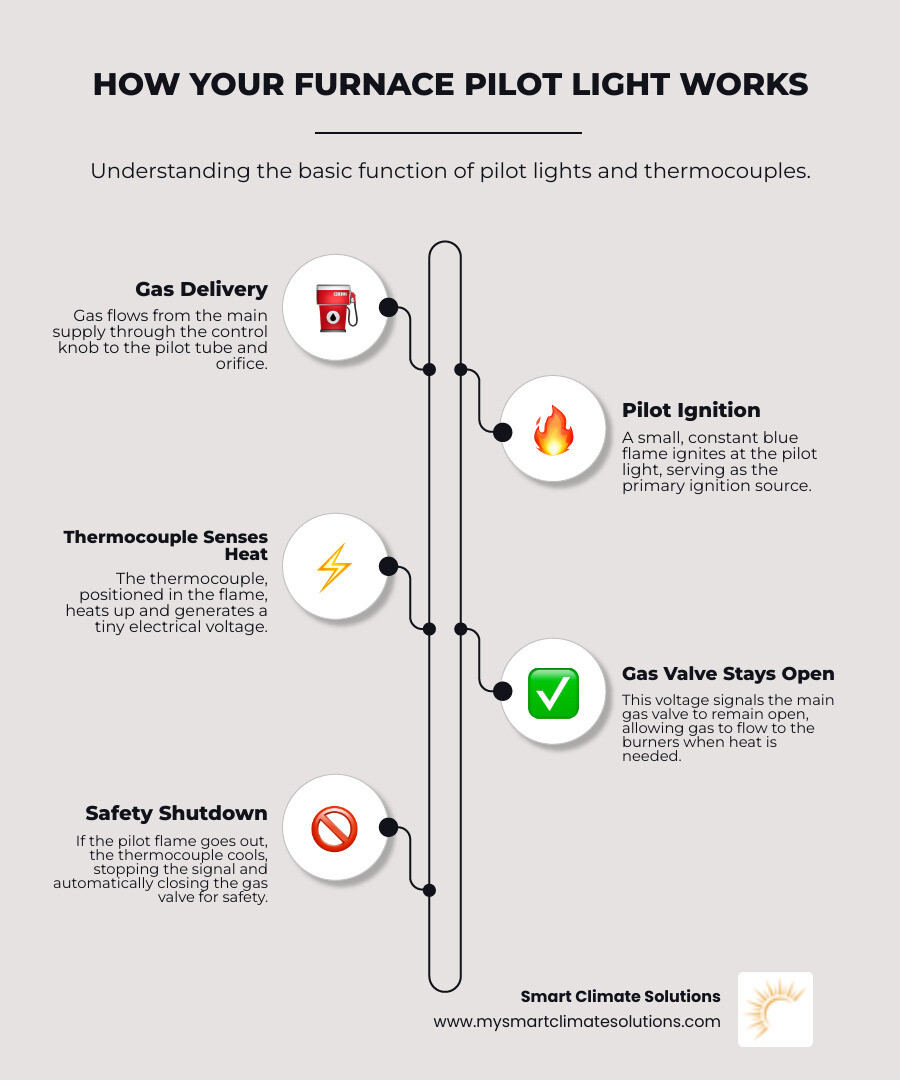
Basic furnace pilot light out terms:
What Is a Pilot Light and Why Is It Important?
A pilot light is a small, continuously burning flame that acts as the ignition source for the main burners in a gas furnace. Think of it as a tiny, ever-present match, ready to ignite the larger flames that heat your home. This technology is typically found in older gas HVAC systems, especially those manufactured before 2010. While modern furnaces have largely moved away from standing pilot lights, many homes in Pittsburgh and our surrounding service areas like South Hills, Burgettstown, Washington, Steubenville, St. Clairsville, and Weirton still rely on them.
The primary function of this pilot light is simple: when your thermostat calls for heat, the gas valve opens, releasing gas to the main burners. The pilot light then ignites this gas, starting the heating cycle. Without a working pilot light, your furnace cannot produce heat.
Crucially, a safety device called a thermocouple works hand-in-hand with the pilot light. The thermocouple is a small, copper rod positioned directly in the pilot light's flame. When heated by the pilot flame, it generates a small electrical current. This current signals the gas valve to remain open, allowing gas to flow to the pilot. If the pilot light goes out, the thermocouple cools down, the electrical current stops, and the gas valve automatically closes. This critical safety feature prevents raw gas from continuously flowing into your home, which could lead to dangerous gas buildup. You can learn more about the basic science behind thermocouples to better understand how this safety device works.
While essential for older furnaces, these constantly burning pilot lights do consume a small but continuous amount of natural gas. In fact, some estimates suggest that a perpetually lit pilot light can account for a significant portion of a gas furnace's energy consumption. This is one reason newer, more energy-efficient models have adopted electronic ignition systems.

Common Causes for a Furnace Pilot Light Out
When your furnace pilot light is out, it's usually not a random occurrence. Several factors can contribute to this common problem. Understanding these causes can help you determine the best course of action.
Faulty or Dirty Thermocouple: This is arguably the most common culprit. As we mentioned, the thermocouple is a safety sensor that detects the pilot flame. If it's dirty, corroded, bent, or simply worn out, it won't properly sense the flame's heat. This causes it to stop signaling the gas valve to stay open, and the gas supply to the pilot light is cut off. A pilot flame that isn't hitting the thermocouple effectively, perhaps due to misalignment, can also cause this issue.
Clogged Pilot Orifice: The pilot orifice is a tiny opening that delivers gas to the pilot light. Over time, dust, dirt, or other debris can accumulate here, restricting the gas flow. This results in a weak, flickering, or yellowish pilot flame instead of the strong, steady blue flame it should be. A weak flame might not be hot enough to properly activate the thermocouple, or it could simply be too fragile to stay lit.
Strong Drafts: While it might seem simplistic, a strong gust of air can literally blow out your pilot light, much like a candle. This is especially common in furnaces located in basements or utility closets with poor sealing or near frequently opened doors or windows. Changes in your home's ventilation system, or even a missing chimney cap, can create drafts strong enough to extinguish the flame.
Interrupted Gas Supply: Your furnace needs a consistent supply of natural gas to keep the pilot light burning. Issues with your home's gas line, such as a partially closed gas valve, or even broader problems with the municipal gas supply (like pressure fluctuations during peak demand), can cause the pilot light to go out.
Faulty Gas Regulator: The gas regulator is responsible for maintaining a consistent gas pressure to your furnace and other gas appliances. If it's failing or improperly adjusted, the gas pressure can become too low or too high, leading to the pilot light extinguishing. If multiple gas appliances in your home are experiencing pilot light issues, a problem with the gas regulator could be the cause, and you should contact your utility company.
Failing Gas Valve: The gas valve controls the flow of gas to both the pilot light and the main burners. If the internal components of the gas valve are worn or faulty, it might not be able to maintain the gas flow to the pilot light, causing it to go out. This is a more complex issue that requires professional attention.

A Homeowner's Guide to Safely Checking and Relighting Your Pilot
Before you attempt to relight your pilot light, safety must be your absolute top priority. Working with natural gas carries inherent risks, and we want to ensure you and your family remain safe.
A Homeowner's Guide to Safely Checking and Relighting Your Pilot
Critical Safety Precautions:
- Smell for Gas: This is the most important step. If you detect a strong odor of natural gas, do not proceed. Leave your home immediately, call your gas utility company's emergency line from a safe location, and then call us at Smart Climate Solutions. Do not turn on or off any electrical switches, use your phone inside, or operate any appliances, as a spark could ignite accumulated gas.
- Turn Off Thermostat: Set your thermostat to its lowest setting or completely to "Off." This prevents the furnace from attempting to cycle and potentially igniting gas prematurely during your relighting attempt.
- Turn Off Power: For an added layer of safety, consider turning off the electrical power to your furnace at the circuit breaker.
- Wait 5-10 Minutes: After turning off the gas supply (as described below), wait at least five to ten minutes. This allows any residual gas that may have accumulated around the pilot assembly to dissipate, significantly reducing the risk of a flash fire when you introduce a flame.
- Carbon Monoxide Risks: A malfunctioning pilot light or furnace can produce carbon monoxide (CO), an odorless, colorless gas that can be deadly. The CDC recommends using battery-powered carbon monoxide detectors in all sleeping areas and on every level of your home. Check their batteries regularly, especially when you change your clocks for daylight saving time. If your CO detector goes off, evacuate immediately and call 911.
Step-by-Step: How to Relight a Furnace Pilot Light That is Out
Once you've taken all safety precautions and confirmed there's no gas smell, you can attempt to relight your pilot light. Always refer to your furnace's owner's manual for specific instructions, as procedures can vary slightly between models.
- Locate the Pilot Assembly: This is usually found at the bottom of your furnace, behind an access panel. You'll typically see a gas control knob with settings like "ON," "OFF," and "PILOT," along with a small pilot tube and the thermocouple.
- Turn the Gas Control Knob: Rotate the gas control knob to the "OFF" position. Wait the recommended 5-10 minutes (or longer, as per your manual) for any gas to clear out.
- Set to "PILOT": Turn the knob to the "PILOT" setting.
- Press and Hold the Reset Button: On most older furnaces, you'll need to press and hold down a "reset" or "pilot" button. This manually overrides the gas valve's safety mechanism, allowing gas to flow to the pilot.
- Use a Long Lighter or Match: While holding down the reset button, use a long-stemmed lighter, BBQ lighter, or a long match to ignite the pilot light. Position the flame directly over the pilot orifice where the gas comes out. You should see a small, blue flame ignite.
- Hold the Button for 60 Seconds: Once the pilot light is lit, continue to hold down the reset button for about 30-60 seconds. This crucial step allows the thermocouple to heat up sufficiently and generate the electrical current needed to keep the gas valve open. If you release it too soon, the pilot light will likely go out again.
- Slowly Release the Reset Button: Gently release the reset button. The pilot light should remain lit. If it goes out, repeat steps 2-6. You might need to hold the button a bit longer.
- Turn the Knob to "ON": Once the pilot light is stable and burning steadily, turn the gas control knob from "PILOT" to the "ON" position.
- Confirm Burners Ignite: Go to your thermostat and set it to a temperature higher than the current room temperature. Your furnace should now kick on, and you should hear the main burners ignite from the pilot flame.
If at any point you feel uncomfortable or unable to follow these steps, please do not hesitate to call a professional HVAC technician. Your safety is paramount.
Troubleshooting: What to Do When the Pilot Won't Stay Lit
It's frustrating when you go through the relighting process, only to find that your furnace pilot light is out again shortly after. If your pilot light won't stay lit, it's a clear sign of an underlying issue that needs attention.
Common Scenarios and What They Mean:
- Pilot goes out immediately after releasing the reset button: This almost always points to a faulty or dirty thermocouple. If the thermocouple isn't heating up properly or is unable to generate the necessary current, it won't signal the gas valve to stay open, and the pilot light will extinguish as soon as you release the manual override.
- Pilot goes out when the main burners kick on: This could indicate a few issues. A strong draft created by the main burner's operation might be blowing out the pilot. Alternatively, a problem with the gas valve or even a cracked heat exchanger could be causing airflow disruptions that extinguish the pilot.
- Weak or yellow flame vs. strong blue flame: A healthy pilot light should be a strong, steady blue cone-shaped flame. If your pilot flame is weak, flickering, or yellow/orange, it suggests a problem with gas flow or combustion. This is often due to a dirty pilot orifice, which restricts gas flow and prevents proper ignition.
Initial Troubleshooting Steps:
- Cleaning the Pilot Orifice: If you suspect a dirty pilot orifice (due to a weak or yellow flame), you can try cleaning it. After turning off the gas and power and waiting for dissipation, carefully remove the pilot assembly. Using a very thin wire (like from a paperclip) or compressed air, gently clear any debris from the tiny opening of the pilot orifice. Be extremely careful not to enlarge the opening.
- Check Thermocouple Alignment: Ensure the tip of the thermocouple is fully engulfed in the pilot flame. If it's bent or misaligned, gently adjust it so it sits correctly in the flame.
If these basic steps don't resolve the issue, or if you're uncomfortable performing them, it's time to call in the experts. Repeatedly relighting a pilot light without addressing the root cause is not only inconvenient but can also indicate a safety concern.
What to Do When Your Furnace Pilot Light is Out and Won't Relight
When the usual troubleshooting steps fail, you're likely dealing with a more advanced problem requiring professional diagnosis. Here at Smart Climate Solutions, we understand the urgency when your heat goes out, especially in the middle of a Pittsburgh winter.
Signs you need professional help:
- You've tried to relight the pilot multiple times, and it simply won't stay lit.
- The pilot light ignites but goes out once the main burners try to come on.
- You notice a persistent yellow or orange pilot flame even after cleaning.
- You suspect a problem with the gas valve. Replacement gas valves can start around $350, highlighting the complexity and cost of this repair.
- You hear unusual noises from your furnace or smell anything out of the ordinary.
- Your furnace is older, and these issues are becoming frequent.
A professional HVAC technician can accurately diagnose issues like a failing gas valve, which might not be supplying consistent gas pressure, or a more serious problem like a cracked heat exchanger. A cracked heat exchanger is particularly dangerous as it can allow exhaust gases, including carbon monoxide, to leak into your home's air supply. Repairing a heat exchanger is often compared to "heart surgery" for your furnace and can be costly, sometimes thousands of dollars, especially if not under warranty. In such cases, replacing the furnace might be a safer and more cost-effective long-term solution.
For any furnace repair in Pittsburgh or our service areas, our certified technicians are ready to provide expert emergency furnace help. We can quickly identify the problem and offer reliable solutions. Regular furnace tune up appointments are also crucial to prevent these issues before they leave you in the cold.
Beyond the Pilot: Modern Furnace Ignition Systems
While this guide focuses on the common issue of a furnace pilot light out, it's important to recognize that pilot lights are an older technology. Modern gas furnaces have largely moved away from standing pilot lights in favor of more efficient and reliable electronic ignition systems.
Standing Pilot vs. Electronic Ignition Systems:
| Feature | Standing Pilot Light (Older Furnaces) | Electronic Ignition (Modern Furnaces) |
|---|---|---|
| Ignition Method | Small, continuous gas flame | Electric spark or heated element |
| Gas Consumption | Continuous, even when furnace is not heating | Only consumes gas when furnace calls for heat |
| Energy Efficiency | Lower (estimated half of a furnace's energy can be from pilot light) | Higher (no wasted gas from continuous flame) |
| Safety | Relies on thermocouple as safety shut-off; risk of gas leaks if pilot out | Electronic sensors for gas shut-off; generally safer |
| Reliability | Can be blown out by drafts, prone to thermocouple failure | More reliable, less susceptible to external factors |
| Maintenance | Requires occasional cleaning, thermocouple replacement | Less maintenance for ignition system itself, but sensors can fail |
| Common in Furnaces | Manufactured before 2010 | Manufactured after 2010 |
There are two main types of electronic ignition systems:
- Hot Surface Ignitors (HSI): These use a silicon carbide or silicon nitride element that heats up to a very high temperature, glowing red hot, to ignite the gas. They are similar to a light bulb filament and are very common in newer furnaces. If your furnace ignitor fails, your furnace won't start, but it's a different troubleshooting path than a pilot light.
- Intermittent Pilot Systems: These systems use an electronic spark to ignite a pilot light only when the thermostat calls for heat. Once the main burners ignite, the pilot light turns off. This is a hybrid approach that offers better efficiency than a standing pilot but still uses a pilot flame.
The advantages of these modern systems are clear: increased energy efficiency due to less wasted fuel, improved safety, and greater reliability. While upgrading your furnace is a significant investment, a new, high-efficiency model with an electronic ignition can lead to substantial savings on your energy bills over its lifespan and provide greater peace of mind.
Frequently Asked Questions about Furnace Pilot Lights
Can a bad thermostat cause the pilot light to go out?
No, it's highly unlikely that a bad thermostat would directly cause your pilot light to go out. The thermostat's primary function is to signal the furnace to turn on or off based on the desired temperature. It doesn't directly manage the pilot light itself. The pilot light operates as a separate circuit, designed to stay lit independently of the thermostat's call for heat. If your pilot light is out, the problem lies within the furnace's pilot assembly, gas supply, or safety mechanisms, not the thermostat. However, a faulty thermostat could prevent the main burners from igniting even if the pilot light is working correctly.
How do I know if my furnace has a pilot light or an electronic ignition?
The easiest way to tell is by the age of your furnace. As a general rule, furnaces manufactured before 2010 typically have standing pilot lights, while most newer models (2010 and later) use electronic ignition.
You can also perform a quick visual check:
- Look for a gas control knob: Furnaces with pilot lights usually have a knob with "ON," "OFF," and "PILOT" settings near the bottom of the unit.
- Visual inspection for a constant flame: If you carefully observe the burner area (often through a small window or after removing an access panel, following all safety precautions), a standing pilot light will have a small, continuous flame. An electronic ignition system will have no visible flame when the furnace is off; you might hear a clicking sound or see a glowing element when the thermostat calls for heat.
- Check the owner's manual: Your furnace's owner's manual will clearly state the type of ignition system it uses.
What are the dangers of a malfunctioning pilot light?
A malfunctioning pilot light, or one that repeatedly goes out, can pose several serious dangers:
- Natural Gas Leaks: If the pilot light goes out and the thermocouple (or other safety device) fails to shut off the gas valve, raw natural gas can leak into your home. Natural gas is highly flammable and explosive. Even a small spark from a light switch, appliance, or static electricity can trigger an explosion. This is why it's critical to evacuate and call your utility company immediately if you smell gas.
- Carbon Monoxide Poisoning: While a pilot light itself doesn't typically produce dangerous levels of carbon monoxide (CO), a malfunctioning furnace where the pilot light is out can indicate broader issues. Incomplete combustion, often caused by a dirty burner, clogged flue, or cracked heat exchanger, can lead to the production of carbon monoxide. CO is a silent killer: it's an odorless, colorless, and tasteless gas. Symptoms of carbon monoxide poisoning can include headache, dizziness, nausea, and flu-like symptoms, often mistaken for other illnesses. Severe exposure can lead to unconsciousness, brain damage, or death. This underscores the vital importance of having working carbon monoxide detectors on every level of your home, especially near sleeping areas.
These dangers highlight why addressing a furnace pilot light out promptly and safely is crucial. If you're ever in doubt, always call a professional.
Conclusion: Keep Your Pittsburgh Home Warm with Expert Help
Dealing with a furnace pilot light out can be a chilly and concerning experience for any homeowner in Pittsburgh, South Hills, Burgettstown, Washington, Steubenville, St. Clairsville, or Weirton. We've walked through what a pilot light is, why it might go out, how to safely check and relight it, and when to recognize that it's time to call in the professionals.
Safety is always first. If you smell gas, evacuate immediately. If you're uncomfortable with any part of the relighting process, or if your pilot light repeatedly goes out, it's a clear sign that a deeper issue is at play. Don't risk your family's safety or further damage to your heating system.
At Smart Climate Solutions, we're dedicated to ensuring your home stays warm and safe, even in the harshest winter conditions. Our certified technicians have over 20 years of experience, offering fast, reliable service with 24/7 emergency support. We can diagnose and resolve any pilot light issue, perform essential maintenance, or discuss upgrading to a more efficient modern furnace.
For reliable furnace repair and maintenance, explore our HVAC Preventative Maintenance Plans or contact us for expert HVAC service and repair. We're here to keep you comfortable.


.png)
