
Why Choosing the Right Gas Heating System Matters
Gas heating system installation is a critical decision that impacts your home's comfort, safety, and energy bills for years. Here's what you need to know:
Quick Answer: Gas Heating System Installation Overview
- Types: Gas furnaces (forced-air) and gas boilers (radiant heat).
- Timeline: 4-10 hours for a standard furnace; 1-3 days for complex systems.
- Cost: $3,800 to $12,000+ including equipment and labor.
- Efficiency: Modern systems range from 80% to 98.5% AFUE.
- Professional Required: Licensed technician mandatory for safety and warranty.
When winter hits Pittsburgh, a reliable heating system is not a luxury - it is essential. Many homeowners face a confusing array of choices when it's time for a new gas heating system. Furnace or boiler? What size do you need? And why is professional installation so important?
Getting your gas heating system installation right the first time saves money, prevents safety hazards, and ensures your family stays warm. An oversized system wastes energy, while an undersized one struggles to keep up. Improper installation can lead to dangerous gas leaks or carbon monoxide exposure.
Most U.S. homes use furnaces or boilers. Modern high-efficiency systems can reach 90% to 98.5% AFUE (Annual Fuel Utilization Efficiency), while older systems might be as low as 56-70% AFUE. Upgrading from 56% to 90% efficiency can cut your fuel bills in half and save 1.5 tons of carbon dioxide emissions annually.
I'm Bill Scott, general manager of Smart Climate Solutions. With over 20 years of experience helping Pittsburgh homeowners, I'll guide you through choosing the perfect system and explain why professional installation is non-negotiable.
Understanding Your Gas Heating System Options
Choosing the right gas heating system for your home in Pittsburgh, South Hills, Burgettstown, Washington, Steubenville, St. Clairsville, or Weirton means understanding the different technologies available. Each system offers unique benefits. Let's break down the primary types of gas-powered heating systems for residential use.
Gas Furnaces: The Forced-Air Standard
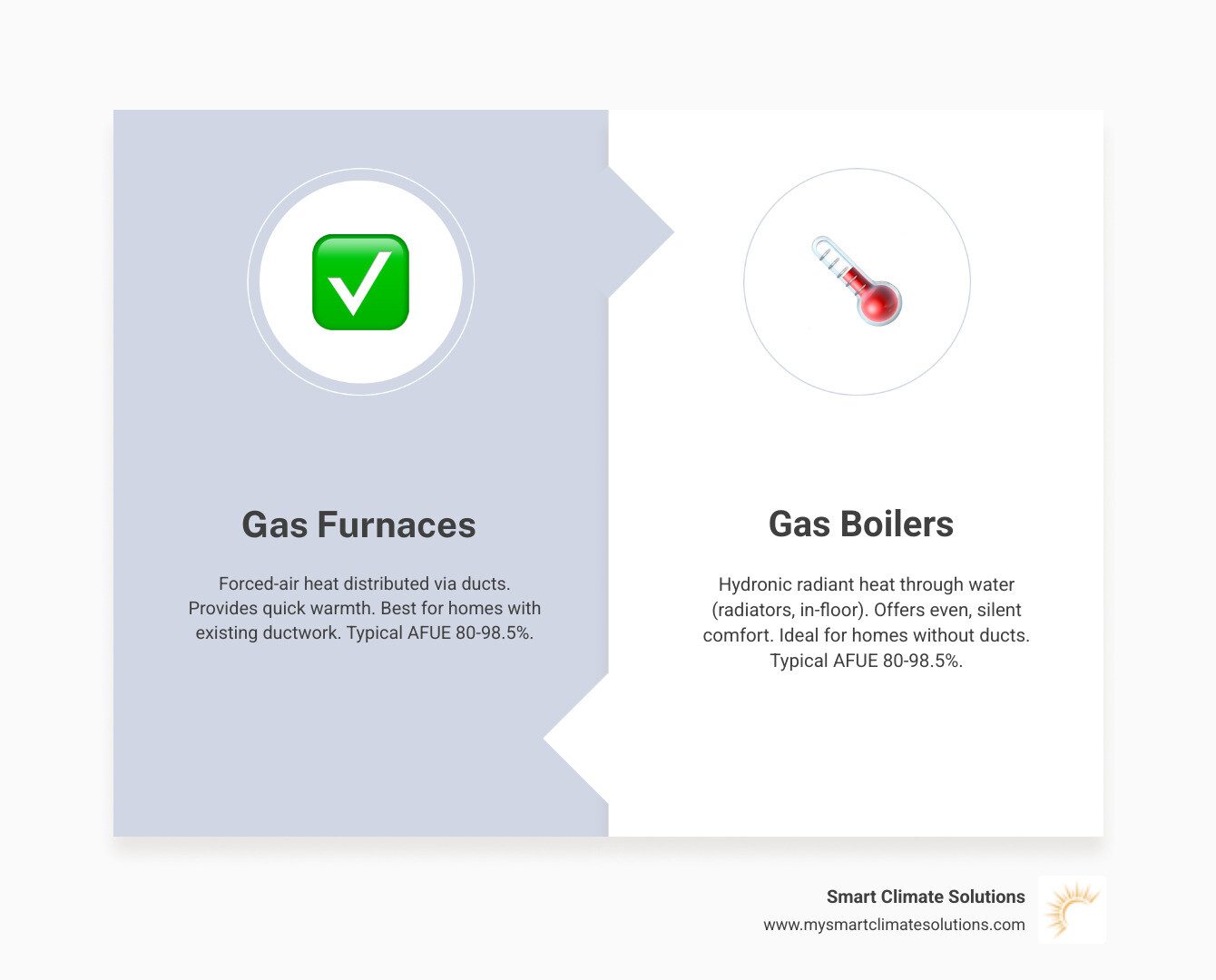
Most people picture a gas furnace when they think of home heating. These are the workhorses of central heating, using a forced-air system to distribute warmth. A furnace heats air, and a blower fan pushes it through a network of ducts and vents into each room, creating an even temperature.
The air circulation from furnaces can also be integrated with air conditioning, offering a complete HVAC solution. You can explore more about these integrated systems in our guide on Residential Heating and Cooling Options.
Gas furnaces come in a few varieties:
- Single-stage furnaces: Operate at full capacity when on. They are simpler and less expensive but can cause temperature swings.
- Two-stage furnaces: Have two settings (high and low) for more consistent temperatures and better efficiency.
- Modulating furnaces: Adjust heat output in small increments, providing the most consistent comfort and highest efficiency.
Gas Boilers: Radiant Heat Champions
If you prefer a different kind of warmth, a gas boiler might be your ideal choice. Boilers provide hydronic (hot water) heating, circulating water through pipes to radiators, baseboard heaters, or in-floor radiant systems. This method delivers a gentle, even heat that many find incredibly comfortable and less dry than forced-air systems.
Boilers come in various configurations:
- Combi boilers: Provide both heating and hot water on demand, saving space by removing the need for a water tank. Excellent for smaller homes.
- System boilers: Heat water for central heating and a separate hot water storage cylinder. Ideal for larger homes with high hot water demand.
- Conventional boilers: Also called heat-only boilers, these work with a separate hot water cylinder and are good for homes with a traditional setup.
For more details on different boiler types, you can refer to the Boilers System Type information. If you're dealing with issues in an existing radiant system, our HVAC Radiator Repair Pittsburgh Guide can offer insights.
Floor-Mounted and Other Specialty Systems
Beyond traditional furnaces and boilers, other gas heating options like floor furnaces or wall heaters can be suitable for specific situations, such as smaller spaces or supplemental heating. While these can be cost-effective for targeted heating, they typically don't offer the whole-home capabilities of a central furnace or boiler. For comprehensive solutions, we often recommend exploring our broader Residential HVAC Solutions.
To help you decide, here's a quick comparison:
| Feature | Gas Furnaces | Gas Boilers |
|---|---|---|
| Heat Delivery | Forced-air through ducts | Radiant heat through water/steam |
| Comfort Feel | Quick, even heat, can be dry | Gentle, consistent, less dry, luxurious |
| Installation | Typically 4-8 hours for replacement | 1-3 days, often more complex |
| Maintenance | Filter changes, annual tune-ups | Annual tune-ups, pressure checks, descaling |
| Initial Cost | Often lower | Can be higher due to system complexity |
| Efficiency | High-efficiency models up to 98.5% AFUE | High-efficiency models up to 98.5% AFUE |
| Ductwork | Required | Not required (uses pipes) |
| Domestic Hot Water | Separate water heater needed | Can be integrated (combi/system boilers) |
| Noise Level | Blower fan noise | Generally quieter |
Key Factors in Selecting Your System
Choosing the right system is about matching the unit to your home's specific needs for optimal performance and savings. For homeowners in the greater Pittsburgh area, including South Hills, Burgettstown, Washington, Steubenville, St. Clairsville, and Weirton, these factors are crucial for winter comfort.
Sizing Your System for Your Pittsburgh Home
Proper sizing is one of the most critical aspects of any gas heating system installation. An HVAC professional performs a "load calculation" to determine your home's precise heating needs. This is not a guess based on square footage; it considers many variables:
- Square footage: The total area to be heated.
- Insulation levels: How well your home retains heat.
- Window quality: Energy-efficient windows reduce heat loss.
- Climate considerations: The severity of winter temperatures in our region.
- Air leakage: Gaps and cracks that allow cold air in.
An oversized system costs more upfront and short-cycles, leading to uneven heat, wasted energy, and premature wear. It's like buying a monster truck to drive to the grocery store - it's overkill. An undersized system struggles to keep your home warm, running constantly without reaching the target temperature. Getting the size right is key to efficiency and comfort, and it's a core part of finding the Most Efficient Residential Heating System for your property.
Decoding Efficiency Ratings (AFUE)
When looking at new gas heating systems, you will see the term AFUE, or Annual Fuel Utilization Efficiency. This percentage shows how efficiently a unit converts fuel into heat over a year. The higher the AFUE percentage, the more efficient the system and the more you will save on energy bills.
Here's what the percentages mean:
- Older, low-efficiency systems: Have AFUE ratings between 56% to 70%. This means 30-44% of the fuel you pay for is wasted.
- Mid-efficiency systems: Fall in the 80% to 83% AFUE range, a significant improvement over older models.
- High-efficiency systems: Boast AFUE ratings from 90% to 98.5%, wasting only a tiny fraction of fuel.
The U.S. Department of Energy provides more insights into these ratings in their standards for residential furnaces. Upgrading your furnace from 56% to 90% efficiency can save 1.5 tons of carbon dioxide emissions each year. This translates to lower utility bills and a smaller carbon footprint. We've compiled more tips in our Energy Saving HVAC Tips guide.
The Benefits of High-Efficiency Condensing Units
For those committed to energy savings, high-efficiency condensing units are the gold standard. These systems use a secondary heat exchanger to capture heat from exhaust gases that would otherwise be lost. As these gases cool, they condense, releasing even more heat. This technology allows units to achieve impressive 90% to 98.5% AFUE ratings.
The exhaust from condensing units is cooler, requiring special PVC venting instead of traditional metal flues. While the upfront cost is higher, the long-term benefits are substantial:
- Lower energy bills: You use less gas to achieve the same level of comfort.
- Reduced carbon footprint: More efficient combustion means fewer emissions.
- Consistent comfort: Often paired with modulating burners, these systems provide stable temperatures.
Investing in a high-efficiency condensing unit is a smart choice for your wallet and the planet. Learn more in our High Efficiency Heating and Air Conditioning article.
The Professional Gas Heating System Installation Process
A successful gas heating system installation is a meticulous process ensuring safety, efficiency, and longevity. It is more than swapping one box for another; it is about integrating a complex system into your home.
Home Preparation and Assessment
Before any work begins, our process starts with a thorough home assessment. This consultation allows our certified technicians to understand your needs and inspect your existing setup. We will examine your current ductwork or piping to ensure it's compatible with the new system. We will also assess the installation space for adequate room and future maintenance access.
To ensure a smooth installation day, we ask you to help prepare:
- Clearing the work area: Please clear personal items from around the existing unit and the path to it.
- Protecting floors: We use drop cloths, but moving delicate rugs beforehand is helpful.
- Securing pets: For their safety, please keep pets in a separate area away from the work zone.
This preparation helps our team work efficiently and safely. For more on what to expect, check our HVAC Installation Services page.
Key Steps in a Gas Heating System Installation
Once your home is ready, our expert team gets to work. While every installation is unique, the core steps are consistent:
- Removing the old unit: We carefully disconnect and safely remove the old furnace or boiler.
- Site preparation: We prepare the installation area, ensuring it is level and secure for the new unit.
- Setting the new unit: The new furnace or boiler is carefully positioned and leveled.
- Connecting ductwork or piping: We precisely measure, cut, and seal new connections for optimal airflow or water circulation.
- Gas line connection: This critical step requires a licensed professional. We connect the new unit to the gas supply, ensuring all connections are secure and leak-free.
- Electrical wiring: The new system is wired to your home's electrical supply and thermostat.
- Venting installation: Proper venting is essential for safety. High-efficiency units often require new PVC venting.
A typical furnace installation takes 4-8 hours, while complex jobs can take 10-15 hours. Boiler installations often take one to three days. Our Furnace and Heating System Installation guide provides more details.
Final Testing and Walkthrough
The installation is not complete until we have thoroughly tested everything. This phase is crucial for safety and peak efficiency. Our technicians will:
- Perform system testing: We power up the unit and test all components.
- Check for gas leaks: We use specialized tools to inspect all gas connections for leaks. Safety is our top priority.
- Calibrate the thermostat: We ensure your new thermostat accurately controls your home's temperature.
- Verify airflow (for furnaces): We check that air is flowing properly through your ductwork.
- Conduct safety control checks: All safety features are tested to ensure they function correctly.
Finally, we will conduct a walkthrough with you. We will answer your questions and explain your new system's operation and maintenance. Our goal is for you to feel confident with your new heating system. For comprehensive service in the Pittsburgh area, refer to our HVAC Service Pittsburgh Complete Guide.
Why Professional Installation is Non-Negotiable
While some home tasks are great for DIY, gas heating system installation is not one of them. The stakes are too high. Attempting to install a gas furnace or boiler yourself can lead to severe safety hazards, costly errors, and voided warranties.
The Dangers of DIY vs. The Safety of a Pro
While saving money is tempting, cutting corners on a gas installation can have catastrophic results. Here's why professional installation is the only safe approach:
- Gas leaks: Incorrectly connected gas lines can cause dangerous, explosive leaks.
- Carbon monoxide exposure: Faulty venting can release deadly, odorless carbon monoxide (CO) into your home.
- Fire hazards: Faulty wiring or improper clearance from combustibles can cause a fire.
- Electrical risks: High-voltage connections are dangerous without proper training.
- Improper venting: Incorrect venting leads to inefficiency, CO buildup, and moisture damage.
- Voided warranties: Manufacturers require professional installation to keep warranties valid. A DIY job leaves you without coverage.
Our certified technicians are trained to install your system correctly and safely. If you ever face an emergency, our Emergency Furnace Help is just a call away.
Safety and Regulations in Gas Heating System Installation
Beyond the dangers, gas heating system installation is heavily regulated for good reason. In Pittsburgh and surrounding areas like South Hills, Burgettstown, Washington, Steubenville, St. Clairsville, and Weirton, local building codes and permits are required for new heating system installations. These regulations protect homeowners and ensure all installations meet strict safety standards.
Our team handles all permits and inspections, ensuring full compliance with local codes. Our technicians are licensed gas fitters and hold industry certifications like NATE (North American Technician Excellence), demonstrating their expertise. This ensures your installation is safe and legally compliant. When you need reliable service, turn to our team for HVAC Repair Pittsburgh PA and beyond.
Protecting Your Warranty and Investment
A new gas heating system is a significant investment. Professional installation is crucial for protecting it. As mentioned, most manufacturers require installation by a licensed HVAC professional for their warranties to be valid. Without this, you could be responsible for future repairs.
Proper installation also ensures your system operates at peak efficiency from day one. An incorrectly installed system uses more energy, increases utility bills, and has a shorter lifespan. Our expertise ensures your system is correctly sized and configured, maximizing its long-term reliability. We offer plans to protect your investment; learn more about if Are HVAC Maintenance Plans Worth It?.
Life After Installation: Maintenance and Troubleshooting
Congratulations on your new gas heating system! Proper care after installation is key to your system's longevity, efficiency, and reliability, helping you avoid unexpected breakdowns.
Ongoing Maintenance for Longevity
Think of your heating system like a car; it needs regular tune-ups. Consistent maintenance extends its life and keeps it running efficiently, saving you money.
Here are essential maintenance tasks:
- Changing air filters: This is the most crucial DIY task. A clogged filter restricts airflow, making your system work harder. Change filters every 1-3 months.
- Annual professional tune-ups: Schedule a yearly check-up with our certified technicians. We clean components, check connections, and test safety controls, catching small issues before they become expensive problems.
- Cleaning vents and registers: Regularly vacuum your vents to ensure unobstructed airflow.
- Checking the heat exchanger: A cracked heat exchanger can leak carbon monoxide. Professional inspections are vital for safety.
- Clear the area around the unit: Keep the area around your furnace or boiler clear of clutter for proper airflow and safety.
We offer HVAC Preventive Maintenance Plans to make this easy, and you can learn more about our Furnace Tune Up services.
Signs You Need a Replacement
Even with great maintenance, systems eventually need replacement. Recognizing the signs can save you from a mid-winter breakdown.
- System age: Furnaces and boilers last 15-20 years. If yours is over 15, it's less efficient and nearing retirement.
- Frequent repairs: If repairs are frequent or cost nearly half of a new unit, consider replacement.
- Rising energy bills: An unexplained spike in heating bills often signals declining efficiency.
- Strange noises: Banging, rattling, or squealing can signal serious mechanical problems.
- Uneven heating: Cold spots mean your system isn't distributing heat effectively.
- Yellow pilot light: A healthy pilot light is blue. A yellow light can indicate a carbon monoxide issue.
- Visible rust or cracks: These are clear signs of wear and potential safety hazards.
If you notice these signs, it's time to discuss a new gas heating system installation. Our Furnace Replacement Cost guide can help you budget.
Common Post-Installation Issues
Professional installation reduces the chance of issues, but minor troubleshooting may be needed.
- No heat: First, check your thermostat settings and circuit breaker. If that doesn't work, call us. Our Heating System Not Working article offers more tips.
- Thermostat issues: Check the batteries or connections if the thermostat is unresponsive.
- Airflow problems: For furnaces, ensure vents are not blocked. We can make minor airflow adjustments if needed.
- Unusual smells: A slight "new furnace" smell is normal at first. A strong gas or burning smell is an emergency. If you smell gas, leave the house immediately and call your gas provider and 911.
- Pesky leaks and drips: For boilers, check for drips at connections. Persistent leaks need professional repair.
If you experience any issues, don't hesitate to reach out. Our Furnace Repair Pittsburgh Guide provides more troubleshooting advice.
Frequently Asked Questions about Gas Heating Installation
What is the typical cost of a new gas heating system?
The cost of a new gas heating system installation varies based on system type, efficiency (AFUE), home size, and local labor rates. A gas furnace installation typically ranges from $3,800 to $12,000 or more, including the unit and labor. High-efficiency models and complex jobs will be at the higher end of this range. For a detailed breakdown, consult our Residential HVAC Installation Cost guide. Always get a detailed quote from a professional.
How long does the installation take?
A standard furnace replacement takes about 4-8 hours, though more involved jobs can take up to 10 hours. A complex installation, like a new boiler system or one requiring major modifications, can take one to three days. The exact duration depends on the job's complexity.
Can I install a gas furnace myself?
Absolutely not. Due to high risks like gas leaks, carbon monoxide poisoning, and fire, a gas heating system installation must be performed by a licensed, certified HVAC professional. A DIY installation is extremely dangerous and will void the manufacturer's warranty on your new equipment.
Conclusion: Ensuring Your Home's Comfort
Choosing and installing the right gas heating system is a significant investment in your home's comfort and safety, especially during Pittsburgh's cold winters. From understanding the differences between furnaces and boilers to recognizing the critical importance of professional installation, being informed empowers you to make the best decision. For expert guidance and a flawless installation backed by over 20 years of experience, trust the certified technicians at Smart Climate Solutions to keep your home warm and safe. Our team is ready to serve you in Pittsburgh, South Hills, Burgettstown, Washington, Steubenville, St. Clairsville, and Weirton. Schedule your professional HVAC installation today.

.png)
