

Introduction: Why Is My House So Cold?
If your furnace not heating is leaving you shivering at home, here are the most common causes and quick fixes:
| Problem | Quick Check | DIY Fix? |
|---|---|---|
| Thermostat Issues | Set to HEAT, temperature 5+ degrees above room temp | Yes - adjust settings, replace batteries |
| Dirty Air Filter | Hold filter to light - can't see through it? | Yes - replace every 1-3 months |
| No Power | Check furnace switch and circuit breaker | Yes - flip switch on, reset breaker |
| Pilot Light Out | Look for flame in older gas furnaces | Maybe - relight carefully or call pro |
| Gas Supply Off | Check gas valve position | Yes - turn valve to open position |
| Blower Motor Failure | Listen for motor running | No - call professional |
That sinking feeling when you realize the cold isn't just in your imagination - your furnace not heating has turned your home into an icebox. Especially during a harsh Pittsburgh winter, a broken furnace is more than an inconvenience. It can be an emergency.
The good news? Many heating problems have simple causes you can fix yourself in just a few minutes.
The most common furnace problem is a dirty or clogged air filter, which restricts airflow and causes the system to overheat or shut down completely. Other frequent culprits include incorrect thermostat settings, tripped circuit breakers, and pilot light issues.
This guide will walk you through the essential steps to diagnose why your furnace stopped working. You'll learn which problems you can solve on your own and when it's time to call for professional help.
I'm Bill Scott, general manager of Smart Climate Solutions, and I've spent over 20 years diagnosing and repairing furnace not heating issues for homeowners across Pittsburgh and Southwestern Pennsylvania. I've seen thousands of cases where a simple five-minute check saved a homeowner from a cold night and an expensive emergency call.
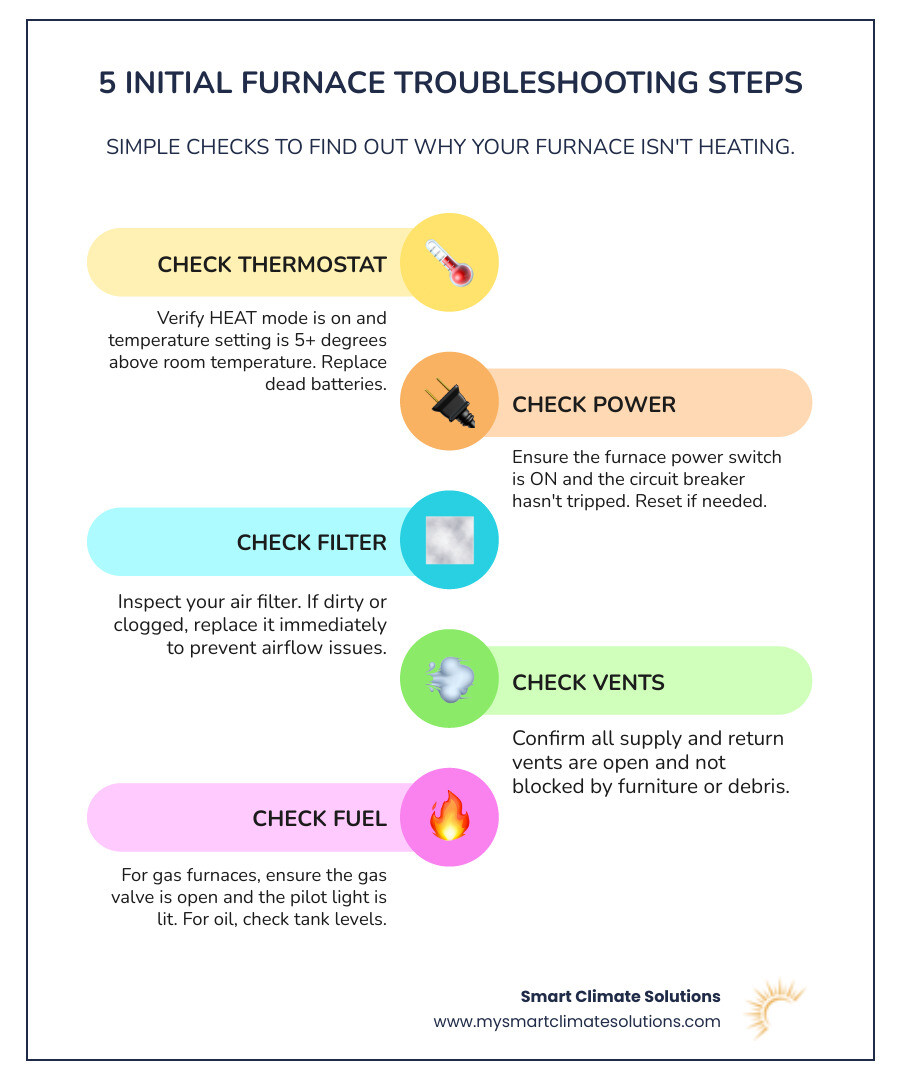
Furnace not heating basics:
First Steps: Simple Checks You Can Do in 5 Minutes
Before panicking, run through these basic checks. Many heating issues are caused by simple oversights that you can fix in minutes without any special tools. These initial steps can save you time and the cost of a service call.
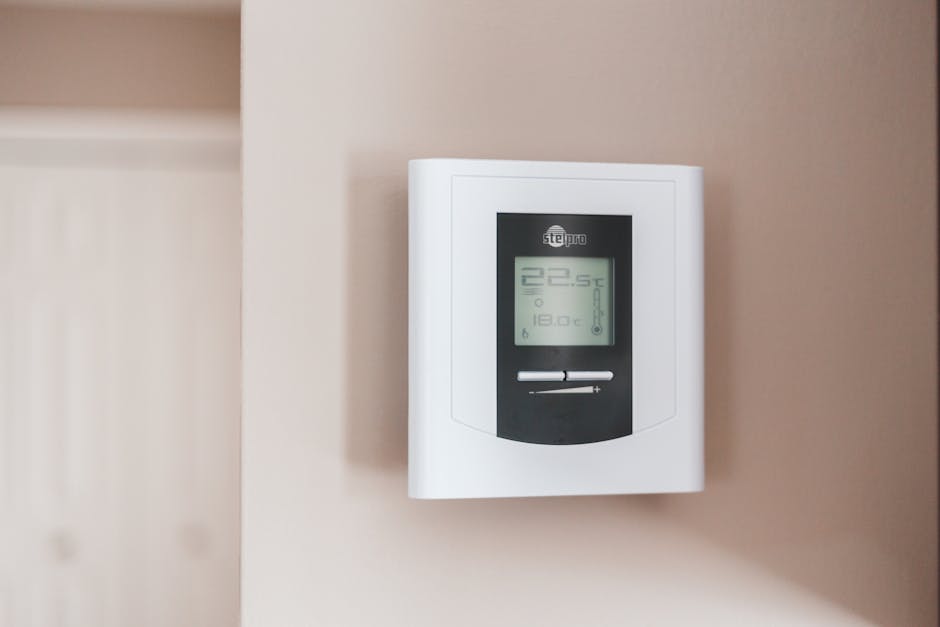
Initial Troubleshooting for a Furnace Not Heating
The very first thing to check when your furnace not heating is your thermostat. It might seem obvious, but we've seen countless service calls where the fix was as simple as adjusting a setting. Ensure your thermostat is set to "HEAT" mode, not "COOL" or "OFF." Then, confirm that the temperature setting is at least 5 degrees higher than the current room temperature. If your thermostat runs on batteries, check if they're dead or low. A blank display or unresponsive controls are tell-tale signs. We recommend replacing thermostat batteries annually to avoid this common issue.
Next, verify that your furnace has power. Locate the furnace's power switch, often found on the side of the unit or on a nearby wall, typically resembling a light switch. Make sure it's in the "ON" position. If it was accidentally flipped off, turning it back on might resolve the problem immediately. If the switch is on, head to your home's electrical panel. Look for the circuit breaker labeled "FURNACE" or "HVAC." If it's tripped (usually in the middle position), switch it completely off and then firmly back to the "ON" position. If the breaker immediately trips again, do not attempt to reset it further; this indicates a more serious electrical issue that requires professional attention.
A heating system not working can often be resolved with these simple checks.
How and When to Reset Your Furnace
Sometimes, a furnace just needs a reboot. Modern furnaces have safety mechanisms that can cause them to shut down, and a reset can clear minor glitches. Here's how we recommend resetting your furnace safely:
- Turn off the power: Go to your thermostat and switch it to "OFF." Then, locate the furnace's power switch (usually on the unit itself or a nearby wall) and turn it off. For an added layer of safety, flip the corresponding circuit breaker at your electrical panel to the "OFF" position.
- Wait: Give the furnace about 5 minutes. This allows the system to cool down and any internal safety controls to reset.
- Locate the reset button: Many furnaces have a red or yellow reset button on the blower motor housing. Refer to your furnace's owner's manual for its exact location and specific instructions.
- Press and hold: Press and hold the reset button for about 30 seconds.
- Restore power: Switch the circuit breaker back to "ON," then turn on the furnace's power switch, and finally, set your thermostat back to "HEAT" at your desired temperature.
- Observe: Listen for the furnace to ignite and begin its heating cycle.
It's appropriate to reset your furnace if you've performed the initial troubleshooting steps (thermostat, power, filter) and haven't found an obvious problem. However, if the furnace doesn't start after a reset, or if it starts but quickly shuts off again, do not repeatedly press the reset button. This could indicate a more serious issue that needs expert diagnosis. For situations like this, our team is ready to provide emergency furnace help.
Why Your Furnace is Not Heating: Common Culprits Explained
If the basic checks didn't solve the problem, it's time to investigate the most common culprits. These issues account for the vast majority of furnace failures and are often related to airflow, ignition, or fuel supply.
The Role of a Dirty Air Filter
The most common furnace problem is a dirty or clogged air filter, hands down. We see this issue contributing to a furnace not heating more than almost anything else. Think of your furnace as needing to breathe. A dirty filter is like trying to breathe through a thick scarf: it restricts airflow. When airflow is reduced, the furnace's heat exchanger can overheat, triggering a safety sensor that shuts down the system to prevent damage. This leads to your furnace running but producing no heat, or constantly cycling on and off.
A clogged filter not only prevents your furnace from heating effectively but also forces it to work harder, leading to higher energy bills and increased wear and tear on components. If your HVAC is running but not blowing air strongly, a dirty filter is a prime suspect.
To check your filter, turn off your furnace and thermostat. Remove the filter and hold it up to a light source. If you can't see light passing through it, it's definitely time for a replacement.
Pilot Light and Electronic Ignition Failures
For older gas furnaces, an extinguished pilot light is a frequent reason your furnace not heating. The pilot light is a small, continuous flame that ignites the main burners when the thermostat calls for heat. If it goes out, the furnace won't be able to produce warm air.
Relighting a Pilot Light (for gas furnaces with a standing pilot):
- Locate: Find the pilot light assembly, usually near the gas valve.
- Follow Instructions: Carefully follow the relighting instructions printed on a label on your furnace or in your owner's manual. Procedures vary by model.
- Safety First: If you smell gas, do NOT attempt to relight the pilot. Evacuate your home immediately and call your gas company.
- If it doesn't stay lit: If the pilot light repeatedly goes out, it could indicate a problem with the thermocouple (a safety sensor that detects the pilot flame), which requires professional repair.
Newer, high-efficiency furnaces typically use an electronic ignition system (either a hot surface ignitor or a spark ignitor) instead of a standing pilot light. These systems don't have a continuously burning flame. Instead, they ignite the gas only when heat is needed. If your furnace has an electronic ignition and is not heating, potential issues include:
- Faulty Ignitor: The hot surface ignitor may be cracked or burned out, or the spark ignitor may not be sparking. A faulty ignitor means the gas won't light, and the furnace won't produce heat.
- Dirty Flame Sensor: The flame sensor is a safety device that confirms a flame is present in the burner assembly. If it gets covered in soot or debris, it won't detect the flame, causing the furnace to shut down shortly after ignition. You might hear the furnace attempt to light, then click off. A dirty flame sensor can often be gently cleaned with fine-grit sandpaper or an abrasive pad, but if you're unsure, it's best to call a professional.
Issues with the ignitor can be complex. If you suspect a problem, our team can help with the cost to fix furnace ignitor and perform the necessary repairs.
Fuel Supply Problems
A furnace not heating can simply be due to a lack of fuel. Your furnace needs a steady supply of natural gas, propane, or heating oil to generate heat.
- Natural Gas: Check the main gas shut-off valve to your furnace. It should be in the "open" position (handle parallel to the pipe). If it's closed, slowly turn it to the open position. Also, ensure there aren't any broader gas supply issues in your home or neighborhood.
- Propane: If you rely on propane, check your tank's gauge to ensure it's not empty or critically low.
- Heating Oil: For oil furnaces, verify that your oil tank isn't empty. You might also have a clogged fuel filter or nozzle preventing oil from reaching the burner.
DANGER: If you suspect a gas leak (you smell "rotten eggs," hear a hissing sound near gas lines), do NOT attempt to troubleshoot further. Do NOT turn any lights or appliances on or off, and do NOT use your phone inside the house. Get out of your house immediately and call your gas company from a safe location. Then, call our emergency line.
Advanced Issues and When to Call a Professional
Some problems are more complex and can be dangerous to handle without proper training and tools. This section covers issues that almost always require an expert technician for a safe and effective repair.
Advanced Reasons for a Furnace Not Heating
If you've checked the basics and your furnace not heating persists, it might be one of these more complex issues:
- Blower Motor Problems: The blower motor is responsible for circulating the heated air throughout your home. If it's malfunctioning, you might feel some heat at the furnace, but it won't be distributed effectively. A failing blower motor can make unusual noises (squealing, grinding) or simply fail to turn on. This can be due to a bad motor, a faulty capacitor, or even just debris obstructing its operation. Replacing a furnace blower motor is a job for a professional.
- Faulty Limit Switch: This safety device monitors the temperature inside the furnace's heat exchanger. If the temperature gets too high (often due to restricted airflow from a dirty filter), the limit switch will shut off the burners to prevent overheating. A faulty limit switch can cause your furnace to short-cycle (turn on and off frequently) or prevent it from starting at all, even if there's no actual overheating.
- Electrical Issues: Beyond a tripped breaker, internal electrical problems within the furnace can prevent it from operating. This could include a bad control board, loose wiring, or a malfunctioning transformer. These issues require diagnostic tools and expertise to pinpoint and repair safely.
- Ductwork Leaks or Blockages: Even if your furnace is producing heat, if your ductwork has significant leaks or blockages, that warm air won't reach your living spaces. Leaky ducts can lose up to 30% of your heated air, leading to cold spots and wasted energy. Blocked vents (by furniture, rugs, or debris) can also restrict airflow, causing uneven heating or even furnace shutdowns. Inspect accessible ductwork for gaps and seal them with metal duct tape.
- Frozen Condensate Line: High-efficiency furnaces produce condensation as part of their operation, which drains away through a PVC pipe. In extremely cold weather, this condensate line can freeze, causing a backup that triggers a safety switch and shuts down the furnace. You might see water pooling around the base of the furnace. Thawing the line (if accessible and safe to do so) can sometimes resolve this, but often professional diagnosis is needed to prevent recurrence.
- Extreme Cold Weather Impact: While furnaces are built for cold, extreme temperatures can exacerbate existing issues or create new ones. Ice can build up on the exhaust or intake pipes outside your home, blocking airflow and causing the furnace to shut down. Frozen condensate lines, as mentioned, are also more common. Persistent extreme cold can also cause your furnace to overwork, putting stress on components and potentially leading to breakdowns.
Signs You Need Professional Furnace Repair
While DIY troubleshooting is helpful, there are clear indicators that it's time to call in the experts. Your safety and the proper functioning of your heating system are paramount.
- Loud or Unusual Noises: Banging, rattling, squealing, grinding, or whistling sounds are all signs that something is mechanically wrong with your furnace. These can indicate issues with the blower motor, bearings, or other internal components.
- Burning Smells: While a slight burning dust smell is normal at the beginning of the heating season, a persistent or strong burning odor could signal electrical problems, overheating components, or even a gas leak.
- Frequent Cycling (Short Cycling): If your furnace turns on and off frequently without adequately heating your home, it's "short cycling." This can be caused by a dirty filter, a faulty thermostat, an oversized furnace, or a problem with a limit switch. It increases wear and tear and wastes energy.
- Furnace Won't Stay On: If your furnace ignites but quickly shuts off, or runs for only a short period, it could be a flame sensor issue, a clogged exhaust, or a problem with the heat exchanger.
- Yellow Pilot Light: For furnaces with a pilot light, the flame should be a strong blue. A yellow or orange flame indicates incomplete combustion, which can produce carbon monoxide - a dangerous, odorless gas.
- Visible Rust or Corrosion: Rust on the furnace unit or around the burners can indicate moisture problems and potentially a compromised heat exchanger, which is a serious safety concern.
- Water Pooling: Puddles around your furnace could be from a frozen condensate line, a humidifier leak, or a problem with the heat exchanger.
If you observe any of these signs, or if you've exhausted your troubleshooting efforts, it's time to call in a certified HVAC technician. We have the tools and expertise to diagnose and safely repair complex issues. For additional homeowner guidance on furnace safety and maintenance, you can review the U.S. Department of Energy's advice in their residential heating systems overview.
For immediate assistance, refer to our emergency furnace repair complete guide.
Furnace Maintenance and Lifespan
Preventing a breakdown is always better than fixing one. Understanding your furnace's lifespan and the importance of regular maintenance can keep your system running efficiently for years and help you avoid unexpected failures.
How to Extend Your Furnace's Life
Furnaces typically last 15-20 years. However, their lifespan can vary significantly based on factors like the quality of the unit, how often it's used, and most importantly, how well it's maintained. Regular maintenance is the single best way to maximize your furnace's longevity and efficiency.
Signs that your furnace might be nearing the end of its lifespan include:
- Frequent Repairs: If you're calling for repairs every winter, the cost might outweigh the benefit of keeping an old unit.
- Increased Energy Bills: An aging furnace loses efficiency, leading to higher heating costs.
- Loud or Unusual Noises: Old components wear out, causing strange noises.
- Difficulty Keeping Your Home Warm: If your furnace struggles to maintain your desired temperature, especially in colder weather, it's a sign of declining performance.
- Visible Rust or Cracks: These can indicate serious structural integrity issues.
The benefits of regular furnace maintenance are immense. A professional tune-up ensures all components are clean, lubricated, and operating correctly, preventing minor issues from escalating into major breakdowns. This proactive approach saves you money on emergency repairs, extends the life of your unit, and ensures consistent, efficient heating. Learn more about our furnace tune-up services and consider our comprehensive heating maintenance plans to keep your system in top shape.
How Often Should Furnace Filters Be Changed?
Changing your furnace filter regularly is one of the easiest and most impactful maintenance tasks you can perform. We generally recommend changing or cleaning your air filter once every 1 to 3 months. However, the exact frequency depends on several factors:
- Type of Filter: Some high-efficiency filters can last longer, while basic fiberglass filters need more frequent changes.
- Usage: During peak heating season, filters will get dirty faster.
- Pets: Homes with pets tend to accumulate more dander and hair, requiring more frequent filter changes.
- Allergies/Asthma: If anyone in your household has allergies or asthma, more frequent changes can improve indoor air quality.
- Dust Levels: If you live in a particularly dusty area, or if there's ongoing construction nearby, you'll need to change filters more often.
Here's a general guideline for filter change frequency:
| Home Environment Factor | Recommended Filter Change Frequency |
|---|---|
| No pets, no allergies | Every 90 days (3 months) |
| With pets, no allergies | Every 60 days (2 months) |
| With pets, allergies | Every 30-45 days (1-1.5 months) |
| High dust/construction | Every 30 days (1 month) |
| Vacant/Seldom Used Home | Every 6-12 months |
Regularly replacing your furnace filters can significantly improve the efficiency and performance of your furnace, prevent breakdowns, and contribute to better indoor air quality for your home in Pittsburgh, Burgettstown, Washington, Steubenville, St. Clairsville, or Weirton.
Frequently Asked Questions about Furnace Heating Problems
What is the most common furnace problem?
Without a doubt, the most common furnace problem is a dirty or clogged air filter. This issue restricts airflow, forcing your furnace to work harder and often causing it to overheat and shut down as a safety precaution. A dirty filter can also lead to uneven heating, higher energy bills, and accelerated wear on other furnace components. Regularly changing your filter is the single best thing you can do to prevent problems and ensure your furnace not heating doesn't become a cold reality.
Why is my furnace blowing cold air?
If your furnace is blowing cold air, it's definitely frustrating. First, check that your thermostat is correctly set to 'HEAT' and not 'FAN' or 'COOL'. If the settings are correct, other common causes include a clogged air filter restricting airflow over the heat exchanger, an extinguished pilot light or a faulty ignitor preventing proper combustion, or a lack of fuel supply (gas, propane, or oil). If these aren't the issue, you might have a more serious problem like a malfunctioning flame sensor, a faulty blower motor, or an issue with the heat exchanger, all of which require professional diagnosis. For more detailed information, check out our guide on HVAC blowing cool air not heat.
How do I know if my furnace is dying?
Furnaces typically last between 15 to 20 years, but several signs can indicate yours is nearing the end of its life. If your furnace needs frequent repairs, leading to escalating costs, it's a strong indicator. A significant increase in your energy bills without a change in usage suggests declining efficiency. Loud or unusual noises like persistent rattling, banging, or squealing are often signs of worn-out internal components. Lastly, if your furnace struggles to keep your home consistently warm, or if you notice cold spots, it might be losing its heating capacity. If you're experiencing these issues, it may be time to consider the furnace replacement cost and explore new, more efficient models.
Your Partner for Reliable Heating in Pittsburgh
While many furnace problems can be solved with simple DIY troubleshooting, your safety and comfort are paramount. For complex issues or if you're ever unsure, it's always best to rely on a certified professional. Smart Climate Solutions has over 20 years of experience providing fast, reliable HVAC service and repair in the Pittsburgh area, including South Hills PA, Burgettstown PA, Washington PA, Steubenville OH, St. Clairsville OH, and Weirton WV. Our expert technicians are available 24/7 for any emergency furnace help you may need. We're here to ensure your home stays warm and comfortable, no matter how cold it gets outside.

.png)
