
What Does a New Heating System Cost? Here's What to Expect
New heating system cost is one of the biggest home expenses you'll face -- but knowing what to expect makes it much easier to plan.
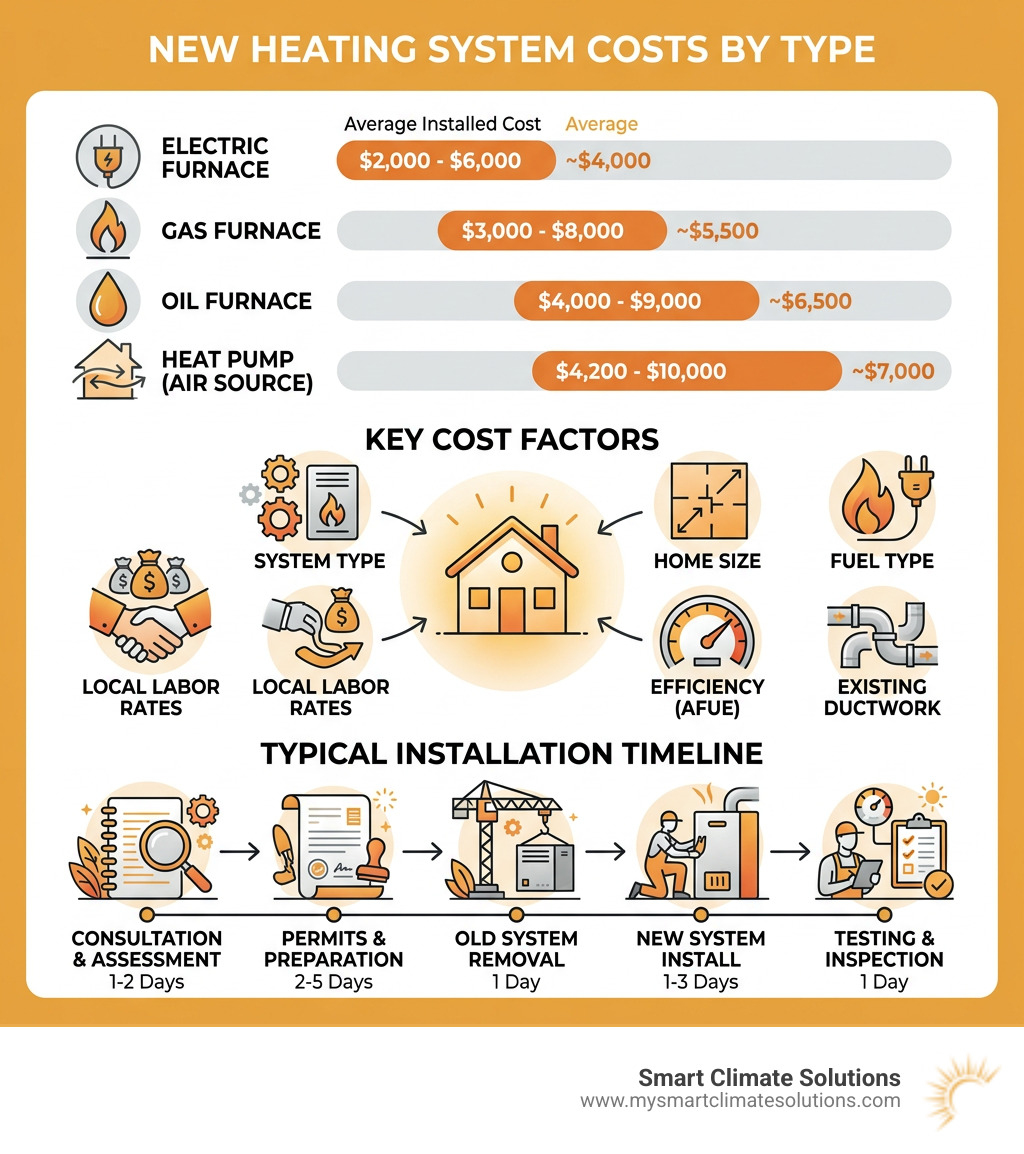
Here's a quick snapshot of typical installed costs in the U.S.:
| System Type | Typical Installed Cost Range | Average |
|---|---|---|
| Gas Furnace | $3,000 - $8,000 | ~$5,500 |
| Electric Furnace | $2,000 - $6,000 | ~$4,000 |
| Oil Furnace | $4,000 - $9,000 | ~$6,500 |
| Heat Pump (Air Source) | $4,200 - $10,000 | ~$7,000 |
These ranges cover both equipment and labor. Your final number will depend on your home size, existing ductwork, fuel type, and local labor rates.
If your system just broke down in the middle of a Pittsburgh winter, you don't want surprises. The sections below walk through exactly what drives these costs -- and how to keep yours as low as possible.
I'm Bill Scott, general manager of Smart Climate Solutions and an HVAC professional with over 20 years of experience helping Pittsburgh-area homeowners navigate new heating system costs -- from quick replacements to full system installs. Let's break it all down so you can make a confident, informed decision.
Related content about New heating system cost:
Average New Heating System Cost by Type
When we talk about a new heating system cost, the first thing to look at is the equipment itself. In the Pittsburgh area, including South Hills and Washington PA, we see a wide variety of systems. The type of fuel your home uses—whether it is natural gas, electricity, or oil—will be the biggest driver of your initial investment.
| System Type | Equipment Cost (Unit Only) | Total Installed Cost (Avg) |
|---|---|---|
| Gas Furnace (Standard) | $1,200 - $2,500 | $3,500 - $5,500 |
| Gas Furnace (High-Efficiency) | $2,000 - $4,500 | $5,500 - $8,000 |
| Electric Furnace | $800 - $2,000 | $2,500 - $5,000 |
| Air Source Heat Pump | $2,500 - $6,000 | $5,000 - $11,000 |
| Hybrid (Dual Fuel) System | $4,000 - $8,000 | $8,000 - $14,000 |
For many of our customers, a furnace replacement cost is the primary concern. A standard gas furnace is often the most cost-effective choice for those already connected to a gas line. However, if you are looking for long-term savings, a high-efficiency model might be the better play.
Labor is the other half of the equation. A typical installation can take anywhere from 12 to 48 labor hours. In our region, labor rates generally fall between $75 and $150 per hour depending on the complexity of the job. A straightforward "swap" where we take out an old unit and put in a new one of the same type is much cheaper than a full system redesign.
Estimating New Heating System Cost for Different Home Sizes
One size does not fit all. If you have a cozy 2-bedroom home in Burgettstown, your new heating system cost will be significantly lower than a large 4-bedroom estate in the South Hills. HVAC systems are measured in BTUs (British Thermal Units).
As a general rule:
- Small Homes (under 1,000 sq. ft.): Usually require 40,000 to 60,000 BTUs.
- Average Homes (1,000 - 2,000 sq. ft.): Usually require 60,000 to 100,000 BTUs.
- Large Homes (over 2,000 sq. ft.): Can require 100,000 to 140,000+ BTUs.
Installing an oversized unit is a common mistake. It leads to "short-cycling," where the system turns on and off too quickly, wearing out the parts and leaving your home with cold spots. We always perform a Manual J load calculation to ensure your new system is sized perfectly for your square footage and insulation levels.
Comparing Gas, Electric, and Oil Systems
Fuel availability is a major factor in Pennsylvania and West Virginia.
- Natural Gas: This is the most popular choice in Pittsburgh. It is relatively inexpensive to run and provides very hot air, which feels great when it is 10 degrees outside.
- Electric: While an electric furnace is often the cheapest to install, it can be the most expensive to run in cold climates because electric resistance heating uses a lot of power.
- Oil: Common in more rural areas like parts of Washington PA or Steubenville OH. Oil systems are reliable but require a storage tank, which adds to the maintenance. Many homeowners are now looking into the cost of replacing oil furnace with natural gas to take advantage of lower fuel prices and cleaner operation.
Key Factors Influencing Your Total Investment
Beyond the box itself, several variables can swing your new heating system cost by thousands of dollars. We believe in transparency, so we always look at the "hidden" parts of your home before giving a final quote.
One of the biggest factors is your home's insulation. A well-insulated home holds heat longer, meaning you can often get away with a smaller, less expensive heating unit. Conversely, if your attic is drafty, your new furnace will have to work overtime, increasing your monthly bills and shortening the system's lifespan.
Ductwork condition is another massive variable. If your ducts are 20 years old, they might be leaky or undersized for a modern high-efficiency blower. We offer comprehensive HVAC installation services that include a full inspection of your air delivery system. If we find that your ducts are losing 20% of your heated air to the crawlspace, we will recommend sealing or repairs to ensure you actually get the comfort you are paying for.
Hidden Factors in Your New Heating System Cost
When budgeting, don't forget the "extras" that don't always show up on a basic price tag:
- Permit Fees: Depending on whether you are in Pittsburgh or Weirton WV, local building permits can cost anywhere from $400 to $1,500.
- Old Unit Removal: Disposing of an old furnace safely usually costs between $60 and $330.
- Electrical Upgrades: If you are switching to an electric heat pump, your electrical panel might need an upgrade to handle the new load, which can add $500 to $2,000.
- Structural Modifications: Sometimes a new, high-efficiency unit is larger than the old one, requiring us to modify the closet or platform where it sits.
- Duct Sealing: Professional duct sealing can add $1,000 to $3,000 but often pays for itself in two to three years through lower energy bills.
Efficiency Ratings and Long-Term ROI
Efficiency is measured by AFUE (Annual Fuel Utilization Efficiency). A furnace with an 80% AFUE wastes 20% of the fuel it burns. A high-efficiency unit with a 96% AFUE wastes only 4%.
While a high-efficiency unit has a higher upfront new heating system cost, the ROI (Return on Investment) can be significant. In our cold climate, the most efficient residential heating systems can save you up to 30% on your annual heating bills. Over the 15 to 20-year life of the system, that adds up to thousands of dollars in savings—far more than the initial price difference.
Local Considerations for Pittsburgh Homeowners
Living in the Pittsburgh area means we deal with some serious cold. Our winters aren't just chilly; they can be brutal. This impacts your new heating system cost because we have to prioritize cold-weather performance.
In Pennsylvania, we often recommend "dual-fuel" or hybrid systems. This pairs an electric heat pump with a gas furnace. The heat pump handles the moderately cold days very efficiently, and the gas furnace kicks in as a "backup" when temperatures drop below freezing. This setup provides the best of both worlds: extreme efficiency and reliable warmth during a polar vortex.
Local labor markets also play a role. Because we serve a wide area—from St. Clairsville OH to South Hills PA—we understand the regional building codes for each municipality. Each area has specific requirements for venting and gas line safety that must be followed to pass inspection. We take care of all these details so you don't have to worry about red tape.
How to Save on Installation and Running Costs
We know that a new heating system cost is a major investment, and we want to help you keep it manageable. There are several ways to shave money off the total price without sacrificing quality.
First, timing is everything. Most people wait until their furnace dies in January to call us. That is our busiest time. If you can plan your replacement for the "shoulder seasons"—late spring or early fall—you may find better scheduling availability and seasonal discounts.
Second, take advantage of incentives. The federal government offers significant tax credits for ENERGY STAR-certified furnaces. For example, you can get a tax credit of 30% of the project cost, up to $600 for high-efficiency gas furnaces, or up to $2,000 for qualified heat pumps. Many local utility companies in the Pittsburgh area also offer rebates for a high efficiency furnace install.
Maintenance and System Longevity
The best way to lower your total cost of ownership is to make your new system last as long as possible. A well-maintained furnace can last 20 to 25 years, while a neglected one might give out after 12.
- Annual Tune-ups: A professional cleaning and inspection once a year keeps the system running at peak efficiency.
- Filter Changes: This is the simplest DIY task. A clogged filter makes the motor work harder, which leads to early failure.
- The 50 Percent Rule: If your current system is more than 15 years old and a repair costs more than 50% of a new unit, it is time to replace it. We can help you determine the cost to fix furnace versus the long-term benefit of a new installation.
Frequently Asked Questions about Heating Expenses
How long does a new heating system typically last?
Most modern gas furnaces and heat pumps last between 15 and 25 years. Electric furnaces can sometimes last a bit longer because they have fewer moving parts and no combustion process. Regular maintenance is the key to hitting the 20-year mark.
Is it cheaper to install a furnace and AC at the same time?
Yes, absolutely. If your AC is also aging, we highly recommend doing both at once. You will save significantly on labor costs because we only have to pull permits once, set up the equipment once, and use the same crew for both jobs. A combined install typically costs $10,500 to $13,500, which is much cheaper than doing them separately.
What is the most cost-effective heating system for cold climates?
For the Pittsburgh and Tri-State area, a high-efficiency gas furnace (95%+ AFUE) is generally the most cost-effective choice due to the low price of natural gas in our region. However, a hybrid dual-fuel system is becoming a top contender for those who want to maximize their energy savings.
Conclusion
Navigating a new heating system cost doesn't have to be overwhelming. By understanding the factors—from home size and fuel type to efficiency ratings and local labor—you can make a choice that fits both your comfort needs and your budget.
At Smart Climate Solutions, we bring over 20 years of experience to every job. Whether you are in South Hills, Washington PA, or across the border in Weirton WV, our certified technicians are dedicated to providing fast, reliable, and transparent service. We don't just sell boxes; we design comfort solutions tailored to the unique needs of your home and the local climate.
Ready to upgrade your home's comfort? Contact us today for a professional assessment and a detailed quote on your HVAC Installation. Let us help you stay warm without getting burned by the price.


.png)
