

Why Boiler Safety Valve Testing Could Save Your Home -- and Your Life

Boiler safety valve testing is the process of verifying that your boiler's pressure relief valve opens and closes correctly to prevent dangerous overpressure buildup. Here is a quick overview of what you need to know:
- What it is: A safety valve test checks that your valve lifts at the correct set pressure and reseats properly afterward.
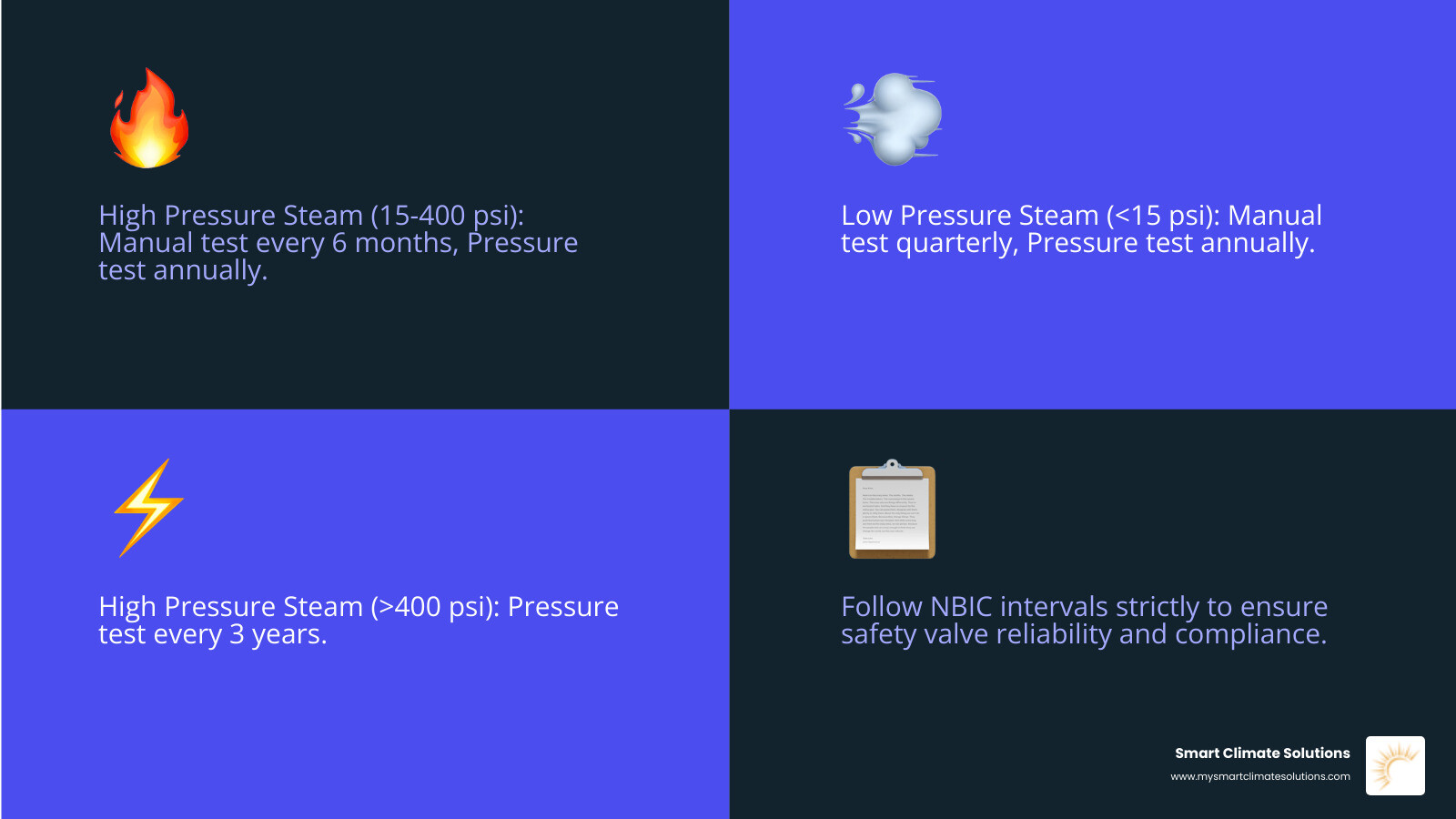
- How often: Low-pressure steam boilers (15 psi and under) need a manual check quarterly and a pressure test annually. High-pressure boilers (15-400 psi) need a manual check every 6 months and a pressure test annually.
- Key tolerances: The valve must lift at no more than 103% of design pressure. Keep at least a 5 psi gap between your operating pressure and the valve's set pressure.
- Why it matters: An untested or failed valve can lead to catastrophic boiler failure -- and serious safety consequences.
- Who should do it: A certified technician should perform pressure tests. Simple manual lever checks can be done during routine maintenance.
Your boiler's safety valve is the last line of defense against a dangerous pressure event. When it fails silently -- from rust, mineral buildup, or simple neglect -- there is no backup. That is why regular testing is not optional. It is required by ASME standards and the National Board Inspection Code, and it is expected by your insurance provider.
When I teach steam classes, I ask attendees: "Do you test the pop safety valve?" Most do not -- usually because testing it means it might start leaking. But skipping the test does not make the risk go away. It just means you will not know there is a problem until it is too late.
I'm Bill Scott, General Manager of Smart Climate Solutions, with over 20 years of HVAC experience serving homeowners across Pittsburgh, PA and Southwestern PA -- including hands-on expertise in boiler safety valve testing and pressure system compliance. In this guide, I'll walk you through everything you need to know to keep your boiler safe, code-compliant, and running reliably.

The Critical Role of Boiler Safety Valve Testing
The primary function of a boiler safety relief valve is simple but life-saving: it acts as a safety guard by automatically releasing internal pressure when it exceeds a predetermined limit. Think of it as a mechanical watchdog that never sleeps. While your boiler's controls manage the day-to-day firing and pressure levels, the safety valve is there for the "what-if" scenarios—like a control failure or a blocked line.
According to the National Board of Boiler and Pressure Vessel Inspectors guidance, these valves are designed to pop fully open when they hit the "set pressure," allowing steam or hot water to escape rapidly. Once the pressure drops back to a safe level, the valve should snap shut.
However, because these valves often sit idle for years, they are prone to internal "freezing." Mineral buildup from the water, rust from the iron components, and general corrosion can essentially weld the valve seat shut. If that happens, the valve won't open when you need it most. This is why a comprehensive heating system check must always include a close look at the safety relief device.
Why Regular Boiler Safety Valve Testing is Mandatory
We often hear from customers in Washington, PA or Steubenville, OH who wonder if they can skip a year of testing. The answer is a firm no. Regular boiler safety valve testing is mandatory for several reasons:
- NBIC Compliance: The National Board Inspection Code (NBIC) sets strict rules for how often these valves must be checked to ensure they are still functional.
- Insurance Requirements: Most commercial and residential insurance policies require proof of regular maintenance. If a boiler fails and you haven't tested the valve, your claim could be denied.
- Liability Protection: For business owners in the South Hills or Weirton, documenting your safety tests provides a "paper trail" of safety that protects you in the event of an accident.
- ASME Code Guidelines: The ASME code guidelines establish the engineering requirements for these valves. Following these codes ensures the valve is actually capable of handling the boiler's full steam capacity.
Signs Your Safety Valve Needs Repair or Replacement
You don't always have to wait for a formal test to know something is wrong. Here are the most common red flags:
- Steam Leakage: If you see a constant "wisp" of steam or water dripping from the discharge pipe, the valve seat is likely fouled by mineral salt deposits or rust.
- Chattering: This is a rapid opening and closing sound. It usually means the valve is oversized or the pressure is too close to the set point.
- Broken Tamper Seals: Every safety valve comes with a lead or wire seal. If this is broken, it means someone has messed with the factory settings, and the valve must be recertified.
- Corrosion: If the exterior of the valve looks like it's been sitting at the bottom of the Monongahela River, the internal springs are likely compromised.
Following established repair and replacement schedules is the best way to avoid these issues before they start.
Industry Standards for Testing Frequency and Tolerances
To keep your system in top shape, you need to follow the specific frequencies suggested by the National Board. In our experience servicing boilers from Pittsburgh to St. Clairsville, we follow these strict intervals:
Understanding Pressure Differentials in Boiler Safety Valve Testing
One of the most common mistakes we see is operating a boiler too close to the valve's set pressure. If your valve is set to pop at 15 psi, you should not be running your boiler at 14 psi.
The "differential" is the gap between your normal operating pressure and the valve's set pressure. Industry standards recommend a differential of at least 20%, or a minimum of 5 psi. If the gap is too small, the valve will simmer and leak, leading to mineral buildup that eventually "gums up" the works.
Additionally, during a full-load pressure test, the accumulation of pressure should never exceed 10% of the maximum allowable working pressure (MAWP). If the pressure keeps climbing past that 10% mark while the valve is wide open, the valve is either too small or the discharge piping is restricted. This is a critical part of our hvac maintenance schedule guide for local property managers.
Documentation and Regulatory Compliance
If you didn't write it down, it didn't happen. That is the mantra of boiler inspectors. Proper boiler safety valve testing requires meticulous record-keeping. Every valve has a nameplate that includes its capacity rating specifications, set pressure, and blowdown.
We ensure that all test results, including the exact pressure at which the valve "popped" and the pressure at which it "reseated," are recorded in the boiler log book. This traceability is essential for jurisdictional requirements in Pennsylvania, Ohio, and West Virginia.
Step-by-Step Procedures for Manual and Pressure Tests
Testing a safety valve can be intimidating. After all, you are intentionally pushing a high-pressure system to its limit. Here is how our certified technicians handle the process.
Executing a Manual Lift Test for Boiler Safety Valve Testing
The manual lift test, often called the "try lever test," is something that can be done more frequently. However, it still requires caution.
- Preparation: Ensure the boiler is at least at 75% of its operating pressure. Never try to lift the lever on a cold boiler, as you might trap debris in the seat.
- PPE: Wear safety glasses, heat-resistant gloves, and hearing protection. The "pop" is loud and the steam is hot!
- The Lift: Pull the lever to the fully open position.
- The Hold: Hold it open for at least 5 seconds. This flushes out any sediment or scale that might be sitting on the seat.
- The Release: Let go of the lever. The valve should snap shut cleanly. If it sizzles or drips, try lifting it one more time to flush it. If it still leaks, it's time for a repair.
This is a core component of our hvac preventative maintenance program guide for high-efficiency systems.
Bench Testing vs In Situ Testing
There are two ways to perform a full pressure test. In situ testing happens while the valve is still on the boiler. We bypass the operating controls to let the pressure rise naturally until the valve pops. This is great because it tests the valve in its actual working environment.
Bench testing, on the other hand, involves removing the valve and taking it to a certified shop. This is the most thorough method. The valve is cleaned, the springs are inspected, and it is tested on a specialized "test stand." For marine applications or high-pressure industrial boilers, bench testing is often the only way to meet strict operational testing guide requirements.
Installation Best Practices for Maximum Safety
Even the best valve will fail if it's installed incorrectly. We follow these gold standards for every installation in the Pittsburgh area:
- Vertical Mounting: Safety valves must always be mounted in a vertical, upright position. Mounting them horizontally or at an angle can cause the internal parts to misalign, changing the set pressure.
- No Isolation Valves: Never, ever install a shut-off valve between the boiler and the safety valve. If that valve is accidentally closed, your safety valve is useless.
- Discharge Piping: Use Schedule 40 pipe for the discharge line. It should be the same diameter as the valve outlet and should be as short and straight as possible.
- Drainage: The discharge pipe should end 6 to 24 inches from the floor and should be angled downward so water doesn't pool inside the valve body.
- Nameplate Visibility: Ensure the nameplate requirements are met and the plate is visible for inspectors.
Including these checks in your hvac service plans ensures that your installation remains safe year after year.
Common Causes of Valve Failure
Why do these valves fail? It usually comes down to three culprits:
- Mineral Salts: In our region, hard water is common. These minerals crystallize around the valve seat, acting like glue.
- Rust and Corrosion: Moisture in the steam system leads to oxidation. If the valve isn't tested, the rust can pit the seat, causing permanent leaks.
- Improper Sizing: If a valve is too small, it won't relieve pressure fast enough. If it's too big, it will "chatter," which destroys the internal delicate surfaces.
Regular boiler safety valve testing is the only way to catch these issues before they turn into a disaster.
Frequently Asked Questions about Safety Valves
What is the difference between a safety valve and a relief valve?
While the terms are often used interchangeably, there is a technical difference. A safety valve is designed for gases and vapors (like steam); it "pops" fully open instantly. A relief valve is typically for liquids (like hot water); it opens gradually as pressure increases. A safety relief valve can do both.
Can I test my own boiler safety valve?
You can perform the manual "try lever" test if you are comfortable and have the proper PPE. However, a full "pop" pressure test or any repair should only be handled by a certified professional. At Smart Climate Solutions, we have the specialized gauges and training to do this safely.
What happens if a safety valve fails a test?
If the valve fails to open, the boiler must be shut down immediately. It is unsafe to operate. If the valve opens but fails to close (leaks), it usually needs to be cleaned or replaced. Do not try to "fix" it by tightening the spring or hanging weights on the lever—that is how explosions happen.
Conclusion
At Smart Climate Solutions, we take your safety seriously. Whether you are in Burgettstown, PA or Weirton, WV, your boiler is a powerful machine that requires expert oversight. With over 20 years of experience, our certified technicians provide the thorough boiler safety valve testing and maintenance you need to stay compliant and keep your family or employees safe.
Don't leave your "last line of defense" to chance. From 24/7 emergency support to routine preventative maintenance, we are here to ensure your comfort and peace of mind.
Ready to schedule your annual safety check? Contact our team today for Expert HVAC Services you can trust.

.png)
