

Why Commercial Climate Control Contracts Are Essential for Your Business
Commercial climate control contracts are formal service agreements between a business and an HVAC provider that define scheduled maintenance, emergency response terms, and pricing for keeping your building's heating and cooling systems running reliably.
Here is what you need to know at a glance:
- What they are: Written agreements covering preventive maintenance, inspections, and priority repair access for commercial HVAC systems
- Who needs them: Any business, property manager, or facility owner responsible for keeping an occupied building comfortable
- Key benefit: They replace unpredictable, expensive emergency repair bills with a fixed, manageable service cost
- What they cover: Filter changes, coil cleaning, electrical checks, refrigerant monitoring, condensate drain clearing, and more
- Cost impact: Regular maintenance can reduce energy bills by 5% to 15% and extend equipment life by up to 10 years
- Bottom line: Operating without a contract leaves your business exposed to sudden system failures, inflated emergency labor rates, and long wait times during peak seasons
Your commercial HVAC system is one of the hardest-working assets in your building. In many facilities, it runs nearly every day of the year. When it fails without warning, the consequences go beyond discomfort -- lost productivity, damaged inventory, and emergency repair bills that can easily exceed the cost of a full year of preventive service.
Yet many business owners still operate on a "fix it when it breaks" model. That reactive approach is expensive, stressful, and entirely avoidable.
A well-structured maintenance contract shifts your HVAC from a liability into a managed asset. It locks in service schedules, protects your budget, and gives you priority access to a technician when you need one most.
I'm Bill Scott, General Manager of Smart Climate Solutions, and with over 20 years in the HVAC industry, I have helped hundreds of commercial property owners across Pittsburgh and Southwestern PA navigate commercial climate control contracts -- from simple inspection plans to comprehensive full-service agreements. In this guide, I'll walk you through everything you need to know to choose and protect the right contract for your facility.

Learn more about commercial climate control contracts:
- RTU replacement South Hills
- american standard packaged rooftop units
- bryant commercial air conditioners
Understanding the Types of Commercial Climate Control Contracts
When you begin looking into commercial climate control contracts, you will quickly realize that there is no single standard template. Agreements are highly customizable and fall into several distinct categories depending on how much risk your business is willing to assume and how much predictability you want in your annual budget.
In the broader commercial climate sector, agreements can range from localized preventive maintenance plans to massive utility-scale partnerships. For example, large-scale infrastructure projects often utilize highly structured, multi-decade agreements. A prime example of this is the 30-year, 950 million dollar district cooling contract awarded to Keppel in Singapore's Jurong Lake District, which is detailed in this Keppel Infrastructure news release. While a local retail store or office building in Pittsburgh does not require a district-level system, the trend toward structured, long-term climate agreements is growing rapidly.
Another emerging contract type is Cooling-as-a-Service (CaaS). This is a subscription-based, performance-driven model where the business does not purchase the physical HVAC hardware. Instead, you pay a monthly fee for cooling outcomes while the provider owns, operates, and maintains the equipment. This model eliminates upfront capital expenditures (CapEx) and shifts the risk of equipment obsolescence and maintenance entirely to the service provider.
This model is already being deployed at scale globally, such as the 12,100 TR Cooling-as-a-Service deployment at Intellion Park Chennai. You can read more about this innovative 15-year partnership in the Tata Power and Keppel CaaS Deployment article or review the corporate announcement in the Tata Power and Keppel Consortium Release.
For most local businesses in the tri-state area of Pennsylvania, Ohio, and West Virginia, the choices are more traditional but equally critical. Let's break down the three primary models you will encounter.
Basic Inspections vs. Full-Service Agreements
The most common decision business owners face is choosing between a basic inspection plan, a full-service agreement, or relying on a time-and-materials model. Each has its own balance of cost and risk.
| Feature | Basic Inspection Plan | Full-Service Agreement | Time-and-Materials Model |
|---|---|---|---|
| Upfront Cost | Low | Moderate to High | None |
| Maintenance Tasks | Filter changes, basic safety checks, and visual inspections | Comprehensive cleaning, calibrations, parts replacement, and tuning | None (reactive repairs only) |
| Emergency Coverage | Priority scheduling, but labor and parts are billed separately | Priority scheduling; most labor and parts are fully covered | Standard scheduling rates; emergency fees apply |
| Budget Predictability | Moderate (know inspection costs, but repairs are unpredictable) | High (fixed annual cost covers almost all issues) | Low (highly unpredictable repair expenses) |
| Best For | Newer systems under manufacturer warranty | Critical infrastructure, older systems, or strict budget environments | Businesses willing to accept high risk for zero upfront cost |
To help visualize how these models function over a typical service year, consider the following operational workflow:
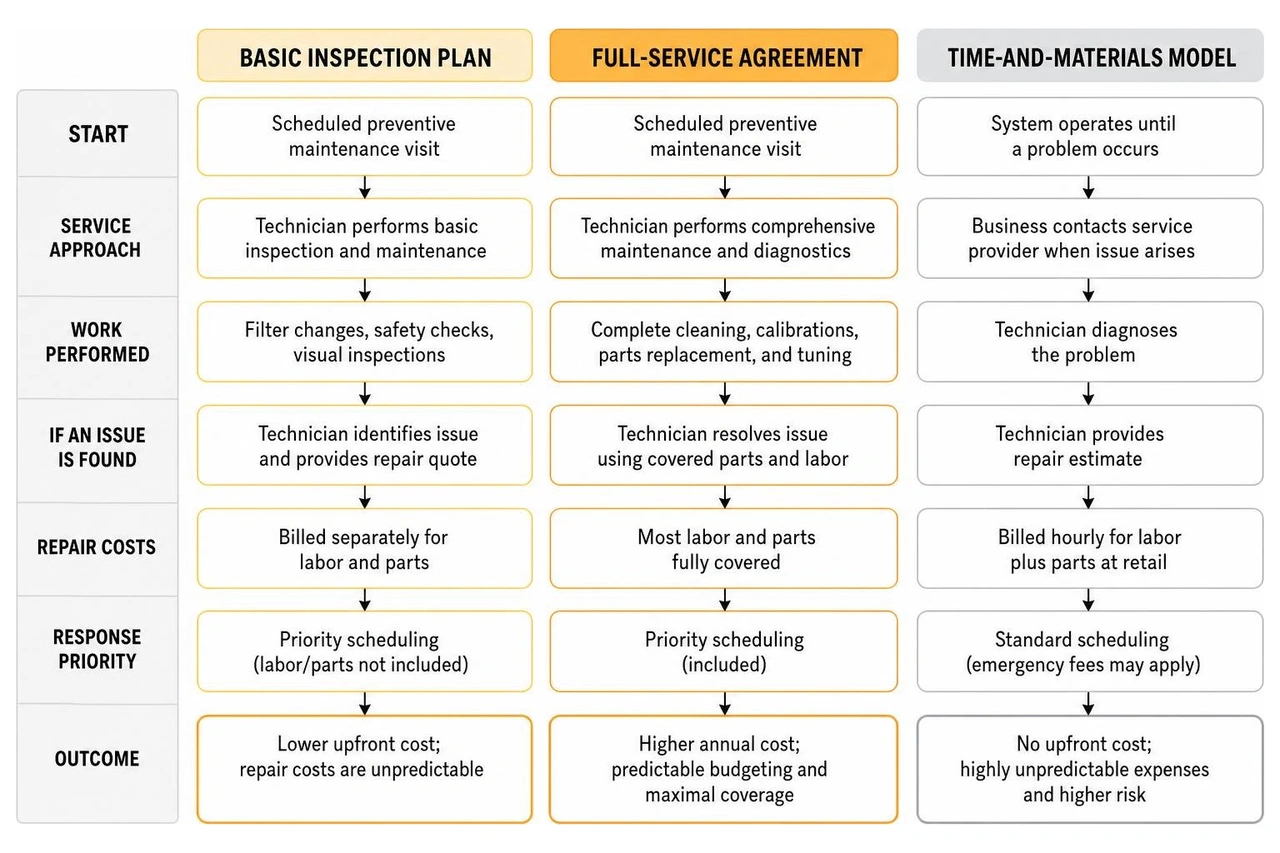
Under a Basic Inspection Plan, a technician visits your facility periodically (usually quarterly) to perform basic tasks like replacing air filters, checking belt tension, and inspecting critical components. If they discover a failing part, they will provide a quote for the repair. You pay a low flat rate for the inspections, but you are fully responsible for the cost of any actual repairs.
A Full-Service Agreement is the gold standard for businesses that want absolute budget predictability. Under this contract, you pay a higher annual or monthly fee, but it covers both the preventive maintenance and the cost of almost all labor and parts required for repairs. If a compressor fails in the middle of a hot July afternoon, the replacement labor and the part itself are typically covered under the agreement.
The Time-and-Materials Model is not a contract at all; it is a purely reactive approach. You only call a technician when something stops working, and you are billed hourly for labor plus the retail cost of parts. While this avoids any upfront monthly fees, it exposes your business to maximum financial risk and puts you at the back of the service line during peak heating and cooling seasons.
How Facility Types Shape Commercial Climate Control Contracts
Your facility type dictates the complexity and frequency of your climate control needs. A retail boutique in Washington, PA has vastly different requirements than a medical clinic in South Hills or a data center in downtown Pittsburgh.
- Office Buildings: These spaces require consistent, even temperatures to maintain employee productivity and comfort. Contracts typically focus on standard quarterly filter changes, damper adjustments, and indoor air quality (IAQ) monitoring to prevent "sick building syndrome."
- Retail Centers: High foot traffic means doors are constantly opening and closing, introducing outside air and dust. Maintenance agreements for retail environments often prioritize frequent filter replacements and condenser coil cleanings to keep up with the heavy load.
- Healthcare Facilities: Medical clinics and offices must comply with strict state health regulations regarding ventilation, air filtration, and pressure relationships. Contracts for these facilities require highly specialized documentation, HEPA filter management, and precise calibration of air handlers.
- Data Centers and Server Rooms: These spaces require precise temperature and humidity control 24/7/365. A single hour of overheating can destroy millions of dollars in equipment. Contracts for data centers demand monthly inspections, immediate emergency response times (often guaranteed under a tight Service Level Agreement), and built-in system redundancies.
- Indoor Pools and Athletic Facilities: High humidity from indoor pools can quickly lead to structural rot, mold, and severe corrosion of mechanical systems. These facilities require specialized commercial dehumidification systems (such as Desert Aire or Dectron units) that must be maintained under highly specific contracts focusing on moisture control and corrosion-resistant coil treatments.
To learn more about tailoring a strategy for your property, check out our guide on choosing a Commercial HVAC Maintenance Plan.
Core Components and Regional Service Frequencies
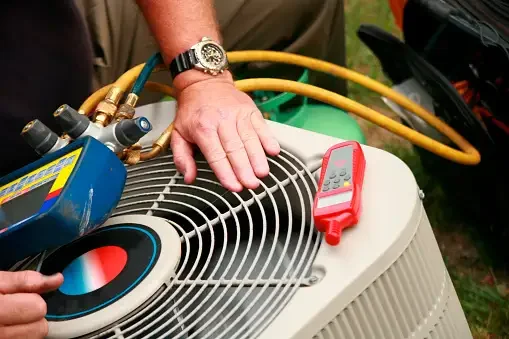
A comprehensive commercial maintenance contract is much more than a simple checklist. It is a highly technical process designed to optimize every component of your building's climate system. When we perform a maintenance visit, our certified technicians focus on several critical areas:
- Filter Changes and Belt Replacements: Dirty filters restrict airflow, forcing blower motors to work harder, which increases electrical draw and can lead to premature motor failure. Worn or cracked belts can snap without warning, shutting down entire air handlers.
- Coil Cleaning: Evaporator and condenser coils must be kept clean to transfer heat efficiently. Dust, dirt, and outdoor grime act as insulators. When coils are dirty, your system has to run significantly longer to achieve the same cooling effect, driving up your energy bills.
- Electrical Connections: Loose electrical connections can cause voltage drops, system shut-offs, and even electrical fires. Technicians tighten all terminals, measure current draw on motors, and inspect contactors for pitting or wear.
- Condensate Drains: Air conditioners extract massive amounts of moisture from the air. If condensate drains or pans become clogged with algae or debris, water can overflow, causing severe drywall damage, mold growth, and structural issues in your ceiling spaces.
For a deeper look into the specific technical tasks performed during these visits, read our article on Commercial HVAC PM.
Mid-Atlantic Climate Challenges and Service Frequency
Our service area -- spanning Pittsburgh, South Hills, Burgettstown, and Washington in Pennsylvania, Steubenville and St. Clairsville in Ohio, and Weirton in West Virginia -- experiences some of the most dramatic weather shifts in the country. From freezing, snowy winters to hot, humid summers, our local commercial HVAC systems are subjected to intense mechanical stress.
Because of these distinct seasons, a single annual inspection is simply not enough to protect your investment. We recommend a quarterly maintenance schedule to address these climate-specific challenges:
- Spring Visit (Cooling Prep): Performed in April or May before the first heatwave. The focus is on cleaning condenser coils, checking refrigerant charge, testing fan motors, and clearing condensate lines to prevent summer backups.
- Summer Mid-Season Check: High-traffic facilities benefit from a mid-summer check to replace heavily loaded air filters and ensure systems are maintaining proper head pressures during peak heat.
- Fall Visit (Heating Prep): Performed in September or October. Technicians inspect heat exchangers for cracks (which can leak deadly carbon monoxide), calibrate burners, test safety limits, and ensure boilers or furnaces are ready for sub-zero temperatures.
- Winter Mid-Season Check: Focuses on belt inspections, lubrication of moving parts in freezing temperatures, and verifying that outdoor heat pumps are defrosting correctly.
Skipping these seasonal calibrations can lead to sudden system failures when the weather is at its worst. To explore customized scheduling options, browse our HVAC Preventive Maintenance Plans.
Financial Analysis: Cost Factors and ROI Calculations
The cost of a commercial climate control contract is not arbitrary; it is calculated based on several physical and operational variables of your property. When estimating a contract, we conduct a comprehensive site walkthrough to evaluate:
- Total System Tonnage: The physical cooling and heating capacity of your equipment. Larger buildings with high-tonnage chillers or multiple packaged rooftop units (RTUs) require more labor hours to service, which naturally increases the contract cost.
- Equipment Age and Condition: Older systems that have been neglected require more intensive deep-cleaning, calibration, and monitoring than brand-new systems.
- Physical Accessibility: Are your units easily accessible on a flat roof with a permanent hatch, or do they require specialized extension ladders, safety harnesses, or even a crane to access? High-risk or difficult-to-reach equipment requires additional safety protocols and labor.
- Number of Units: A facility with ten small split systems spread across a property requires more travel and setup time than a facility with one large, centralized air handler.
To put this in perspective, enterprise-level organizations handle HVAC costs on a massive scale. For example, the maximum fee for the Johnson Controls HVAC maintenance contract with the Los Angeles World Airports (LAWA) for facilities at LAX and Van Nuys Airport was capped at $6,063,724.00 for its multi-year term, as detailed in the LAX HVAC Maintenance Contract Details. While a local warehouse in Steubenville, OH or a commercial office in South Hills, PA operates on a much smaller scale, the fundamental principles of pricing -- balancing tonnage, equipment age, and required labor hours -- remain exactly the same.
Calculating the ROI of Preventive Maintenance
Many business owners view maintenance contracts as an optional operational expense. However, when you look at the actual numbers, a proactive contract is a high-yield investment that pays for itself.
Let's look at the financial return on investment (ROI) across three key areas:
- Direct Energy Savings: According to industry data, regular mechanical calibration and cleaning can lower your business energy bills by 5% to 15%. For a mid-sized commercial building spending $3,000 a month on electricity, a conservative 10% savings translates to $3,600 saved annually -- often more than the cost of the entire maintenance contract.
- Extended Equipment Lifespan: A commercial rooftop unit represents a massive capital investment, often costing $15,000 to $50,000 or more to replace. Neglected systems typically fail completely within 10 to 12 years. With consistent, documented maintenance, that same equipment can easily run efficiently for 15 to 20 years. Extending the life of a $30,000 asset by just 5 years saves your business thousands of dollars in annualized capital depreciation.
- Avoiding Emergency Premiums: Standard emergency service calls during peak seasons often carry inflated hourly labor rates, travel surcharges, and premium pricing for expedited parts shipping. A business with a maintenance contract typically receives priority service and waived or reduced emergency fees, saving hundreds of dollars per incident.
To help determine if this financial transition makes sense for your specific property, read our detailed analysis: Are HVAC Maintenance Plans Worth It?.
Navigating the Fine Print and Legal Clauses
Before signing any commercial agreement, it is vital to understand the legal terms and operational clauses that protect both your business and the service provider. A high-quality contract should be transparent, legally binding, and free of ambiguous language.
When reviewing a contract, pay close attention to these critical clauses:
- Response Time Guarantees (SLA): A strong contract will specify a guaranteed response time for emergency service calls (e.g., within 2 to 4 hours for critical systems). Without this clause, you have no legal leverage if your system fails during a heatwave and you are forced to wait days for a technician.
- Standard of Work: The contract should explicitly state that all work will meet or exceed the professional standards of the industry and comply with all local building codes in Pennsylvania, Ohio, or West Virginia.
- Termination for Convenience: Look for a clause that allows either party to exit the agreement with 30 days' written notice. This protects your business if you sell the property or are unhappy with the quality of service.
- Notice to Cure: This clause gives the contractor a set period (usually 10 days) to correct any service deficiencies after receiving written notice from you. If they fail to remedy the issue within that window, you have the right to terminate the contract or hire a third party at their expense.
For an example of how highly structured public and enterprise contracts are organized, you can review the Washington State Master Contract Template, which outlines standard terms for warranties, economic adjustments, and contractor compliance.
Key Exclusions to Watch for in Commercial Climate Control Contracts
One of the most common sources of friction between business owners and HVAC providers is a misunderstanding of what is not covered in a standard agreement. Always read the exclusions section carefully.
Standard maintenance contracts typically exclude:
- Major Component Replacements: Unless you have a premium, fully comprehensive full-service agreement, the cost of replacing major parts like compressors, heat exchangers, or condenser fan motors is usually billed separately.
- Ductwork and Air Distribution: Repairs to leaking ductwork, fire dampers, or architectural grilles are rarely covered under a standard mechanical maintenance agreement.
- Overtime and Holiday Labor Rates: While a contract may grant you priority 24/7 emergency scheduling, the actual labor performed after standard business hours, on weekends, or on holidays may still be billed at overtime rates.
- Pre-Existing Conditions: Any defects or system failures that existed before the start date of the contract are excluded from coverage.
Understanding these boundaries from day one prevents unexpected billing disputes later. For a complete breakdown of typical inclusions and exclusions, see our guide: What Does an HVAC Maintenance Plan Include?.
Frequently Asked Questions about Commercial HVAC Agreements
How much does a commercial HVAC maintenance contract cost?
The annual cost of a commercial contract varies widely based on the size of your facility, the number of units, their age, and the selected level of coverage. Because every building is unique, a reputable provider must conduct an on-site evaluation to provide an accurate quote. Generally, the cost is calculated based on the estimated labor hours required to perform thorough seasonal maintenance, and it is almost always more cost-effective than paying for ad-hoc, emergency repairs.
Does a standard contract cover 24/7 emergency repairs?
A standard preventive maintenance contract typically covers scheduled daytime service visits. However, one of the greatest benefits of having a contract is that it grants you priority status in our service queue. If your system fails after hours, you are moved to the front of the line. While the cost of after-hours labor and parts may be billed separately depending on your contract tier, you will never be left waiting for days during peak weather.
How often should commercial HVAC systems be serviced in Pennsylvania?
Due to the extreme seasonal shifts in the Pittsburgh tri-state area, commercial systems should be serviced at least four times per year (quarterly). This ensures your heating system is calibrated and safe before the freezing winter months, and your cooling system is cleaned and pressurized before the summer humidity sets in. High-demand environments, such as restaurants or medical facilities, may require monthly filter changes and inspections.
Conclusion
Investing in a commercial climate control contract is one of the smartest operational decisions you can make for your business. It transforms a highly unpredictable, high-stress facility expense into a stable, managed line item while protecting your building's comfort, energy efficiency, and indoor air quality.
At Smart Climate Solutions, we bring over 20 years of local industry experience to every facility we manage. Serving Pittsburgh, South Hills, Burgettstown, Washington, Steubenville, St. Clairsville, and Weirton, our team of fully certified technicians is dedicated to providing fast, reliable service and 24/7 emergency support. We don't believe in one-size-fits-all checklists -- we tailor every agreement to the exact needs of your property, your equipment, and your budget.
Don't wait for your system to fail during the next major weather event. Contact our team today to schedule a comprehensive site walkthrough and secure your customized commercial agreement.



.png)
