Start With the Fastest AC Cooling Checks
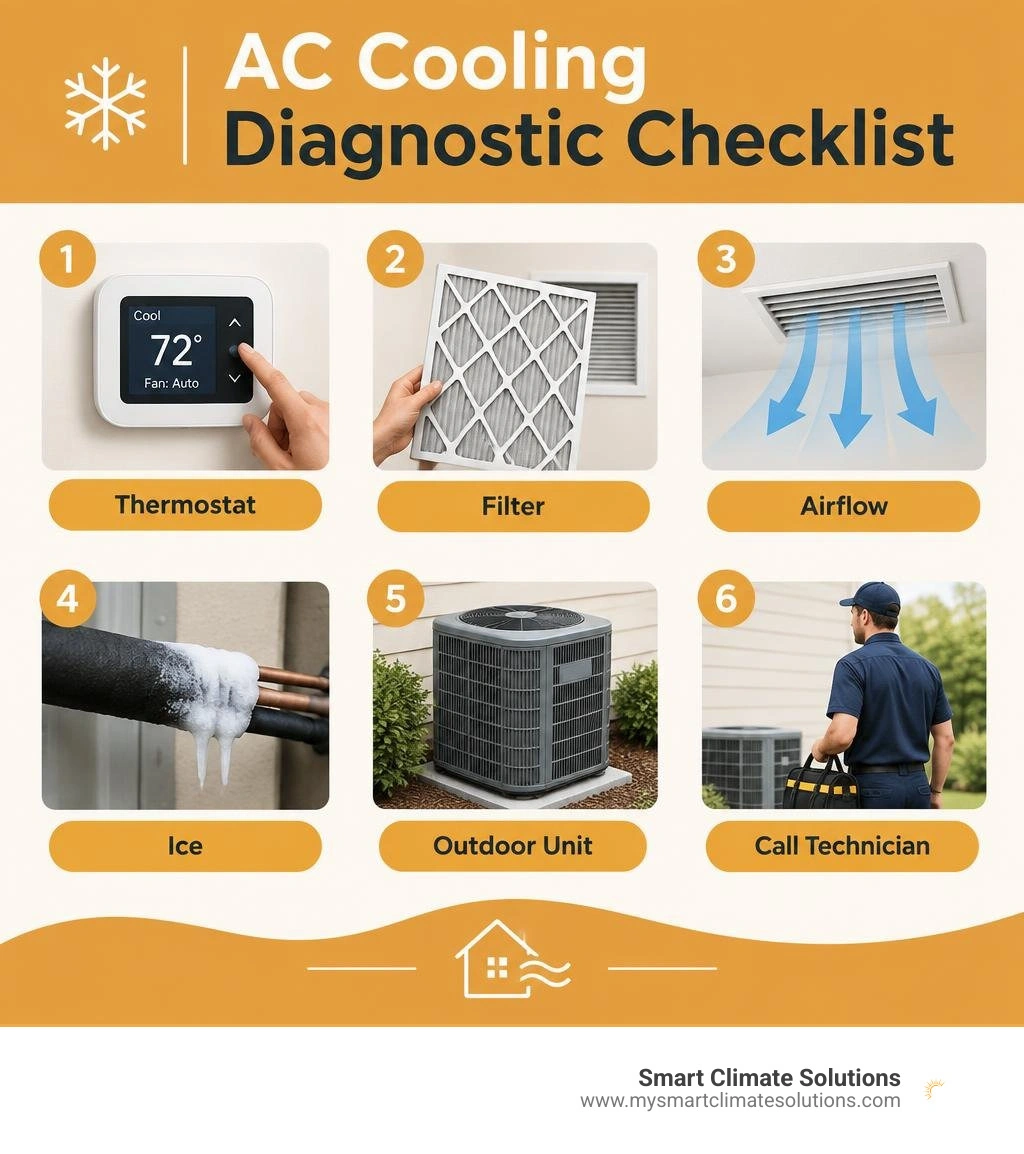
If your air conditioner is not cooling, check the easy items first: set the thermostat to Cool with the fan on Auto, make sure the temperature setting is below the room temperature, inspect the air filter, and confirm the outdoor unit is running with its fan spinning. A dirty filter, blocked airflow, thermostat setting, tripped breaker, frozen coil, or dirty outdoor coil can let the system run without removing enough heat from your home.
For Pittsburgh homeowners, start with this quick sequence:
- Replace a dirty air filter and open blocked supply and return vents.
- Check thermostat settings, batteries, and any schedule or Away mode.
- Look for ice on the refrigerant line or indoor equipment, then turn cooling off and allow it to thaw.
- Clear leaves, grass, and debris from around the outdoor unit.
- Call a professional if the unit blows warm air, repeatedly freezes, trips a breaker, makes unusual noises, or the outdoor fan will not spin.
Do not add refrigerant or work on capacitors yourself. Low refrigerant usually means there is a leak, and electrical components can be dangerous even after power is turned off.
I am Bill Scott, general manager of Smart Climate Solutions. With more than 20 years in HVAC and thousands of homes served across Pittsburgh and Southwestern PA, I have seen that an air conditioner not cooling often has a simple cause, but a careful diagnostic order helps prevent wasted time and costly repairs.
Common Reasons for an Air Conditioner Not Cooling
When an air conditioner runs constantly without lowering indoor temperatures, it is usually struggling to transfer heat. Central air systems operate on a simple principle: the indoor evaporator coil absorbs heat from indoor air, and the outdoor condenser coil releases that heat outside. If any link in that chain breaks down, your system simply circulates unconditioned air. Understanding basic central cooling system mechanics helps you see why small maintenance oversights create massive comfort issues.
In our experience across Western Pennsylvania, most cooling failures trace back to three main culprits: restricted airflow, dirty or blocked coils, or refrigerant charge problems. When you find your AC running but not cooling, identifying which of these factors is at play saves you both time and unnecessary expense.
Airflow Restrictions and Dirty Air Filters
A clogged air filter is the single most common reason a central air conditioner fails to cool a house. Air filters trap dust, pollen, pet dander, and debris before they enter the air handler. Over time, that captured dirt forms an impenetrable blanket across the filter media.
When airflow is restricted, several problems occur at once:
- The blower motor strains against high static pressure, reducing total airflow delivered to your living spaces.
- The reduced volume of warm air passing over the indoor evaporator coil prevents the refrigerant from absorbing enough heat.
- Closed supply registers or obstructed return vents starve the system further, creating hot spots in upstairs bedrooms while dropping system efficiency.
Under standard conditions, an air filter should be inspected every month during the cooling season and replaced every 30 to 90 days. Homes with multiple pets or higher dust levels often require monthly filter swaps to prevent severe airflow bottlenecks.
Frozen Evaporator Coils and Dirty Condenser Coils
A frozen evaporator coil is almost never a root cause by itself; it is a downstream symptom of a system that cannot absorb heat properly. When a dirty air filter or blower failure starves the indoor coil of warm air, the refrigerant inside stays too cold. The coil surface temperature drops below 32 degrees Fahrenheit, causing moisture in the air to freeze onto the fins. Layer by layer, ice builds up until air cannot pass through at all.
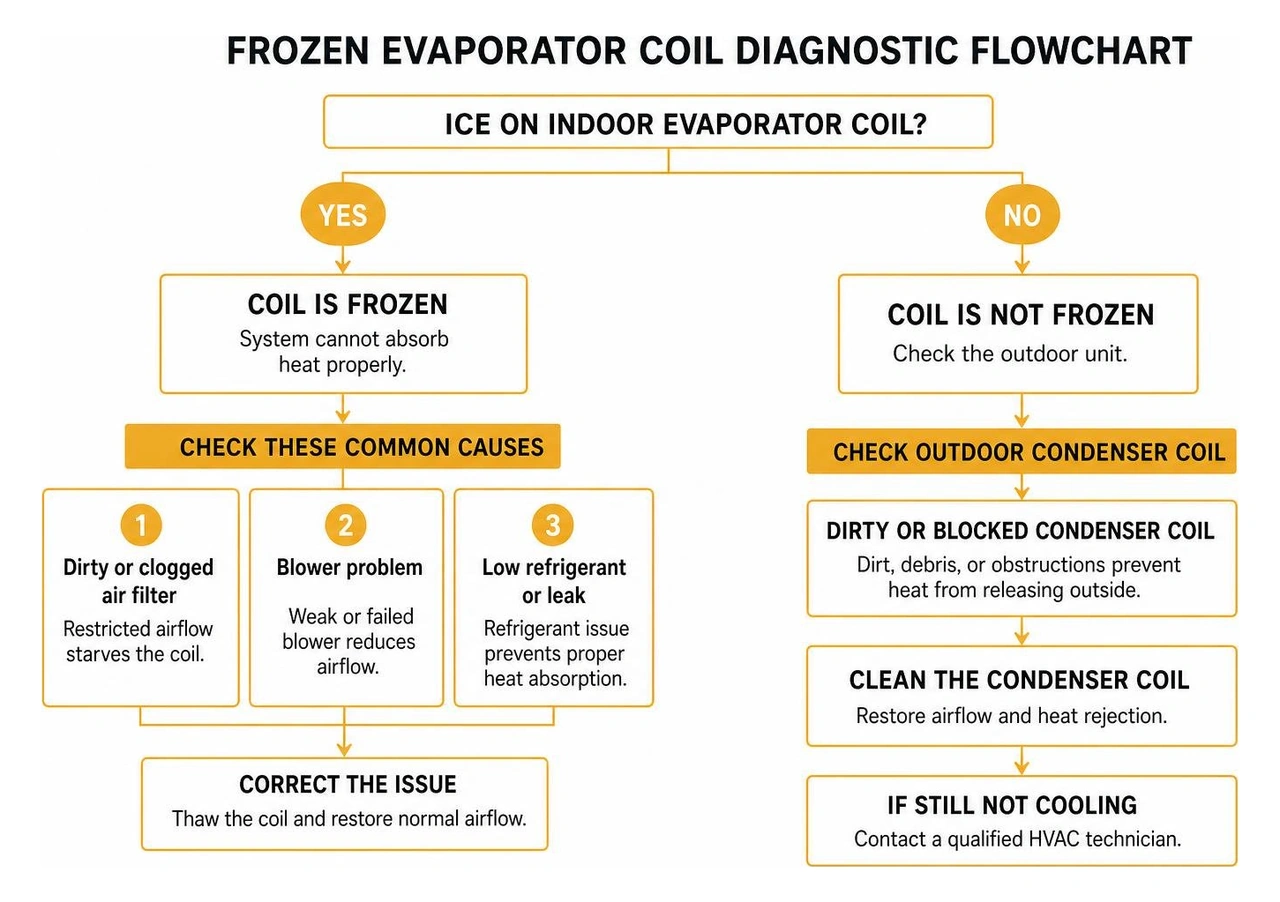
Outdoor condenser coils face the opposite problem. Located outside, the condenser coil must reject all the heat extracted from your home. When it becomes caked with mud, lawn clippings, cottonwood seeds, or tree pollen, it cannot dissipate that heat into the outdoor air. The compressor runs hotter, head pressure spikes, and cooling performance plummets. In many cases, you will find your AC not cooling without frozen coils simply because the outdoor unit is smothered in dirt.
Low Refrigerant and Undetected Leaks
Refrigerant is the chemical compound that cycles continuously through your system to transport heat. A central air conditioner does not consume refrigerant like a car consumes gasoline. It operates within a completely sealed closed loop.
If your system is low on refrigerant, there is a leak somewhere in the tubing, service valves, or coil connections. Common indicators of low refrigerant include:
- A small temperature split between the return air and supply registers (less than 12 degrees Fahrenheit).
- Light frost developing along the brass service valves or the insulated copper suction line outside.
- Hissing or bubbling noises near the indoor air handler or outdoor condenser.
- The unit running all day without reaching the thermostat setpoint.
Adding refrigerant without finding and repairing the leak is a temporary, expensive band-aid. Under EPA Section 608 regulations, handling and recharging refrigerant requires specialized certification and proper recovery tools.
Step-by-Step Diagnostic Sequence for Cooling Failures
Diagnosing an HVAC problem requires a methodical approach that starts with the simplest, zero-cost checks before moving on to complex components. Following structured HVAC diagnostic principles prevents misdiagnosis and saves you from paying for parts you do not need.
| Component | Normal Operating Condition | Faulty Condition / Symptom | Likely Cause |
|---|---|---|---|
| Thermostat | Set to Cool, Fan Auto, display active | Display blank, set to Heat, or Fan On | Dead batteries, tripped breaker, setting error |
| Air Filter | Clean, white or light gray media | Dark gray, dusty, or caked with pet hair | Lack of routine maintenance (replace immediately) |
| Indoor Coil | Sweating lightly, condensate draining | Solid sheet of white ice or frost | Airflow blockage or low refrigerant charge |
| Supply Vents | Blowing strong air 15 to 20 degrees cooler than room | Weak airflow or blowing room-temperature air | Duct leak, blower failure, or compressor issue |
| Outdoor Fan | Spinning smoothly, blowing warm air upward | Not spinning while cabinet hums | Bad run capacitor or seized fan motor |
| Suction Line | Cold and sweating with condensation | Warm to the touch or covered in thick ice | Dirty filter (iced) or low refrigerant (warm/iced) |
When you need a complete overview of the process, our comprehensive system troubleshooting guide walks you through every testing phase step by step.
Troubleshooting an Air Conditioner Not Cooling at the Thermostat
Always start your diagnostic process at the thermostat. It acts as the brain of your HVAC system, and simple configuration errors account for a significant percentage of no-cooling calls. Following proven thermostat troubleshooting methods will quickly rule out digital or setting issues:
- Verify Operating Mode: Confirm the thermostat is explicitly set to COOL. If someone accidentally switched it to HEAT or OFF, the system will remain idle.
- Check the Fan Setting: Ensure the fan is set to AUTO, not ON. When set to ON, the indoor blower runs continuously even when the outdoor compressor is resting, blowing unconditioned, humid air through your registers.
- Verify the Setpoint: Set the cooling temperature at least 3 to 5 degrees below the current room temperature to force a solid call for cooling.
- Check the Batteries: Digital thermostats often use AA or AAA batteries for backup power. If batteries are weak, the screen may stay lit, but the internal relays will fail to send the 24-volt signal to start the condenser.
- Clear Schedules and Holds: Check if a smart thermostat is locked in an "Away", "Eco", or vacation hold mode that overrides your standard cooling preferences.
Checking Air Handlers and Circuit Breakers
If the thermostat is calling for cooling but nothing happens, inspect your electrical panel and the indoor air handler.
A central air conditioning system uses two separate electrical circuits: one 240-volt double-pole breaker for the outdoor condenser and a 120-volt or 240-volt breaker for the indoor air handler or furnace. If the outdoor breaker trips while the indoor breaker stays on, your indoor blower will continue blowing warm room air through the vents. Reset any tripped breaker once. If it trips again immediately, leave it off and call a technician, as repeated tripping indicates a serious short circuit or grounded motor.
Additionally, modern air handlers feature a condensate float switch mounted on the primary drain line or secondary drain pan. If your condensate drain line becomes clogged with algae or mold, the drain pan fills with water. The float switch rises and cuts power to the low-voltage control wire, shutting down the outdoor cooling unit to prevent catastrophic water damage to your ceilings and floors.
Inspecting the Outdoor Condenser Unit
Walk outside to the condenser unit while the thermostat is actively calling for cooling. Observe both what you see and what you hear:
- Fan and Compressor Operation: Both the top exhaust fan and the internal compressor should be running. The air discharged from the top of the unit should feel noticeably warm, indicating that heat is being pulled from your home and rejected outside.
- Cabinet Humming with No Fan: If you hear a deep electrical hum from the cabinet but the fan blades are stationary, turn the system off immediately at the thermostat to prevent the compressor from overheating.
- Clearance and Debris: Ensure there is at least two feet of clear space around the entire perimeter of the condenser. Trim back overgrown shrubs, tall grass, and weeds that restrict air intake through the coil fins.
Identifying Mechanical and Component Breakdowns
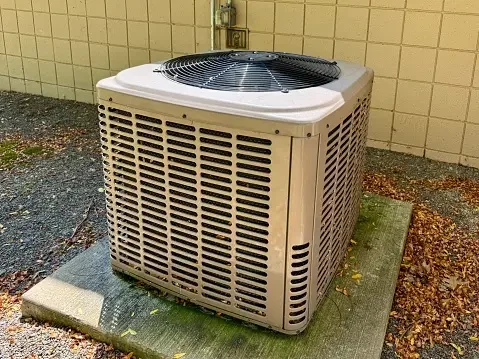
When basic airflow and electrical checks fail to resolve the problem, the issue is typically a mechanical or electrical failure inside the outdoor cabinet. If your air conditioner blowing warm air continues despite clean filters and clear vents, internal parts require closer inspection.
Failed Run Capacitors and Seized Fan Motors
A dual run capacitor is the small, cylindrical metal component located inside the condenser electrical access panel. It acts like a temporary battery, storing electrical charge to provide the steady phase-shifted voltage required to keep both the fan motor and compressor running smoothly.
A failed run capacitor is the single most common component failure on residential outdoor units. Over time, high summer heat, electrical surges, and age cause the internal dielectric material to break down. Signs of a failing capacitor include:
- A bulging, swollen, or domed top on the capacitor cylinder.
- Oil leaking down the sides of the metal casing.
- An outdoor fan motor that hums but will not spin unless gently pushed with an insulated stick (never use your hands).
If the capacitor fails completely, the fan motor or compressor will overheat, drawing excessive electrical current until the internal thermal overload safety trips.
Failing Compressors and Electrical Faults
The compressor is the mechanical heart of your air conditioning system, pumping refrigerant between the indoor and outdoor coils. When a compressor begins to fail mechanically or electrically, cooling performance drops sharply.
Watch for these indicators of compressor distress:
- Pitted or Burnt Contactor Points: The contactor is an electrical switch that pulls in when cooling is requested. If the electrical contact surfaces become pitted or burned, power cannot flow cleanly to the compressor.
- Hard Starting and Clunking: A compressor struggling against internal mechanical wear will shake the outdoor unit upon startup or produce loud rattling, buzzing, or metallic clicking sounds.
- Thermal Overload Trips: A failing compressor draws excessively high amperage, causing internal thermal sensors to shut it down after 10 to 15 minutes of operation. This creates frustrating intermittent cooling issues where the system blows cold air briefly, shuts off, and then blows warm air until the compressor cools down.
Diagnosing a Brand New Air Conditioner Not Cooling
It is particularly alarming when a newly installed cooling system fails to keep the home comfortable. When you encounter new AC installation cooling problems, the root cause is almost never equipment age, but rather design or commissioning errors:
- Improper Sizing: An undersized unit lacks the British Thermal Unit (BTU) capacity required to handle the home's peak heat gain during hot summer afternoons.
- Incorrect Refrigerant Charge: New systems come factory pre-charged for standard line set lengths (typically 15 feet). If your refrigerant line set is longer and the installer did not weigh in additional refrigerant, the system will run undercharged.
- Ductwork Inefficiencies and Leaks: Older duct systems in Western PA homes often have detached joints, missing insulation, or undersized returns in unconditioned attics, pulling hot, humid air straight into your living space.
When to Call for Professional HVAC Service
While homeowners can easily swap an air filter, clear brush from the condenser, and reprogram a thermostat, technical repairs must be handled by trained professionals.
You should shut your system off and call for certified professional HVAC repair under the following conditions:
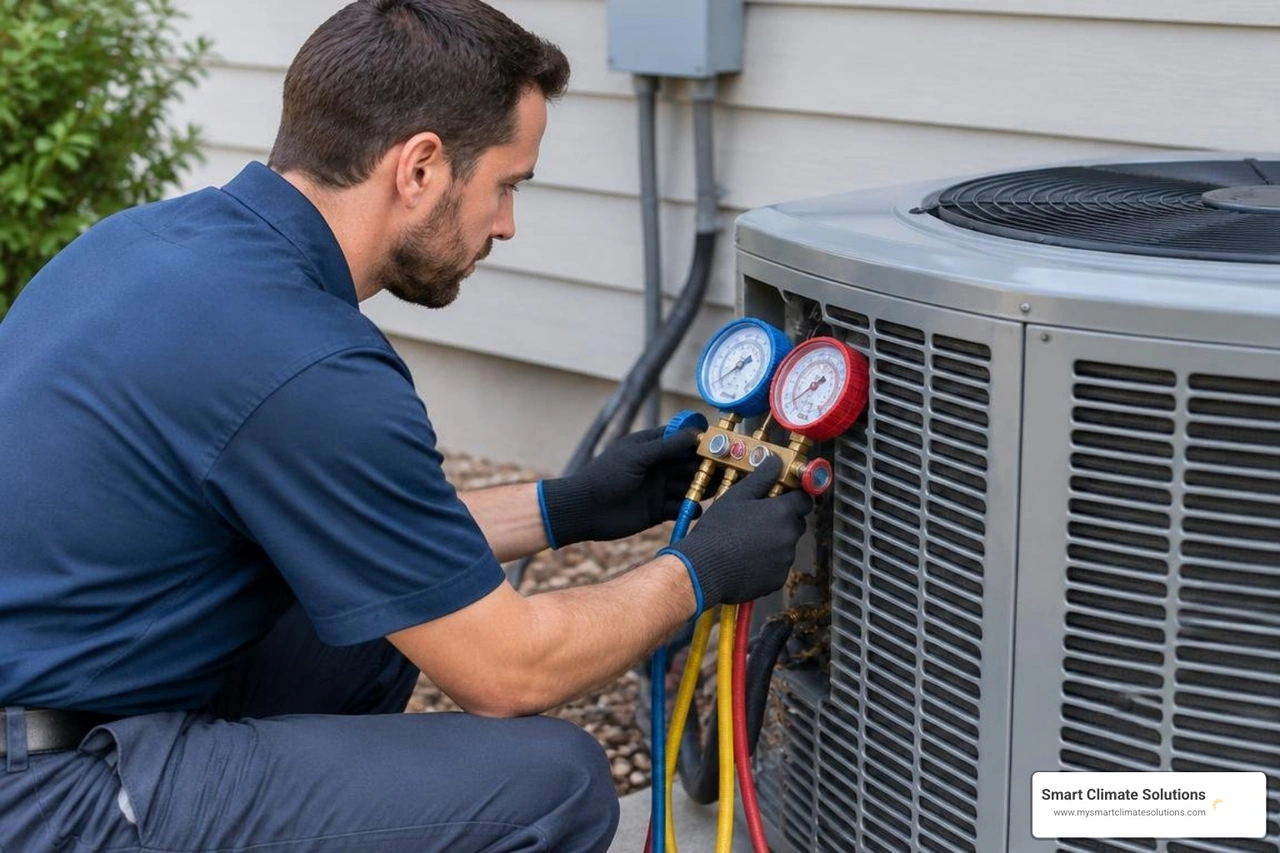
- Refrigerant System Issues: Identifying microscopic leaks, brazing copper lines, pulling a deep vacuum, and charging refrigerant requires certified manifold gauges, electronic leak detectors, and mandatory EPA Section 608 credentials.
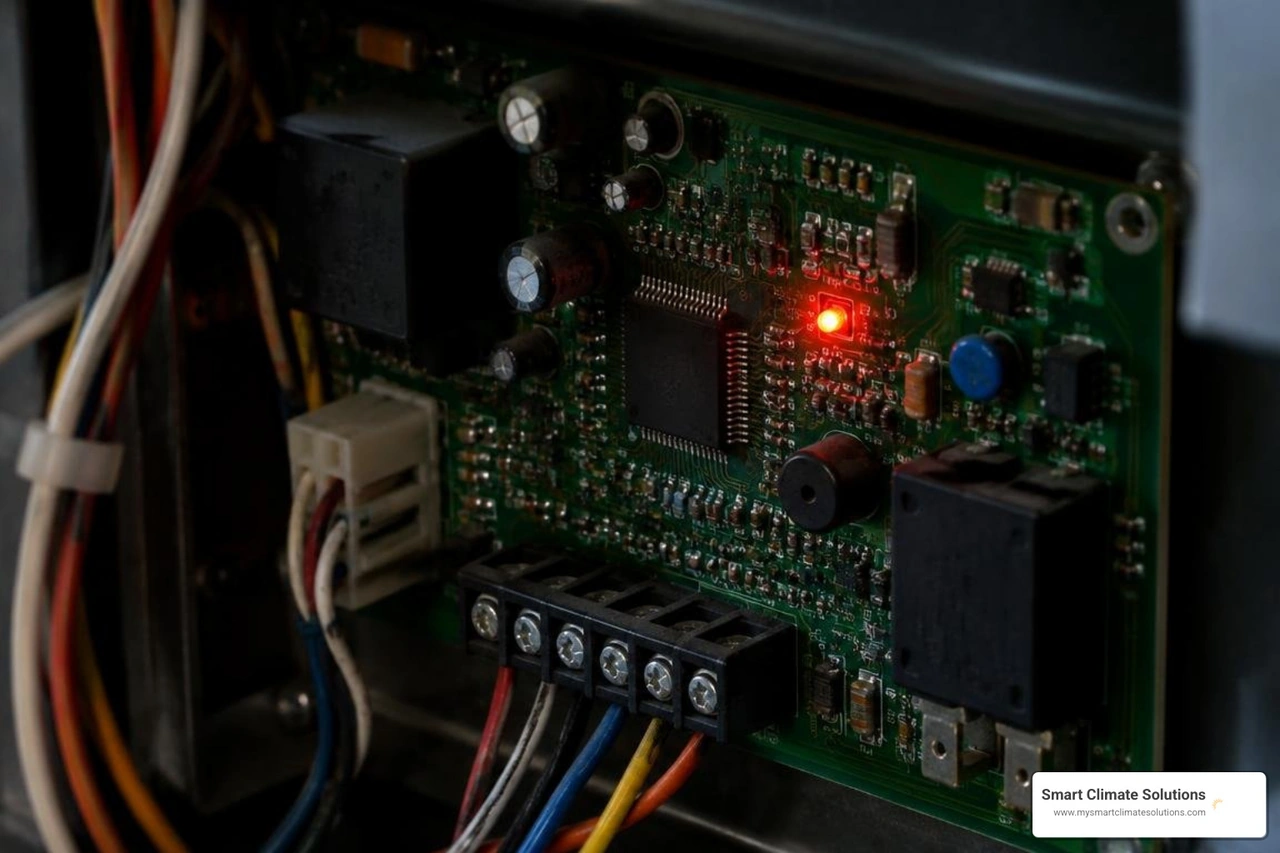
- High-Voltage Electrical Repairs: Capacitors store dangerous electrical charges even with the main breaker turned off. Testing contactors, relays, and motors with a multimeter carries severe risk of electrical shock.
- Repeated Breaker Tripping: Breakers trip to prevent electrical fires. Repeatedly resetting a tripping breaker can permanently melt motor windings or damage your home's electrical panel.
- Loud Grinding or Squealing Noises: Internal mechanical failures inside the compressor or blower motor require specialized disassembly and equipment replacement.
Frequently Asked Questions About AC Cooling Issues
How long does it take for a frozen AC coil to thaw?
A lightly frosted evaporator coil can thaw in about 2 to 3 hours if you turn the cooling mode OFF and set the fan mode to ON at the thermostat. Running the fan forces warm indoor air across the coil without activating the refrigeration cycle, speeding up the melting process.
If the coil is encased in a thick, solid block of ice, complete thawing can take 12 to 24 hours. Never use an open flame, heat gun, knife, or screwdriver to scrape ice off the coil fins; the thin aluminum fins and copper tubing puncture easily, turning a simple airflow issue into a costly coil replacement. Keep old towels around the base of your air handler to catch water overflow if the condensate drain backs up.
Why won't my AC cool below 75 degrees or keep up in extreme heat?
Residential central air conditioners are engineered to maintain an indoor temperature roughly 20 degrees Fahrenheit cooler than the outdoor temperature. When outdoor temperatures climb into the 90s with heavy humidity, a system designed for a 20-degree differential will naturally top out around 72 to 75 degrees indoors.
Under normal operating conditions, a properly sized, fully charged air conditioning system drops indoor room temperatures at a rate of roughly 1 degree Fahrenheit every 15 to 20 minutes. If the outdoor temperature is 85 degrees and your system cannot reach 75 degrees after several hours of continuous operation, check for a dirty air filter, dirty condenser coils, or duct leaks before assuming the system is failing.
Is it normal for the outdoor unit to hum if the fan is not spinning?
No, this is an abnormal and urgent symptom. When the outdoor unit hums while the fan remains motionless, the compressor or motor windings are receiving high-voltage power, but the motor cannot generate the magnetic force needed to turn the fan blades.
This symptom almost always points to a failed dual run capacitor or a seized fan motor bearing. If left powered on, the compressor will quickly overheat and trip on internal thermal overload, potentially causing irreversible motor damage. Shut the system down at your thermostat immediately until an HVAC technician can replace the faulty capacitor or motor.
Conclusion
A central air conditioner that runs without cooling your home is an urgent issue during hot, humid weather. By following a structured diagnostic sequence, starting with the thermostat, inspecting the air filter, verifying breaker status, and checking for coil ice, you can quickly identify whether your cooling failure requires a simple five-minute fix or professional attention.
Smart Climate Solutions brings over 20 years of dedicated heating and cooling experience to homeowners throughout Pittsburgh, the South Hills, Washington, Burgettstown, as well as Steubenville, St. Clairsville, and Weirton. Our certified technicians provide fast, reliable system diagnostics and 24/7 emergency support to restore your home comfort. If your DIY checks reveal frozen coils, electrical failures, or suspected refrigerant leaks, turn to our team for comprehensive air conditioner diagnostic support and long-lasting repairs.