

Why American Standard Commercial Air Conditioners Are a Smart Choice for Your Business

American Standard commercial air conditioners are a top-tier choice for businesses that need reliable, energy-efficient cooling across a wide range of building sizes and applications.
Here is a quick snapshot of what they offer:
| Feature | Details |
|---|---|
| System Types | Packaged rooftop units, split systems |
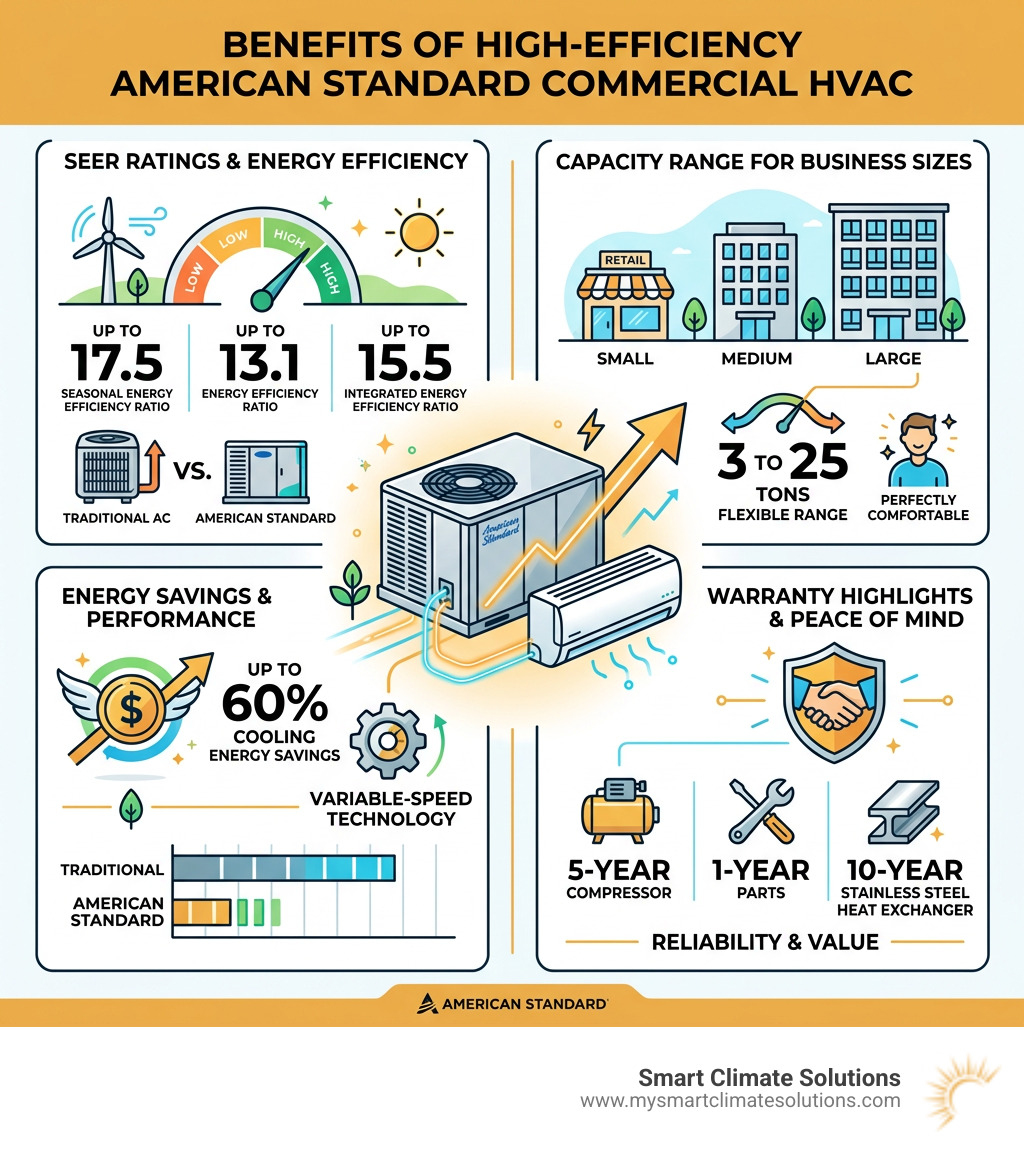
| Capacity Range | 3 to 25 tons |
| Efficiency Ratings | SEER up to 17.5, EER up to 13.1, IEER up to 15.5 |
| Key Product Lines | Precedent, Voyager, Foundation, Odyssey |
| Energy Savings | Up to 60% on cooling energy with variable-speed technology |
| Warranty | 5-year compressor, 1-year parts, 10-year stainless steel heat exchanger |
| Refrigerants | R-410A, R-454B (low-GWP A2L option) |
Whether you run a small retail shop or a large multi-room facility, there is an American Standard unit built to fit your needs and your budget.
Your building's temperature does more than keep people comfortable. In many industries, a failed AC system can mean damaged equipment, lost productivity, or even closed doors. That is why choosing the right commercial cooling system matters so much.
I'm Bill Scott, general manager of Smart Climate Solutions, and over my 20+ years in the HVAC industry I've installed and serviced american standard commercial air conditioners across hundreds of Pittsburgh-area businesses. I'll walk you through everything you need to know to make a confident decision.
Types of American Standard Commercial Air Conditioners
When we talk to business owners in places like Washington, PA or Weirton, WV, the first thing they often ask is, What kind of unit do I actually need? American Standard offers two primary configurations for light commercial use: packaged systems and split systems.
Each has its own set of perks depending on your building's architecture and your specific cooling needs. American Standard provides a wide range of light commercial solutions that prioritize indoor comfort and energy-saving efficiency. Whether you are looking for a unit that sits on your roof or one that splits between the inside and outside of your building, there is a solution available.
You can find a variety of American Standard HVAC Commercial Packaged Air Conditioners designed to handle the heavy lifting of commercial cooling while keeping your utility bills manageable.
Packaged Rooftop Units
Packaged rooftop units (RTUs) are the workhorses of the commercial world. In a packaged system, all the components—the compressor, condenser, and evaporator—are housed in one single cabinet. This is a huge space-saver because it keeps the entire cooling plant on the roof or a concrete pad outside, leaving your indoor square footage for, well, your business.
American Standard offers three main series of packaged units:
- Precedent series: These cover the 3 to 10-ton range and are known for high efficiency (up to 17.5 SEER).
- Voyager series: These are designed for larger applications, covering 12.5 to 25 tons.
- Foundation series: Specifically engineered for easy replacement, these fit common competitor footprints without the need for expensive curb adapters.
One of the best things about these units is their convertible airflow. They can be configured for either downflow (blowing air straight down into the building) or horizontal flow (blowing air through the side into ductwork). This flexibility is vital for businesses in Steubenville or Pittsburgh where building layouts can vary wildly. For more foundational knowledge, you can read More info about air conditioning systems.
Odyssey Split Systems
Not every building has a roof that can support a multi-ton packaged unit. That is where the Odyssey split systems come in. These systems consist of an outdoor condensing unit and an indoor air handler.
Odyssey units are available in capacities from 5 to 25 tons. They are particularly popular in our service areas like South Hills, PA, because they feature a small footprint and indoor air handlers that are designed to fit through standard doorways. This makes them a dream for retrofit projects where space is at a premium.
These systems are factory run-tested before they ever reach your job site, ensuring that when we perform the installation, the unit is ready to perform. If you are considering a split system for your facility, you can find More info about HVAC installation services to see how we handle these complex setups.
Key Features and Efficiency Ratings
In the HVAC world, efficiency is not just a buzzword; it is a direct reflection of your monthly overhead. American standard commercial air conditioners are packed with technology designed to squeeze every bit of cooling out of every watt of electricity.
One of the most impressive things about American Standard is their commitment to durability. They do not just build a unit and hope for the best. Every model undergoes over 2,600 hours of continuous testing in their SEET (Systems Extreme Environmental Test) Lab. This is equivalent to years of wear and tear condensed into just four months. If a unit can survive the SEET Lab, it can certainly survive a humid July in Pittsburgh.
Before diving into the tech, it is important to understand the legal and privacy standards involved in purchasing these systems. You can review the Privacy Policy for more information on how data is handled during dealer interactions.
Understanding SEER2 and EER2 in American Standard Commercial Air Conditioners
If you have looked at any AC specs recently, you have seen a lot of acronyms. Let's break them down:
- SEER2 (Seasonal Energy Efficiency Ratio): This measures efficiency over an entire cooling season. American Standard models range from 13.4 SEER2 up to 23.6 SEER2 for residential-grade light commercial units.
- EER2 (Energy Efficiency Ratio): This measures efficiency at a specific, high outdoor temperature (usually 95 degrees). It is a great indicator of how the unit will perform during a true heatwave.
- IEER (Integrated Energy Efficiency Ratio): This is the commercial standard that accounts for the fact that units rarely run at 100% capacity. It measures performance at various load levels (25%, 50%, 75%, and 100%).
High-efficiency units can save you up to 60 percent on cooling energy compared to older, single-speed systems. For a deeper dive into these metrics, check out Seasonal Energy Efficiency Ratio (SEER2) explained and Energy Efficiency Ratio (EER2) explained.
Innovative Technology for Durability
What makes an American Standard unit different from the rest? It often comes down to the components inside:
- Duration Variable-Speed Compressors: Instead of just being "on" or "off," these compressors can adjust their speed to match your cooling needs exactly. This leads to better humidity control and much quieter operation.
- SpineFin Coils: These all-aluminum coils are more resistant to corrosion than traditional copper/aluminum coils, which is a major plus in industrial areas.
- ReliaTel Microprocessor Controls: These controls provide built-in reliability and faster diagnostics. They eliminate the need for many field-installed timers and sensors.
- Tubular Heat Exchangers: Found in gas/electric packaged units, these provide greater efficiency and are often available with stainless steel options for maximum longevity.
While we are focusing on cooling, many commercial units are part of a larger HVAC strategy. You can find More info about commercial heating systems to see how these systems integrate with your winter heating needs.
Choosing the Right Model for Your Business
Selecting the right model is not just about picking the biggest unit on the list. In fact, an oversized unit is often worse than an undersized one because it will "short cycle," turning on and off constantly, which kills efficiency and leaves your building feeling humid.
In our neck of the woods—from Burgettstown, PA to St. Clairsville, OH—we have to account for high humidity and variable occupancy. A restaurant has very different cooling needs than a warehouse, even if the square footage is the same. To get started, you can Find an HVAC Dealer in Pennsylvania who understands these local nuances.
Comparing Precedent, Voyager, and Foundation
Here is how the three main packaged lines stack up:
- Precedent (3-10 Tons): This is the "gold standard" for light commercial. It offers the highest efficiency ratings (up to 17.5 SEER) and a wide range of factory-installed options. If you want the lowest possible energy bills for a small-to-medium office or retail space, this is usually the winner.
- Voyager (12.5-25 Tons): When you need to move a lot of air in a large facility, the Voyager is the way to go. It features durable scroll compressors and is designed for heavy-duty, long-term performance.
- Foundation (3-5 and 15-25 Tons): The Foundation series is the "problem solver." It is designed to fit directly onto the roof curbs of many other brands. This means we can often replace an old unit without having to modify your roof or wait for custom curb adapters. It uses microchannel condenser coils which are standard on all models for better heat transfer.
Whether you are doing a new build or a replacement, getting the installation right is key. You can find More info about HVAC installation to understand our process.
Sizing American Standard Commercial Air Conditioners
We cannot stress this enough: Never guess on size. We use a Manual J load calculation to determine the exact tonnage your building requires. This calculation takes into account:
- Total square footage.
- Ceiling height.
- Number of windows and their orientation.
- Insulation levels.
- The number of people usually in the building.
- Heat-generating equipment (computers, ovens, machinery).
If a contractor gives you a quote based on a "rule of thumb" or just looks at your old unit, run the other way! Proper sizing is the difference between a comfortable office and a swampy one. To find a pro who does it right, you can Find an HVAC Dealer in Pittsburgh through the American Standard network.
Installation and Maintenance for Long-Term Performance
A high-quality american standard commercial air conditioner is only as good as its installation. At Smart Climate Solutions, we have seen plenty of "bargain" installations that ended up costing the business owner thousands in repairs later on.
American Standard makes our job a bit easier by including features like color-coded and numbered wiring, which speeds up the installation and makes future troubleshooting a breeze. Every unit is also run-tested at the factory, so we know it is in working order before it leaves the crate. If your project involves complex ducting, you can find More info about commercial ductwork installation.
Warranty and Support Options
American Standard stands behind their equipment with some of the best warranties in the business:
- Compressors: Most units come with a 5-year limited warranty.
- Heat Exchangers: Stainless steel models often carry a 10-year limited warranty.
- Parts: A standard 1-year limited warranty covers other components.
Optional extended warranties are also available, which can provide peace of mind for 10 years or more. We always recommend checking the specifics for your model at American Standard Air Conditioning and Heating.
Routine Service and Maintenance
Commercial units work hard—often 24/7. Without routine maintenance, even the best American Standard unit will lose efficiency and eventually break down. We recommend a preventative maintenance plan that includes:
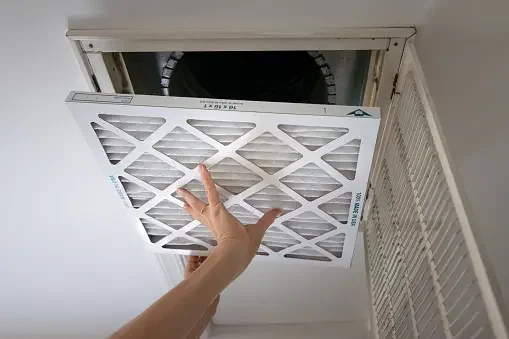
- Cleaning or replacing filters every 1-3 months.
- Cleaning condenser and evaporator coils annually.
- Checking refrigerant levels.
- Inspecting electrical connections and contactors.
- Lubricating moving parts.
Regular service can extend the life of your unit by years and keep your energy bills from creeping up. You can find More info about commercial HVAC maintenance plans and More info about HVAC service and repair to see how we keep businesses running smoothly.
Frequently Asked Questions about Commercial Cooling
What is the difference between Precedent and Voyager units?
The main difference is capacity and application. Precedent units are designed for 3 to 10-ton applications and focus heavily on high efficiency (up to 17.5 SEER). Voyager units are built for larger loads, ranging from 12.5 to 25 tons, and are engineered for industrial-grade durability in larger spaces.
How do I know what tonnage my building needs?
You should never guess. A professional HVAC contractor must perform a Manual J load calculation. This looks at your building's "heat gain"—everything from the sun hitting your windows to the heat given off by your employees and equipment. Generally, 1 ton of cooling is needed for every 400-600 square feet, but this varies wildly based on the factors mentioned above.
Are there financing options for commercial HVAC?
Yes! American Standard often offers special financing, such as 60 months of special financing for qualifying systems. Additionally, there are leasing options available that can help businesses manage the upfront cost of a new system while reaping the benefits of lower energy bills immediately.
Conclusion
Investing in american standard commercial air conditioners is a move toward long-term stability and comfort for your business. From the rigorous SEET Lab testing to the innovative variable-speed technology, these units are designed to perform when the heat is on.
At Smart Climate Solutions, we bring over 20 years of experience to every job. Whether you are in Pittsburgh, PA, Steubenville, OH, or Weirton, WV, our team of certified technicians is ready to help you select, install, and maintain the perfect cooling system. We offer 24/7 emergency support because we know that a cooling failure doesn't always happen during business hours.
Ready to upgrade your business comfort? You can find More info about our commercial HVAC services or give us a call today. Let's keep your business breezy all summer long!


.png)
