HVAC Installation Costs: What to Compare Before You Buy
HVAC installation costs depend on the system, your home's needs, and the work included in the quote. In 2026, estimated installed costs range from $3,800 to $12,000 for a gas furnace, $3,000 to $15,000 for central AC, and $6,000 to $25,000 for an air-source heat pump. To compare quotes fairly, ask each contractor to list the equipment, labor, permits, ductwork, and any electrical work separately.
Price is only part of the decision. Proper sizing, sealed ducts, and startup testing help your new system keep a Pittsburgh-area home comfortable without wasting energy.
I'm Bill Scott, general manager of Smart Climate Solutions. After more than 20 years in heating and cooling, I know that a clear HVAC installation quote helps homeowners avoid surprises.
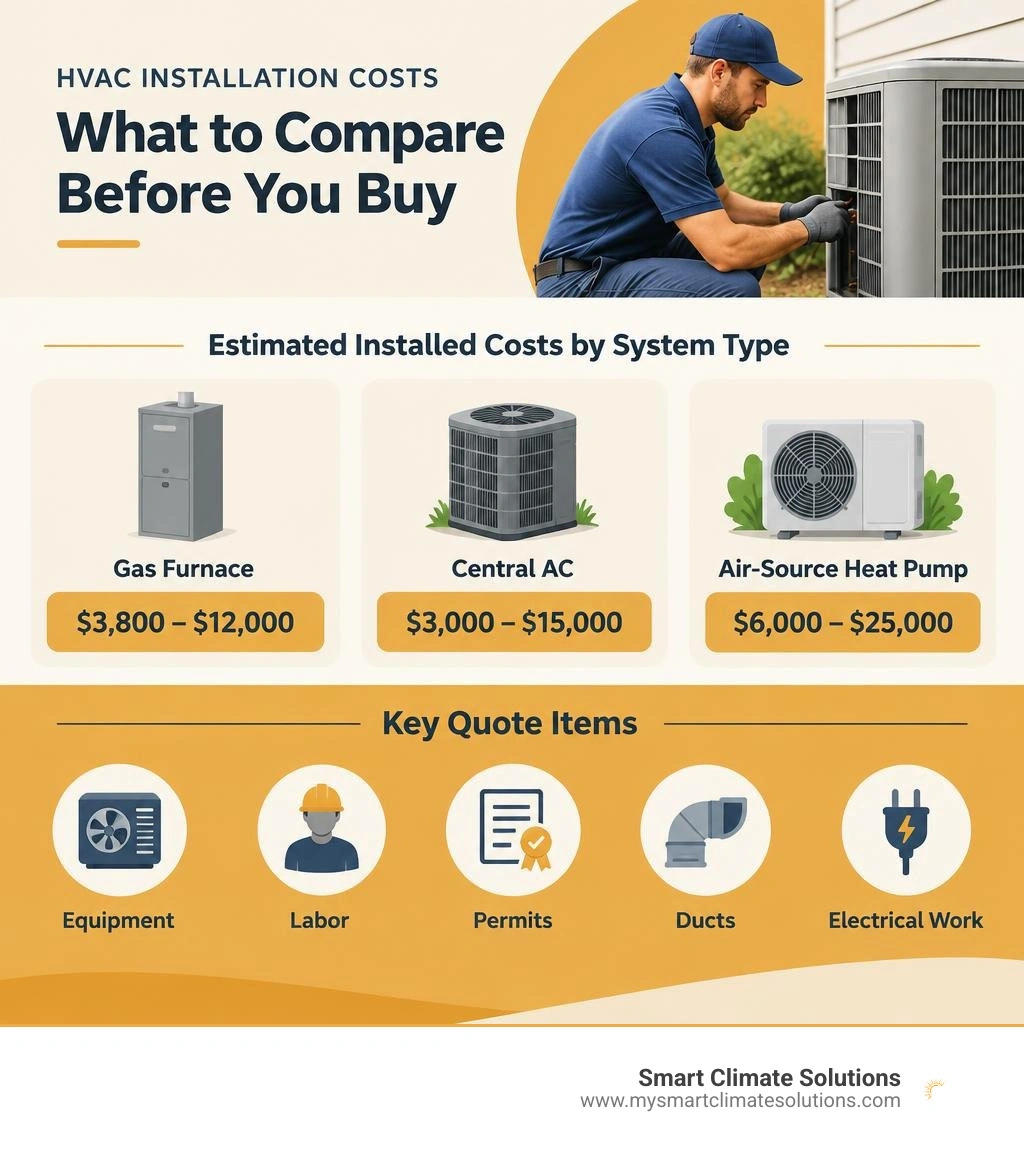
Comparing HVAC Installation Costs by System Type in 2026
Every home has different heating and cooling demands. The total cost of an upgrade depends primarily on the fuel source, mechanical efficiency, system layout, and required infrastructure changes.
| Equipment Type | 2026 Average Installed Cost | Expected Lifespan | Standard Efficiency Ratings |
|---|---|---|---|
| Gas Furnace | $3,800 - $12,000 | 15 - 20 Years | 80% - 98% AFUE |
| Central Air Conditioner | $3,000 - $15,000 | 12 - 15 Years | 13.4 - 24+ SEER2 |
| Air-Source Heat Pump | $6,000 - $25,000 | 12 - 15 Years | 14.3 - 22+ SEER2 / 7.5+ HSPF2 |
| Geothermal Heat Pump | $12,000 - $45,000 | 20 - 25+ Years (50 yr ground loop) | 20 - 40+ EER / 3.5 - 5.0 COP |
A standard gas furnace replacement typically runs between $3,800 and $12,000. Basic 80% AFUE units fall on the lower end, while high-efficiency condensing furnaces requiring dedicated PVC venting sit at the top. For standalone cooling, central air conditioning systems range from $3,000 to $15,000, influenced by the unit capacity and SEER2 rating.
Air-source heat pumps have grown increasingly popular, ranging from $6,000 to $25,000. Advanced cold-climate inverter models can heat homes efficiently even during freezing temperatures. For maximum long-term efficiency, geothermal heat pump systems range from $12,000 to $45,000 due to the extensive ground loop excavation required. Homeowners evaluating full replacements can review detailed HVAC system install cost factors to plan their project budget.
System equipment accounts for only a portion of the project. If your existing electrical service cannot support modern electric heat strips or variable-capacity compressors, a panel upgrade can add $1,500 to $4,000. Structural modifications, such as building custom equipment platforms, cutting new supply registers, or running new high-voltage circuits, also affect final labor expenses.
Evaluating Heating and Cooling Combination Packages
Replacing both your heating and cooling equipment at the same time is usually much more economical than staggering installations. Bundled packages save on labor, disposal fees, and permit applications. Pairing a high-efficiency gas furnace with an electric heat pump creates a dual-fuel hybrid system that switches between energy sources based on outdoor temperatures to minimize utility bills.
Packaged units house the heating and cooling components inside a single outdoor cabinet, making them ideal for homes with limited interior space. Split systems separate the indoor air handler or furnace from the outdoor condenser. Matching these indoor and outdoor components ensures balanced refrigerant metering while managing overall furnace and AC install cost.
Upgrading to a matching system also allows seamless smart thermostat integration. Communicating controls monitor humidity levels, adjust multi-stage blowers, and provide remote diagnostics for modern central air installation.
Regional Climate and Efficiency Standards
Heating and cooling requirements vary significantly by climate. The Department of Energy enforces SEER2 (Seasonal Energy Efficiency Ratio 2) cooling benchmarks alongside HSPF2 (Heating Seasonal Performance Factor 2) standards. Modern systems are tested under realistic external static pressures to provide accurate efficiency data.
In Pittsburgh, PA, and surrounding communities like Bethel Park, Carnegie, and South Hills, winter weather puts intense demand on heating equipment. Investing in a high-AFUE gas furnace or a cold-climate heat pump keeps your home warm throughout sub-freezing stretches, making quality furnace installation in Pittsburgh essential for reliable winter comfort.
Homeowners can offset equipment costs using federal tax credits under the Inflation Reduction Act, which offers up to $2,000 for qualifying heat pumps and $600 for high-efficiency gas furnaces. Local electric and gas utility rebates can provide hundreds more in savings.
Deciding Between HVAC Repair and Replacement
Deciding whether to repair an aging unit or replace it comes down to age, reliability, and recurring maintenance expenses.
- System Age: Most heating and cooling systems last 10 to 15 years. Beyond 15 years, internal components degrade, efficiency drops, and finding replacement parts becomes difficult.
- Recurring Failures: If you have scheduled multiple service calls over the past two seasons, the system is reaching the end of its useful life.
- Energy Bills: Unexplained spikes in your utility bills often indicate failing compressors, dirty heat exchangers, or degraded blower motors.
- Critical Part Failures: A cracked heat exchanger poses carbon monoxide risks, while a locked compressor can lead to costly repairs.
- The 50 Percent Rule: If a single repair quote approaches 50% of the cost of a brand-new system, full replacement is the smarter financial choice.
Comparing ongoing repair estimates against the average HVAC install cost helps you evaluate the long-term energy savings of a modern system.
The 5,000 Dollar Repair Versus Replacement Formula
The $5,000 rule provides an easy economic calculation to guide your decision:
Multiply the age of your HVAC equipment in years by the estimated repair cost in dollars. If the total exceeds $5,000, replacing the unit is generally the best investment.
- Example A (Repair): A 6-year-old furnace needs a $350 draft inducer motor replacement. Multiplying 6 by 350 equals $2,100. Because this is below $5,000, repairing the unit makes sense.
- Example B (Replace): A 12-year-old air conditioner requires a $600 capacitor and fan motor repair. Multiplying 12 by 600 equals $7,200. Because this exceeds $5,000, investing that money into a new system offers a better return.
Key Technical Factors Affecting HVAC Installation Quality
A quality installation matters just as much as the brand of equipment you choose.

According to the ENERGY STAR HVAC Quality Installation guidelines, improper installation can reduce equipment efficiency by up to 30%. Maintaining total external static pressure within 0.1 inches of water column of design specifications protects blower motors from premature burnout. Additionally, indoor evaporator coil airflow must remain above 350 cubic feet per minute per ton to prevent coil freeze-ups. Adhering to ACCA Manual RS residential design standards ensures ideal comfort, air distribution, and humidity control.
ACCA Manual J and Equipment Sizing
Never rely on generic sizing rules of thumb like 500 square feet per ton. A proper installation begins with an ACCA Manual J load calculation that evaluates insulation levels, window orientation, ceiling heights, and air infiltration rates.
ACCA Manual S uses this data to select equipment matched to your home's sensible and latent heating and cooling loads. The equipment's sensible capacity should not exceed the calculated design load by more than 15%. Oversized systems short-cycle, causing wide temperature swings and leaving air damp and humid. Correctly sized equipment runs smooth, steady cycles that manage humidity and lower operating costs.
Preparing for a Residential HVAC Installation
Proper preparation prevents unexpected delays on installation day:
- Home Survey: Check electrical panel capacity, gas supply lines, condensate drains, and equipment clearances.
- Permit Management: Licensed contractors pull all required local mechanical, electrical, and plumbing permits before starting work.
- Technician Credentials: Confirm your installers hold EPA Section 608 certification to handle refrigerants safely.
- Safety Clearances: Maintain clear workspace around indoor and outdoor units according to manufacturer and code specifications.
Thorough planning when installing HVAC keeps the entire replacement process on schedule and hassle-free.
Post-Installation Testing and Duct Sealing Standards
Duct design plays a huge role in overall performance. Leaky ducts increase heating and cooling energy use by 15% to 20% on average. Thermal conduction losses in unconditioned attics can waste more than 40% of conditioned air energy before it reaches the furthest supply registers.
Under InterNACHI HVAC design and installation criteria, duct leakage should not exceed 0.03 times the conditioned floor area in cubic feet per minute at 50 Pascals for rough ductwork, and 0.07 times the floor area for finished installations. Technicians must seal all duct seams and joints with UL-181 listed mastic or foil-faced tape.
Room-by-room airflows must align within 15% of Manual D design targets, and total return airflow should balance within 5% of supply airflow to maintain neutral house pressure.
Step-by-Step Overview of the Professional Installation Process
A typical residential heating and cooling installation takes 1 to 3 days.
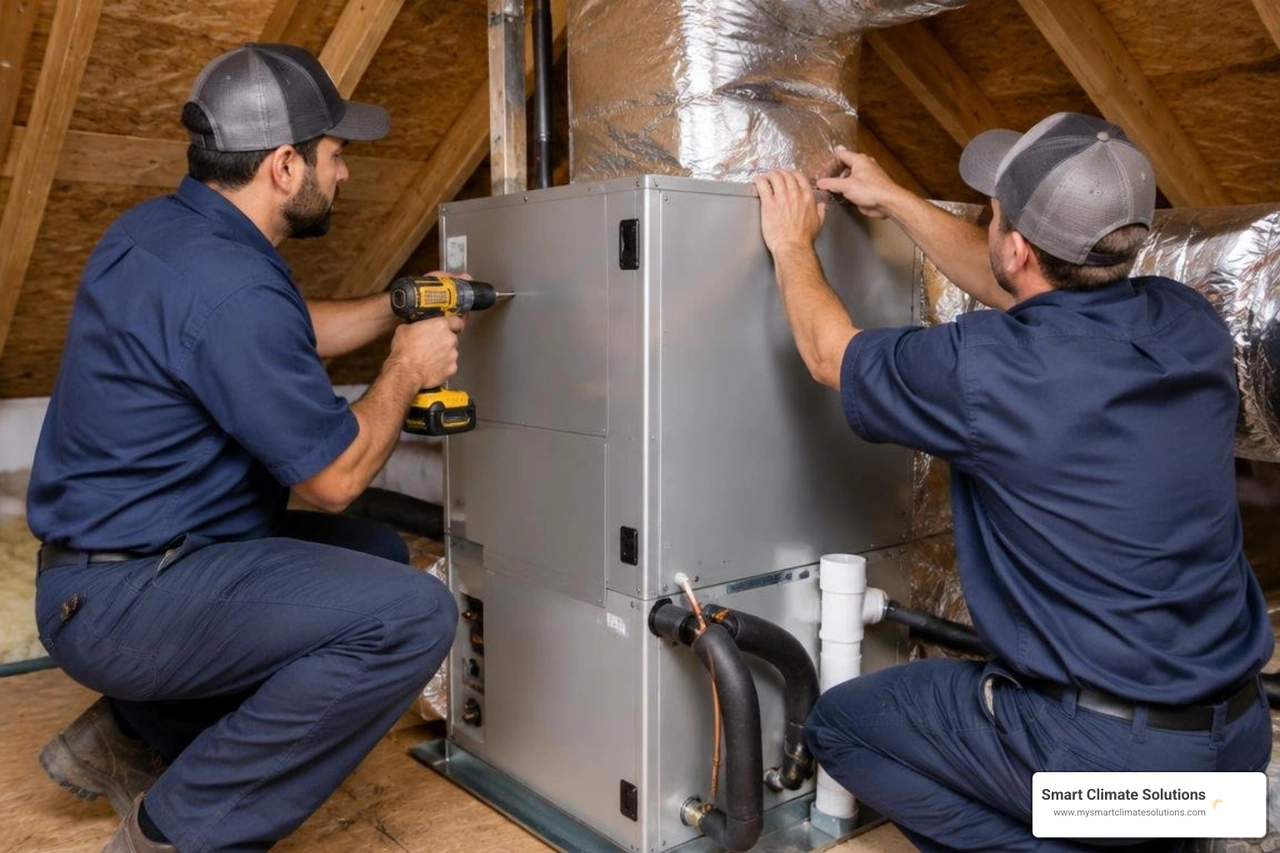
- Site Protection: Technicians lay drop cloths and protective runners across entry paths and living spaces.
- Refrigerant Recovery: Using EPA-certified recovery machines, technicians pump old refrigerant into DOT cylinders without venting it into the atmosphere.
- Old System Removal: Disconnect electrical lines, fuel piping, and exhaust flues, then haul the old equipment away for metal recycling.
- Equipment Placement: Position the new furnace, air handler, or outdoor condenser on vibration-isolating composite pads.
- Duct and Plenum Transitions: Custom-fabricate sheet metal supply and return plenums to fit the new air handler dimensions smoothly.
- Piping and Drainage: Connect gas lines with sediment traps, install safety shut-off switches, and route clear PVC condensate drain lines.
Critical Stages in Modern HVAC Installation
Connecting the refrigerant line set requires precise technical execution:
- Nitrogen-Purged Brazing: Technicians flow dry nitrogen through copper lines while brazing to prevent internal copper oxide scale from forming and clogging expansion valves.
- Deep Vacuum Dehydration: A two-stage vacuum pump pulls the entire line set below 500 microns to remove air, nitrogen, and non-condensable moisture.
- Wiring and Controls: Connect line-voltage power disconnects, run low-voltage thermostat wiring, and wire safety overflow float switches.
- Commissioning: Measure superheat, subcooling, temperature rise, and blower fan amperage to ensure operation matches factory performance curves.
Professional HVAC installation services cover every step of this commissioning process to guarantee peak efficiency.
Permitting, Code Inspections, and Refrigerant Regulations
All professional HVAC projects must comply with local building codes, clear municipal inspections, and follow environmental laws.
New systems use low-Global Warming Potential (GWP) refrigerants like R-454B to replace legacy refrigerants. Classified as mildly flammable A2L refrigerants, these systems include factory-installed leak detection sensors and mitigation circuit boards that automatically engage indoor blowers to disperse refrigerant safely in the rare event of a leak.
Working with an experienced contractor ensures your equipment is registered for full 10-year parts and compressor manufacturer warranties. Flexible financing options also help break upfront project costs into manageable monthly payments.
Frequently Asked Questions About HVAC Systems
What is the 5,000 dollar rule for replacing HVAC equipment?
The $5,000 rule helps you decide whether to repair or replace an aging HVAC system. Multiply the age of your equipment in years by the repair estimate in dollars. If the total exceeds $5,000, replacing the system is usually more cost-effective. If the result is under $5,000, repairing the unit is typically the better choice.
Does standard HVAC installation include full duct replacement?
A standard installation quote covers the heating and cooling equipment, electrical hookups, refrigerant lines, and custom sheet metal plenum transitions. Full duct replacement is priced separately, as duct material needs and layout adjustments vary significantly between homes.
What is the best time of year to schedule heating and cooling installation?
The best times to schedule installation are the spring and fall shoulder seasons. HVAC contractors generally have more flexible schedules between peak summer cooling and winter heating demands, which makes it easier to plan a replacement before an emergency breakdown occurs.
Conclusion
Upgrading your home's heating and cooling system is a major investment in comfort, safety, and energy efficiency. Looking beyond the base price quote and prioritizing proper load calculations, duct sealing, and thorough startup testing ensures your system delivers reliable comfort for years to come.
Smart Climate Solutions serves communities across Western Pennsylvania, Eastern Ohio, and the Northern Panhandle of West Virginia, including Pittsburgh, Washington, Canonsburg, Burgettstown, Steubenville, and Wheeling. Our certified technicians have more than 20 years of experience delivering fast, reliable service backed by 24/7 emergency support.
Ready to upgrade your home comfort? Contact Smart Climate Solutions today to schedule an expert HVAC installation consultation.