

Why RTU Preventative Maintenance Plans Protect Your Budget and Comfort
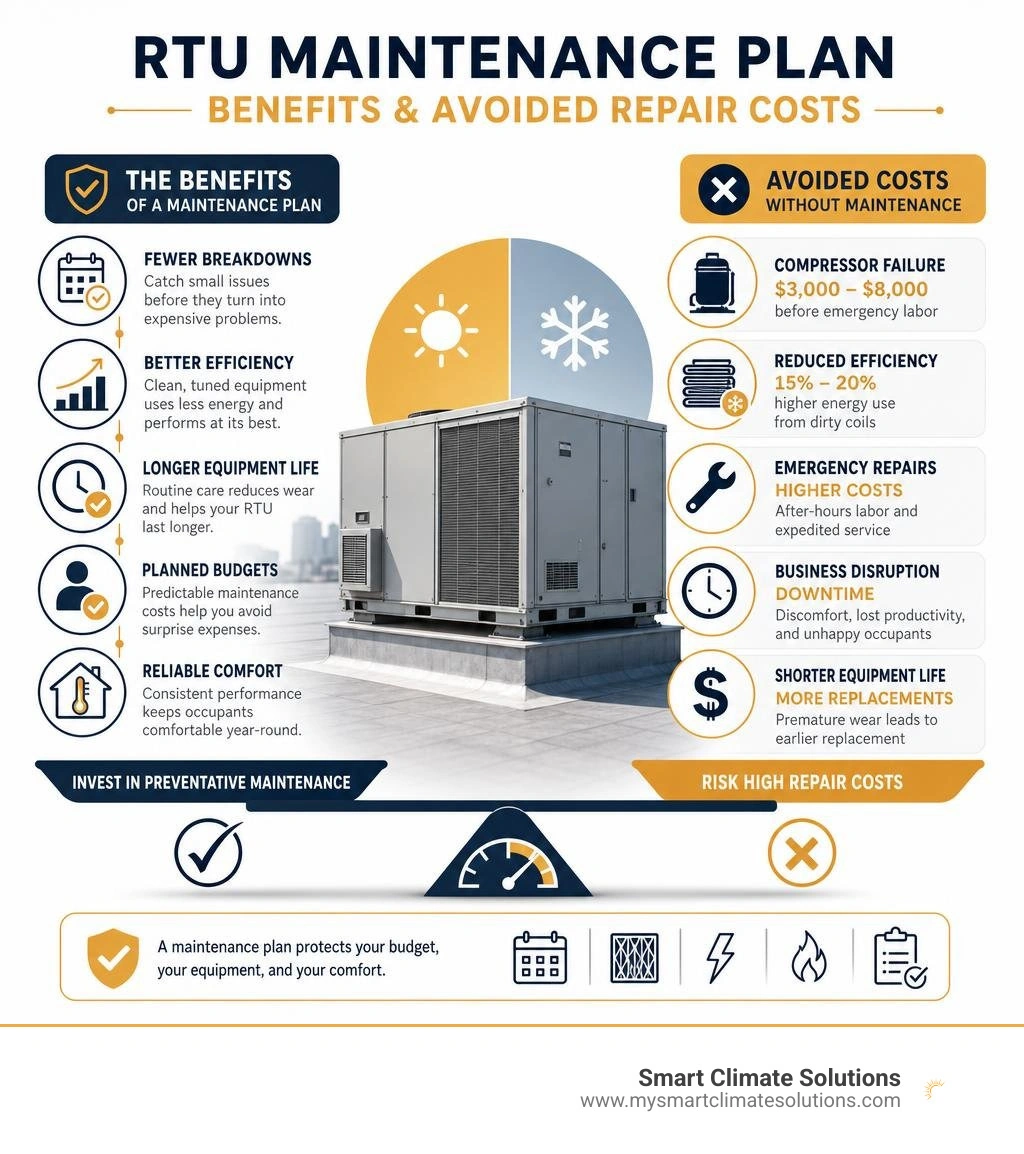
RTU preventative maintenance plans are service agreements that schedule routine inspections, cleaning, testing, and repairs for commercial rooftop HVAC units before small problems become expensive breakdowns.
| What to look for in a plan | Why it matters |
|---|---|
| Quarterly professional service | Helps catch issues before peak heating and cooling seasons |
| Filter, coil, belt, and drain care | Protects airflow, efficiency, and indoor comfort |
| Electrical, refrigerant, and controls testing | Finds warning signs that can lead to compressor failure |
| Gas heat safety checks | Helps identify heat exchanger and carbon monoxide risks |
| Written reports and clear response terms | Makes costs, repairs, and equipment history easier to manage |
Rooftop units work hard in Pittsburgh weather. They sit outdoors through rain, snow, heat, pollen, and debris, often without much attention until a tenant, customer, or employee notices the building is too hot or too cold.
That delay can be costly. A fouled condenser coil can reduce cooling efficiency by 15% to 20%, while a compressor replacement may cost $3,000 to $8,000 before emergency labor and business disruption. A structured maintenance plan helps building owners budget for care, reduce surprise calls, and support a longer equipment life.
I am Bill Scott, general manager of Smart Climate Solutions, with more than 20 years in HVAC service across Pittsburgh and Southwestern PA. I have helped customers choose practical RTU preventative maintenance plans that prioritize reliable comfort, timely repairs, and smart long-term equipment decisions.
Basic RTU preventative maintenance plans vocab:
- commercial climate control contracts
- commercial climate control Pittsburgh
- commercial climate system installation
What Are RTU Preventative Maintenance Plans and Why Do You Need One?
A commercial rooftop unit (RTU) is a self-contained heating and cooling package installed directly on a building roof. These systems condition air for retail stores, warehouses, offices, and industrial sites across Pittsburgh, the South Hills, and neighboring communities. Because RTUs house all major cooling and heating components in a single cabinet on the roof, they deliver efficient climate control without taking up indoor square footage.
However, being on the roof means they operate out of sight. Many facility managers end up adopting an out of sight, out of mind approach to HVAC care. Without structured RTU preventative maintenance plans, small mechanical faults slowly build up over time.
Regular maintenance ensures every part of the rooftop cabinet operates correctly. Whether your facility relies on standard units or high-performance systems like American Standard Packaged Rooftop Units, routine inspections keep components operating within manufacturer guidelines. This active care directly influences energy bills, indoor air quality, and tenant retention.
Understanding Commercial Rooftop Unit Vulnerabilities
Rooftop units endure extreme physical demands. Unlike indoor air handlers or basements systems, RTUs are exposed 24 hours a day to severe weather elements, including freezing winter snow, heavy spring rains, summer heat waves, UV radiation, and airborne dust. In a 200,000 square foot commercial facility operating 15 to 40 RTUs, these units can account for 40% to 60% of total building energy consumption.
When maintenance is deferred, a predictable chain of failure occurs:
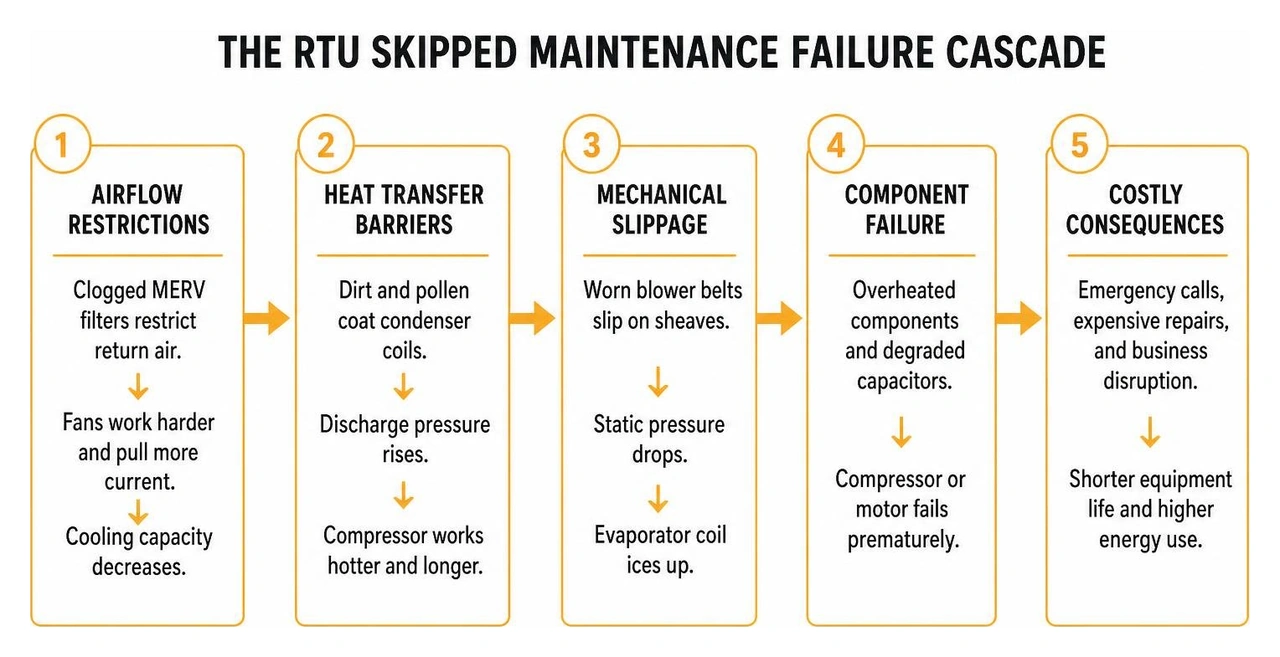
- Airflow Restrictions: Clogged MERV filters restrict return air, forcing fan motors to pull extra current while reducing cooling capacity.
- Heat Transfer Barriers: Dirt and pollen coat condenser coils, increasing discharge pressure and forcing the compressor to work hotter and longer.
- Mechanical Slippage: Worn blower belts slip on sheaves, dropping static pressure and leading to evaporator coil icing.
- Component Failure: Overheated compressors and degraded capacitors suffer premature electrical or mechanical failure.
Research shows that up to 80% of compressor failures show clear warning signs prior to catastrophic breakdown. Catching these early signals through routine checks is the most effective way to protect rooftop equipment.
Key Benefits of RTU Preventative Maintenance Plans
Investing in structured RTU preventative maintenance plans offers substantial financial and operational benefits:
- Lower Utility Bills: Maintaining clean coils and correct refrigerant charge yields up to 25% in direct energy savings each season.
- Extended Equipment Lifespan: Well-maintained RTUs deliver 15 to 20 years of reliable service life, compared to just 8 to 10 years under reactive maintenance.
- Enhanced Tenant Comfort and Air Quality: Consistent airflow and properly managed humidity prevent indoor comfort complaints and protect indoor air quality.
- Warranty Compliance: Manufacturers routinely request complete service logs before honoring parts warranties for major components.
Core Components and Seasonal Tasks in RTU Maintenance
Comprehensive care follows established industry standards, such as ASHRAE Standard 180, which outlines mandatory inspection standards for commercial HVAC systems. A complete service strategy combines quarterly checkups with deep seasonal tune-ups tailored to shifting local weather.
For detailed industry standards and equipment technical guidelines, building managers can reference the Rooftop Unit (RTU) Maintenance Guide or review our comprehensive outline on Commercial HVAC PM.
Seasonal Checklists for RTU Preventative Maintenance Plans
Seasonal weather changes require targeted maintenance tasks:
Spring Pre-Cooling Checklist (March - April)
- Chemically clean outdoor condenser coils from the inside out using low-pressure wash tools to restore heat rejection.
- Check operating refrigerant pressures, measuring superheat and subcooling against manufacturer specifications.
- Test compressor capacitors; replace any reading more than 10% below rated microfarads.
- Verify economizer damper movement from 0% to 100%, checking sensors and minimum outdoor air settings.
- Replace air filters and clean condensate drain pans, placing biocide tablets to clear algae buildup.
Summer Peak-Load Check (June - July)
- Inspect filter static pressure drop across MERV filters.
- Monitor compressor operating amp draw against nameplate full-load amps (FLA).
- Check condenser coils for mid-season cottonwood or debris accumulation.
- Verify condensate lines drain freely without risk of pan overflow.
Fall Pre-Heating Checklist (September - October)
- Inspect gas heat exchangers for cracks, rust, or stress signs using visual and smoke pencil testing.
- Clean and adjust main gas burners, ignition assemblies, and flame sensors (verifying microamp signals exceed 1.0 uA).
- Perform combustion analysis to confirm flue carbon monoxide levels remain safely below 100 ppm.
- Check fan drive belt tension (aiming for 1 inch deflection per foot of span) and replace belts on older units.
- Inspect electrical disconnects, contactors, and wiring terminal tightness.
Winter Heating Check (December - January)
- Verify supply air heating temperature rise matches equipment nameplate ratings.
- Test safety limit switches, roll-out switches, and draft inducer fan operation.
- Verify freeze protection controls and economizer low-limit shutoffs to protect coils from freezing outdoor air.
Safety Controls and Regulatory Compliance Requirements
Gas-fired RTUs combine electrical power, flammable natural gas, and high-pressure refrigerants in a single outdoor assembly. Safety inspections during fall maintenance are essential. A cracked heat exchanger can allow toxic carbon monoxide directly into the building supply airstream. Technicians must conduct flame deflection and combustion analysis tests to confirm heating safety.
Additionally, environmental compliance requires strict adherence to EPA Section 608 guidelines. Any service involving refrigerant checks or recovery must be performed by certified technicians. Systems containing 50 pounds or more of refrigerant require formal leak-rate logs, with mandated repairs if leak rates exceed regulatory limits.
Evaluating Costs: PM Plans Versus Reactive Repairs
When evaluating RTU preventative maintenance plans, facility managers must weigh predictable agreement fees against the true cost of reactive service calls.
| Service Option | Typical Annual Cost Per RTU | What Is Included / Major Benefits | Potential Failure Risks & Costs |
|---|---|---|---|
| Comprehensive PM Plan | $500 - $1,500 | 4 visits/yr, coil washes, filter service, safety testing, priority service | Minimal breakdown risk; predictable budgeting |
| Reactive Care (No Plan) | $0 upfront ($2,500+ avg emergency spend) | No planned costs until unit fails or tenant complains | $3,000 - $8,000 compressor replacements; $2,800 water leaks |
While a typical commercial RTU maintenance agreement ranges from $500 to $2,500 per unit annually depending on tonnage and site access, a single emergency repair call can easily exceed those annual costs. For more information on contract pricing models, explore our guide on choosing a Commercial HVAC Maintenance Plan.
Financial Impact of Deferred Maintenance
Skipping maintenance creates severe financial strain. Research shows that 68% of compressor failures happen in the first 30 days of the cooling season due to uncorrected winter stresses like capacitor degradation or slow refrigerant leaks.
Consider these common financial tradeoffs:
- A $50 belt inspection and annual replacement prevents a $3,000 to $8,000 compressor burnout caused by reduced airflow and frozen evaporator coils.
- A $200 chemical condenser coil wash prevents up to $4,500 in wasted annual electricity costs driven by high head pressures.
- A $40 condensate drain pan flush prevents thousands of dollars in interior ceiling drywall and asset damage from pan overflows.
When an neglected unit experiences repeated major component failures, repair costs often outweigh remaining equipment value. In those cases, building owners can review options for RTU Replacement South Hills to upgrade to reliable, modern equipment.
Modern Technologies Enhancing Service Efficiency
Modern maintenance practices combine hands-on technician skill with advanced digital tools. Computerized Maintenance Management Systems (CMMS) track service histories, schedule seasonal visits automatically, and log refrigerant usage across multi-building portfolios.
Key technologies transforming rooftop service include:
- Smart Wireless Diagnostics: Pressure transducers and temperature clamps allow technicians to measure superheat, subcooling, and air delta-T instantly.
- UV-C Germicidal Lights: Installed inside the air handler section, UV lights prevent biological growth on evaporator coils between regular maintenance visits.
- Automated Fault Detection and Diagnostics (FDD): Sensor retrofits monitor fan current, discharge temperature, and damper positions, sending real-time alerts before a breakdown occurs.
How to Select a Qualified Commercial HVAC Service Partner
Selecting the right commercial HVAC provider ensures your preventive plan delivers maximum return on investment. Look for experienced local contractors who employ certified technicians and offer clear service terms. To better understand vendor requirements, review our detailed HVAC Preventative Maintenance Program Guide.
Evaluating Service Level Agreements and Contract Scope
When reviewing service contracts for your rooftop units, ensure the agreement defines:
- Specific Task Schedules: Detailed quarterly and annual task lists rather than vague inspection language.
- Guaranteed Response Times: Fast response windows (e.g., 2 to 4 hours) for emergency service calls.
- Certified Workforce: Technicians holding EPA Section 608 certifications and commercial experience.
- Transparent Reporting: Digital service reports containing voltage, amp draw, pressure, and combustion readings after every visit.
Frequently Asked Questions About RTU Maintenance
How often should commercial rooftop units be serviced?
Commercial RTUs should be serviced at least four times per year (quarterly). In Western Pennsylvania and the tri-state area, quarterly visits align with seasonal shifts: spring startup, summer peak check, fall heating prep, and winter operational checks.
What is the average cost of an RTU maintenance agreement?
Annual maintenance agreements typically cost between $500 and $3,000 per unit per year. Pricing depends on unit tonnage, roof access, total unit count, and selected service frequency. Multi-unit contracts often receive discounted per-unit pricing.
How does proper maintenance improve energy efficiency?
Clean condenser and evaporator coils transfer heat far more effectively, reducing compressor run hours. Proper belt tensioning maintains correct CFM airflow, while accurate refrigerant charge prevents compressor strain, lowering building utility bills by up to 25%.
Conclusion
Commercial rooftop units are major investments that protect occupant comfort, inventory, and building operations. Establishing structured RTU preventative maintenance plans transforms unpredictable repair emergencies into controllable, planned operating expenses.
At Smart Climate Solutions, we bring over 20 years of hands-on commercial experience to building owners across Pittsburgh, South Hills, Burgettstown, Washington, Steubenville, St. Clairsville, and Weirton. Our certified technicians deliver fast, reliable service, 24/7 emergency support, and custom maintenance programs tailored to your facility needs.
Ready to protect your equipment and lower operating costs? Explore our full range of Professional HVAC Services or contact our team today to request a custom maintenance plan estimate.

.png)
