
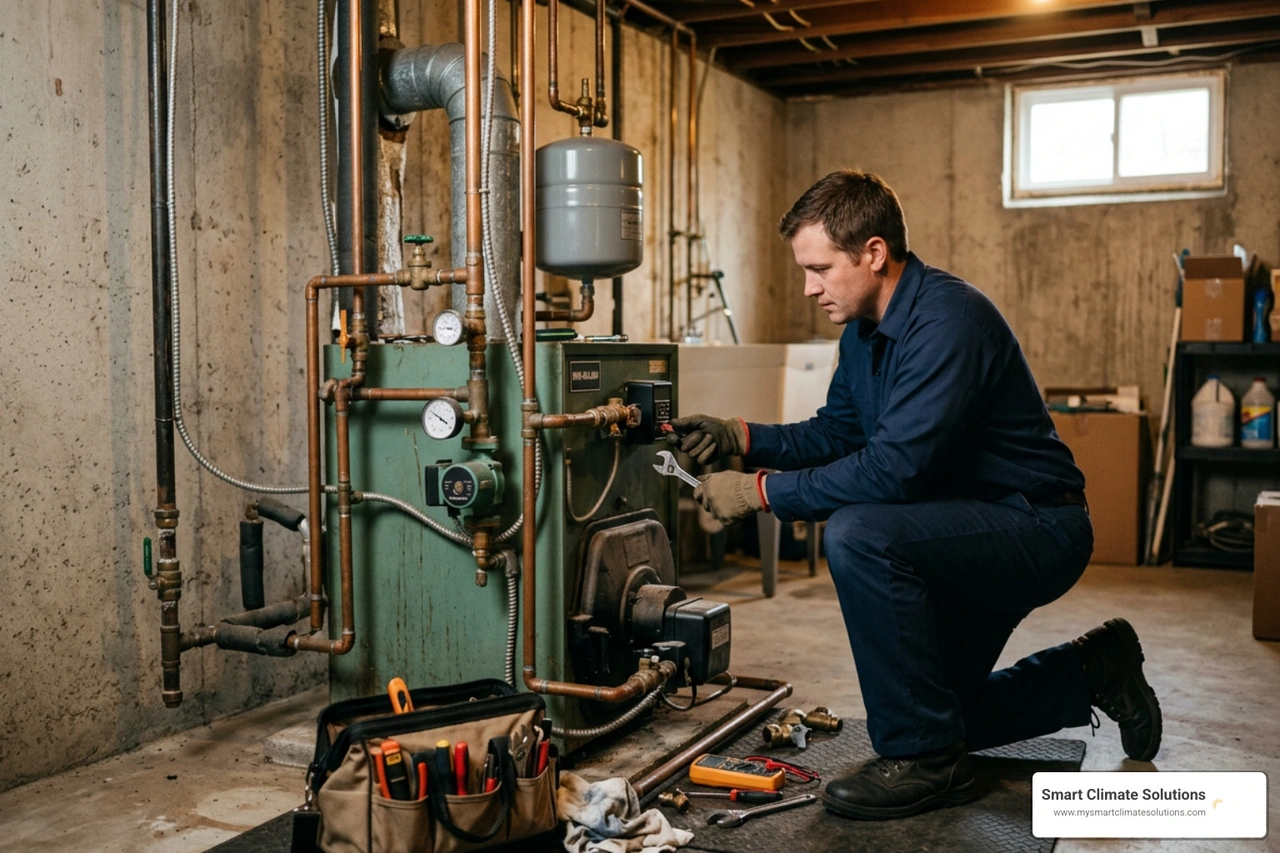
Fast, Safe Boiler Repair Service Starts With the Right Diagnosis
If your boiler has no heat, leaks, loses pressure, makes banging noises, or will not ignite, turn it off if you smell gas or see a yellow or orange flame, then call a licensed professional. A proper Boiler repair service should identify the failed part, check for combustion and carbon monoxide risks, verify safe pressure, and explain whether repair is the smart choice before any work begins.
For Pittsburgh homeowners, quick action can prevent a cold house, water damage, and a small fault turning into a larger repair. Annual tune-ups also help catch common issues early, including worn circulator pumps, dirty burners, trapped air, ignition problems, and scale buildup in the heat exchanger.
I am Bill Scott, general manager of Smart Climate Solutions, with more than 20 years in HVAC serving homeowners across Pittsburgh and Southwestern Pennsylvania. Our Boiler repair service approach is simple: diagnose the problem clearly, repair it when it makes financial sense, and help you protect reliable heat for the long term.
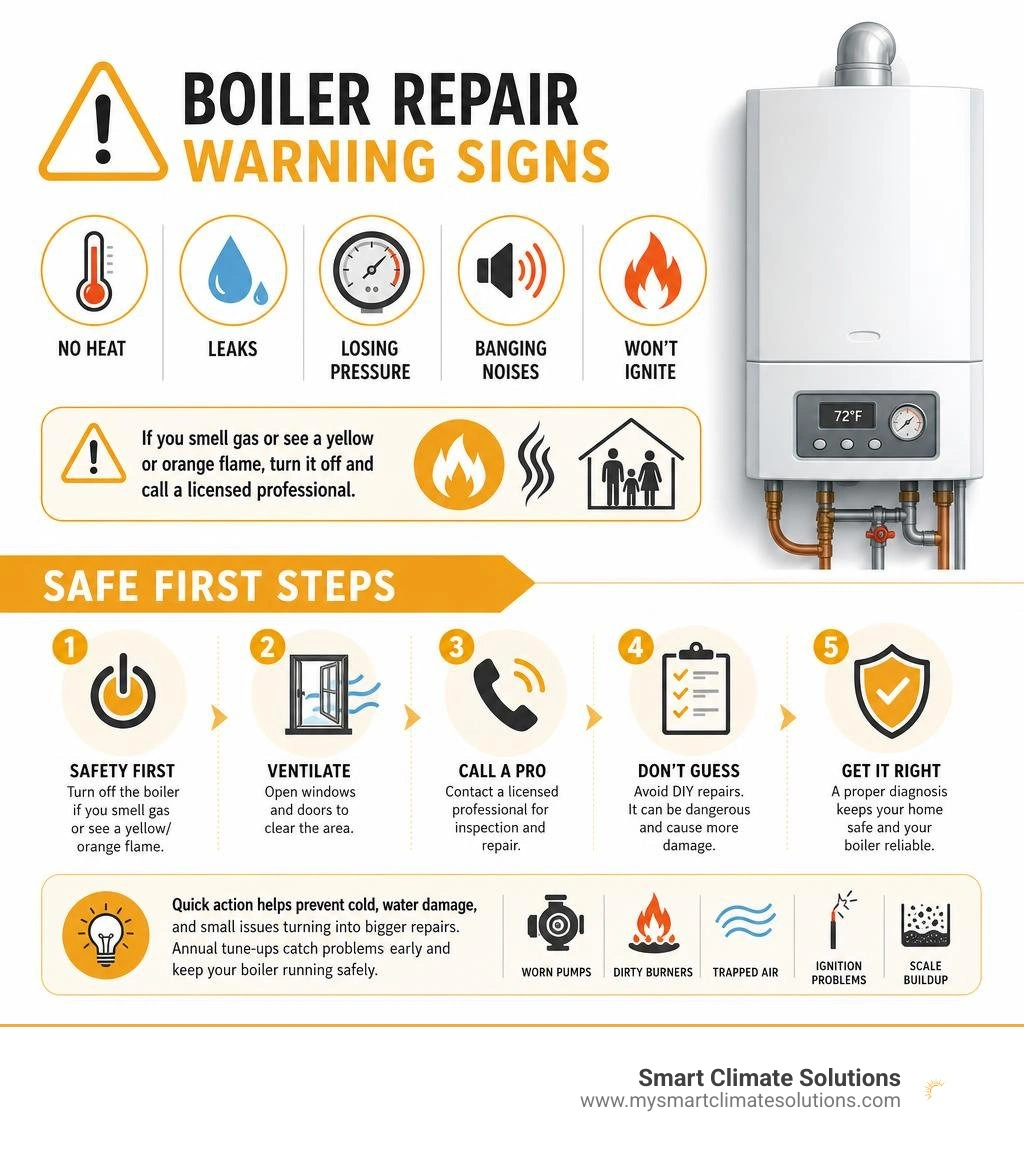
Quick Boiler repair service definitions:
Understanding When You Need Boiler Repair Service vs Replacement
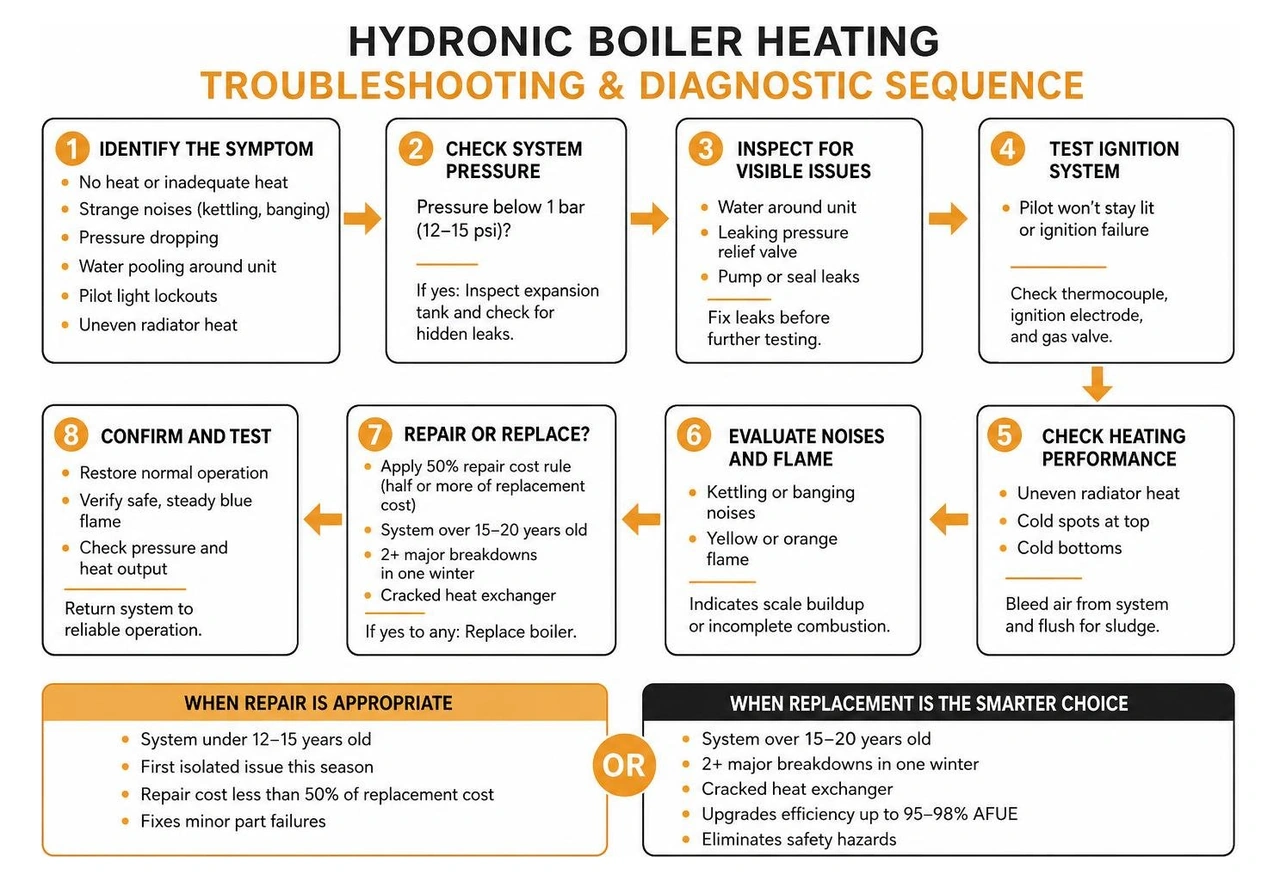
Deciding whether to patch up an existing heating unit or invest in a brand-new system comes down to age, reliability, and cost. When a heating system stumbles during a freezing Western Pennsylvania winter, we look closely at the math and safety implications. A helpful rule of thumb is the 50 percent repair cost rule: if a repair costs half or more of what a new system would cost to install, replacement is almost always the smarter long-term investment.
| Factor | Boiler Repair Service | Complete Boiler Replacement |
|---|---|---|
| Typical Cost Range | $150 to $900 | $3,500 to $10,500+ installed |
| System Age Threshold | Under 12 to 15 years old | Over 15 to 20 years old |
| Breakdown Frequency | First isolated issue this season | 2+ major breakdowns in one winter |
| Energy Efficiency | Restores original efficiency | Upgrades AFUE up to 95-98% |
| Safety Hazards | Fixes minor part failures | Eliminates cracked heat exchangers |
A cracked cast iron heat exchanger is a non-negotiable situation. Once the internal iron castings crack, the risk of water leaks and toxic flue gas seepage increases dramatically, making full replacement the only safe option.
Burner flame health is another critical safety benchmark. A healthy boiler produces a steady, crisp blue flame. A yellow or orange flickering burner flame points to incomplete combustion, which creates immediate carbon monoxide risks. When facing persistent breakdowns or aging equipment, consult our boiler replacement cost guide 2026 to weigh upfront equipment pricing against modern operating efficiencies.
Warning Signs Requiring Immediate Boiler Repair Service
Catching boiler issues early prevents inconvenient mid-winter shutdowns. Homeowners should look out for distinct indicators that point to internal mechanical strain:
- Kettling and Banging Noises: Loud rumbling sounds inside the boiler usually mean mineral scale buildup on the heat exchanger. Water gets trapped under the scale, turns to steam rapidly, and creates popping or whistling sounds.
- System Pressure Drops: If your pressure gauge drops below 1 bar (around 12 to 15 psi), the boiler will lock out. This often points to an issue with the expansion tank or a hidden pipe leak.
- Water Pooling Around the Unit: Water around the base can stem from a failing pressure relief valve, compromised internal seals, or circulator pump leaks.
- Pilot Light Lockouts: Frequent ignition failures happen when thermocouples degrade, ignition electrodes wear out, or gas valves fail to open properly.
- Uneven Radiator Heat: Cold spots at the top of radiators indicate trapped air, while cold bottoms point to built-up magnetic sludge. If your baseboard units or cast iron radiators fail to warm your living space evenly, explore our HVAC radiator repair guide for specific zone diagnostics.
Boiler Lifespan and Efficiency Across Heating Systems
Every heating design comes with its own operational characteristics and service lifespan. Understanding your setup helps you plan for long-term home comfort:
- Standard Gas Boilers: Traditional gas systems generally run for 15 to 25 years when maintained each autumn. They offer dependable heating with simple mechanical parts.
- High-Efficiency Condensing Boilers: These advanced units achieve up to 95% to 98% AFUE by capturing heat from exhaust gases that standard units vent outside. They typically operate for 12 to 15 years, though high-grade models can reach 20 or more years with proper water treatment.
- Combi (Combination) Boilers: Combi units handle space heating and on-demand domestic hot water without an external water heater tank. They last roughly 10 to 15 years, requiring regular descaling in areas with hard water.
- Cast Iron Boiler Systems: Built for exceptional durability, heavy cast iron models frequently last 20 to 30 years with routine cleanings.
To determine which configuration fits your home, check our detailed overview on choosing a boiler heater for house.
Step-by-Step Professional Boiler Installation Process
A successful heating system installation requires careful engineering, precise sizing, and meticulous adherence to regional building codes. We never guess equipment sizing based on the old unit. Instead, we perform thorough heating load calculations to account for your home's square footage, ceiling heights, window insulation, and regional climate needs across Pittsburgh, the South Hills, and nearby communities.
Oversized boilers cause rapid short-cycling that wears out components prematurely, while undersized boilers run continuously without adequately heating the home.
Once sized, proper flue venting is installed. High-efficiency condensing units require Category III or IV venting, often using sealed stainless steel or specialized polypropylene pipes to safely handle acidic condensate and exhaust gases. Gas supply lines are pressure-tested and secured to guarantee uninterrupted fuel delivery.
Preparing Your Home for New Boiler Setup
Before setting up new equipment, technicians prepare the utility space:
- Clearance Verification: Ensure code-compliant clearances around the unit for ventilation and future service access.
- Decommissioning Old Units: Safely drain, disconnect, and haul away the old heating equipment.
- Hydronic System Flushing: Power-flush existing heating loops to clear out rust, sediment, and sludge so contaminants do not damage the new boiler.
- Utility Verification: Confirm that gas line capacity, electrical wiring, and plumbing connections meet current local building codes and safety standards.
Calibrating and Testing New Heating Equipment
After mechanical connections are secure, we test and balance the entire hydronic loop. This includes setting the static water pressure, charging the expansion tank to match domestic line pressures, and checking safety controls.
Technicians also test the safety relief valve to guarantee automatic pressure discharge if line pressure exceeds safe operating limits. Read our walkthrough on boiler safety valve testing to see how critical this component is for home safety. Finally, we connect smart thermostats and multi-zone controllers so you can manage room-by-room temperatures efficiently.
Essential Checklist for an Annual Boiler Tune-Up
Routine preventive maintenance keeps your heating system running safely and efficiently while protecting manufacturer warranty coverage. When our technicians arrive for an annual inspection, we work through a comprehensive service checklist:
- Descale and clean the primary and secondary heat exchangers.
- Clean burner assemblies and inspect ignition spark electrodes.
- Conduct an electronic flue gas analysis to measure combustion ratios.
- Inspect expansion tanks and check internal air bladders.
- Test and exercise the pressure relief valve and low-water cutoff switch.
- Inspect supply and return piping for minor weeping or corrosion.
To learn more about keeping your residential heating systems in peak condition throughout the winter season, browse our full range of HVAC service and repair options.
Mechanical and Electrical System Checks
A full diagnostic tune-up examines both mechanical hardware and electrical controls. Technicians inspect circulator pump seals and bearings to ensure silent water flow without leaks. We check the aquastat calibration to ensure water temperature settings match heating demands accurately.
Wiring terminals are inspected and tightened to prevent loose connections or intermittent power drops. Finally, we test the low-water cutoff to verify that the burner shuts down immediately if water levels drop, protecting the heat exchanger from severe dry-fire damage.
Fuel Efficiency Optimization and Safety Testing
During combustion tuning, we analyze the fuel-to-air mixture using digital combustion analyzers. Adjusting the burner to optimal levels can yield 1% to 3% in fuel savings over a single winter. For broader efficiency guidance, ENERGY STAR explains what to look for in efficient residential boilers.
Technicians also test flame rectification sensors, calibrate draft hoods, and run carbon monoxide checks around the unit and living spaces. If your heating system struggles to maintain consistent heat before winter arrives, our heating repair guide provides helpful troubleshooting tips for common heating issues.
Selecting Professional Heating Contractors and Service Plans
Hydronic heating systems require specialized training and specialized tools. When choosing a heating contractor, ensure the technicians are licensed, insured, and certified by industry bodies like NATE (North American Technician Excellence).
We provide transparent, upfront written estimates before any work begins, along with 24/7 emergency support when severe weather strikes.
What to Expect from a Licensed Boiler Repair Service
When you call for a repair, a professional technician will:
- Conduct a complete diagnostic evaluation before taking components apart.
- Use genuine OEM replacement parts, including premium pumps from manufacturers like Taco and Grundfos.
- Maintain fully stocked service vehicles to finish most common repairs in a single visit.
- Perform code-compliant repairs that restore your equipment's original efficiency ratings.
Benefits of Annual Maintenance Agreements and Warranties
Preventive maintenance agreements take the stress out of home heating. Enrolling in an annual plan ensures pre-scheduled fall tune-ups, priority scheduling during winter emergencies, and discounts on parts and labor.
Most major manufacturers require documentation of regular annual maintenance to keep their 10 to 15 year heat exchanger warranties and parts warranties active. Proactive care prevents minor component wear from turning into unexpected, costly breakdowns.
Frequently Asked Questions About Home Boiler Systems
How often should a residential boiler be serviced?
A residential boiler should be serviced once a year, ideally in early autumn before the winter heating season begins. Annual maintenance ensures burner cleanliness, verifies proper operating pressures, confirms ventilation safety, and satisfies manufacturer warranty terms.
Is it safe to perform DIY boiler repairs?
No. Boilers combine high-voltage electrical circuits, pressurized near-boiling water, and combustible natural gas or propane. Attempting DIY repairs on gas valves, burners, or pressure controls creates serious hazards, including carbon monoxide leaks, water damage, and gas explosions. Always trust a licensed, insured HVAC technician with hydronic system repairs.
How much does professional boiler repair cost compared to replacement?
Minor repairs, such as replacing a thermocouple, zone valve head, or pressure relief valve, generally cost between $150 and $500 for parts and labor. Major component replacements, such as circulator pumps, gas valves, or electronic control boards, typically run from $400 to $900. Complete boiler replacements generally range from $3,500 to $10,500+ installed, depending on whether you choose a standard gas unit, a combi boiler, or a high-efficiency condensing system.
Conclusion
Keeping your residential boiler in top working order protects your home's comfort, improves energy efficiency, and ensures your family's safety all winter long. Whether you need an emergency repair for a noisy circulator pump or want to schedule an annual safety inspection before the cold weather sets in, proactive maintenance pays for itself over the life of your equipment.
At Smart Climate Solutions, our certified technicians bring more than 20 years of hands-on heating experience to homeowners throughout Pittsburgh, South Hills, Burgettstown, and Washington, PA, as well as Steubenville and St. Clairsville, OH, and Weirton, WV. Contact our team today to schedule your system tune-up or explore our comprehensive heating and cooling services designed to keep your home warm, safe, and efficient all winter long.

.png)
