
Average Boiler Replacement Cost in 2026 by Fuel Type
When calculating your total Boiler replacement cost, the fuel source powering your equipment plays a critical role in both equipment expenses and long-term utility expenditures. In Southwestern Pennsylvania and the surrounding tri-state area, natural gas remains the primary heating fuel, but electric, heating oil, and propane systems are also widely used across rural properties in Washington County, West Virginia, and Eastern Ohio.
| Boiler Fuel Type | Equipment Only Cost | Total Installed Cost Range | Average Installed Cost |
|---|---|---|---|
| Natural Gas | $1,500 - $4,500 | $4,000 - $9,000 | $5,800 |
| Electric | $1,000 - $4,000 | $1,800 - $8,000 | $4,500 |
| Heating Oil | $2,500 - $5,000 | $4,800 - $9,500 | $6,500 |
| Propane | $1,800 - $4,200 | $4,000 - $8,500 | $5,500 |
| High-Efficiency Condensing (95%+ AFUE) | $2,500 - $5,500 | $6,200 - $12,000 | $7,800 |
Natural gas boilers offer an excellent balance of upfront equipment price and ongoing operating expenses. Modern natural gas models typically cost between $4,000 and $9,000 fully installed. Because natural gas lines are abundant throughout Pittsburgh, South Hills, and nearby communities, replacing a gas unit like-for-like is often straightforward.
Electric boilers feature lower initial hardware costs, with entry-level units starting as low as $1,000 to $4,000 for equipment alone, and $1,800 to $8,000 for full installation. Electric units convert almost 100% of their energy into heat, making them technically precise. However, because electricity rates are higher per BTU than natural gas in our region, electric units often carry higher monthly utility bills during severe winter cold snaps.
Heating oil boilers are common in older homes and semi-rural areas like Burgettstown or Weirton that lack direct natural gas grid access. Oil equipment is heavy-duty and built to endure extreme conditions, but total installation costs range from $4,800 to $9,500 due to heavier cast-iron assemblies, oil line connections, and flue requirements.
Propane boilers function similarly to natural gas units and generally range from $4,000 to $8,500 installed. They serve as an efficient alternative for homeowners off the municipal gas main who want high heating output without relying strictly on electric resistance heating.
If you are evaluating options for a Boiler Heater for House, choosing the correct fuel source depends heavily on existing infrastructure, fuel availability, and local utility rates. Additional real-time price insights can be explored through the Boiler Replacement Cost: Price Ranges, Components, and Savings 2026 - LatestCost - Real-Time Price Insights.
Estimating Your Boiler Replacement Cost by Home Size
Square footage directly affects the necessary heating output of your replacement system. Boiler output is measured in British Thermal Units (BTUs). A boiler that is too small will struggle to keep your house warm during January freezes, while an oversized unit will short-cycle, wasting energy and causing unnecessary wear on internal components.
In our region, winter temperatures regularly dip below freezing. Homes in Pittsburgh and the surrounding valleys typically require between 45 and 60 BTUs per square foot, depending on insulation quality, draftiness, ceiling height, and window efficiency.
- 1,000 sq. ft. Home (30,000 - 60,000 BTUs): $3,700 - $6,500 total replacement cost.
- 1,500 sq. ft. Home (45,000 - 90,000 BTUs): $4,500 - $7,200 total replacement cost.
- 2,000 sq. ft. Home (60,000 - 120,000 BTUs): $5,200 - $8,500 total replacement cost.
- 2,500 sq. ft. Home (75,000 - 150,000 BTUs): $6,200 - $9,800 total replacement cost.
- 3,000+ sq. ft. Home (90,000 - 180,000+ BTUs): $7,000 - $12,000+ total replacement cost.
Rather than relying purely on square footage, our certified technicians perform a professional heat-loss calculation (Manual J calculation). This evaluation considers wall insulation, attic depth, basement layout, and window thermal ratings to ensure your new heating investment matches your exact home load. To better understand how home size and equipment capacity interact with overall budget expectations, review our guide on New Heating System Cost.
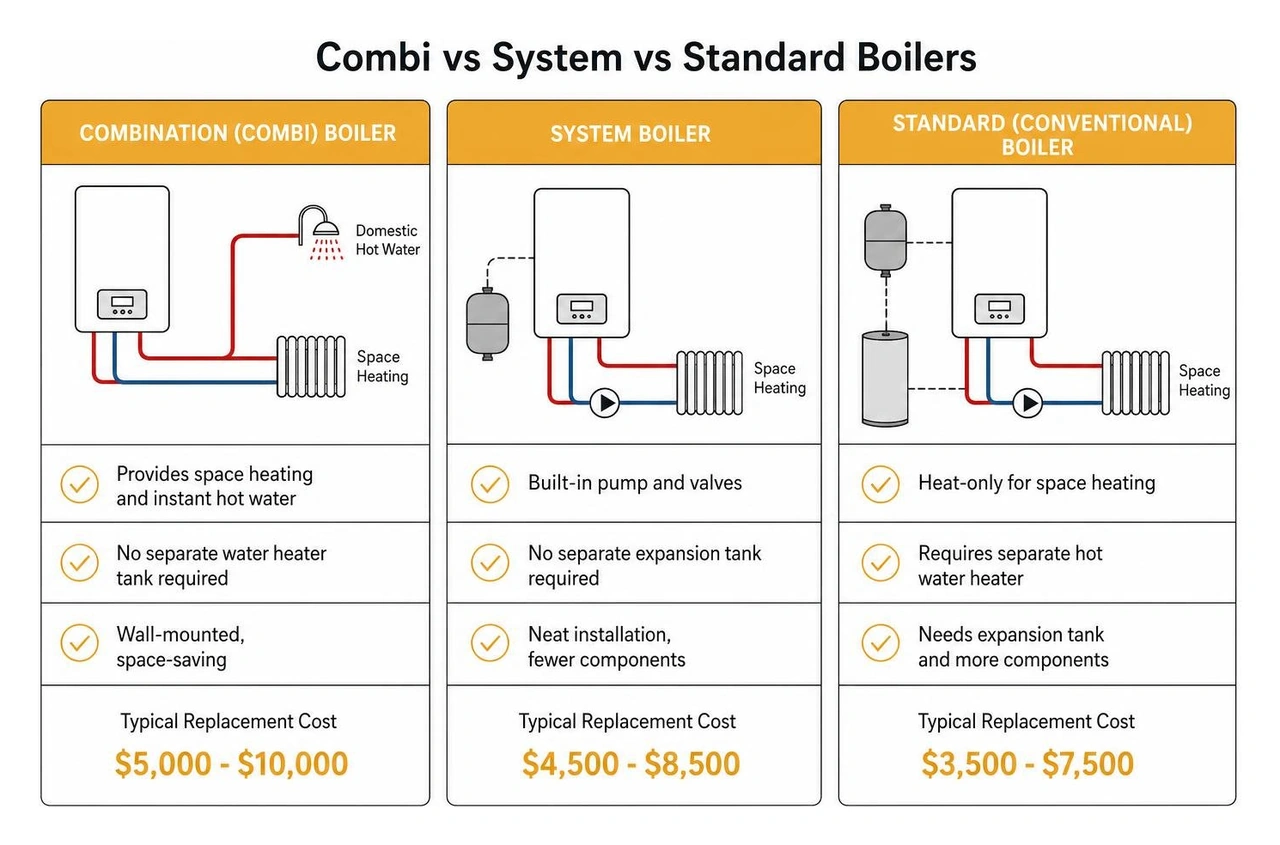
Combi vs System vs Standard Boilers
Understanding how hydronic systems deliver warmth and domestic hot water helps clarify why replacement pricing varies between equipment styles.
- Standard (Conventional or Heat-Only) Boilers: These traditional systems heat water that circulates through cast-iron radiators or baseboards. They often require a separate hot water heater and an expansion tank. Standard replacement costs typically range from $3,500 to $7,500.
- System Boilers: These systems contain built-in pumps and valves inside the main cabinet, eliminating the need for separate external tanks while keeping installation neat. System boiler replacements generally run between $4,500 and $8,500.
- Combination (Combi) Boilers: Modern combi boilers provide both space heating and instant domestic hot water directly from a single wall-mounted unit. They eliminate the need for a separate water heater tank, saving significant floor space in basements or utility closets. Combi boiler replacements usually range between $5,000 and $10,000 fully installed.
For homeowners seeking comprehensive industry standards, you can compare estimates against the national benchmarks outlined in Cost to Install a Boiler (2026 Guide) and Combi Boiler Replacement Cost 2026: Full USA Pricing Guide - Plumbing Guider.
Key Factors Influencing Total Installation Costs
When reviewing a formal proposal for a replacement project, several mechanical variables impact final labor and material costs.
- Efficiency Ratings (AFUE): Standard efficiency boilers operate around 80% to 84% Annual Fuel Utilization Efficiency (AFUE). High-efficiency condensing units achieve 90% to 95%+ AFUE by capturing heat energy from exhaust gases that would otherwise escape up the chimney. While high-efficiency equipment costs $1,000 to $2,500 more upfront, it significantly lowers monthly gas usage.
- Venting Requirements: Older atmospheric boilers vent exhaust through a masonry chimney. High-efficiency condensing boilers produce cooler, acidic exhaust that must vent outdoors through PVC, CPVC, or polypropylene piping, while requiring a condensate drain line. Adding new venting runs adds $500 to $1,500 to the job scope.
- System Conversions: Changing fuel types, such as converting an old heating oil boiler to natural gas, involves running new gas piping, capping or removing oil lines, and safely decommissioning the oil storage tank. Fuel conversions typically add $2,500 to $5,000 to standard replacement costs.
- Piping and Zone Valve Upgrades: If your home uses multiple heating zones with individual thermostats, replacing worn circulator pumps, zone valves, air separators, or manifold piping ensures smooth flow throughout every level of the house. Near-boiler repiping can add $600 to $2,000.
Upgrading to the Most Efficient Residential Heating System ensures that every dollar spent on fuel translates directly into consistent indoor comfort.
Ways to Reduce Your Boiler Replacement Cost
Replacing a residential heating system is a major financial commitment, but strategic planning helps keep expenses manageable without compromising quality or safety.
- Schedule Off-Peak Installations: Emergency replacements during mid-winter freezes carry higher stress and potential overtime charges. Replacing an aging boiler during mild spring or autumn weather allows flexible scheduling and access to off-peak pricing promotions.
- Explore Utility Rebates and Regional Incentives: Local natural gas and electric utilities frequently offer equipment rebates ranging from $500 to $2,000 for installing high-efficiency units rated 95%+ AFUE.
- Reuse Sound Infrastructure When Code Permits: If your existing distribution piping, expansion tank, or venting lines are in excellent condition and meet current building codes, keeping them intact saves substantial material and labor fees.
- Request Detailed Itemized Estimates: Work with established local HVAC contractors who provide itemized quote breakdowns covering equipment, labor, permits, disposal fees, and warranty terms so you know exactly what you are paying for.
For independent cost calculators and planning tools, consult resources like the Boiler Replacement Cost Calculator | UseCalcPro and the How Much Does Boiler Replacement Cost? (2026) | Today's Homeowner.
Additional Expenses: Labor, Permits, and Disposal
Understanding total project scope requires looking beyond hardware prices to account for essential labor, safety compliance, and demolition work.
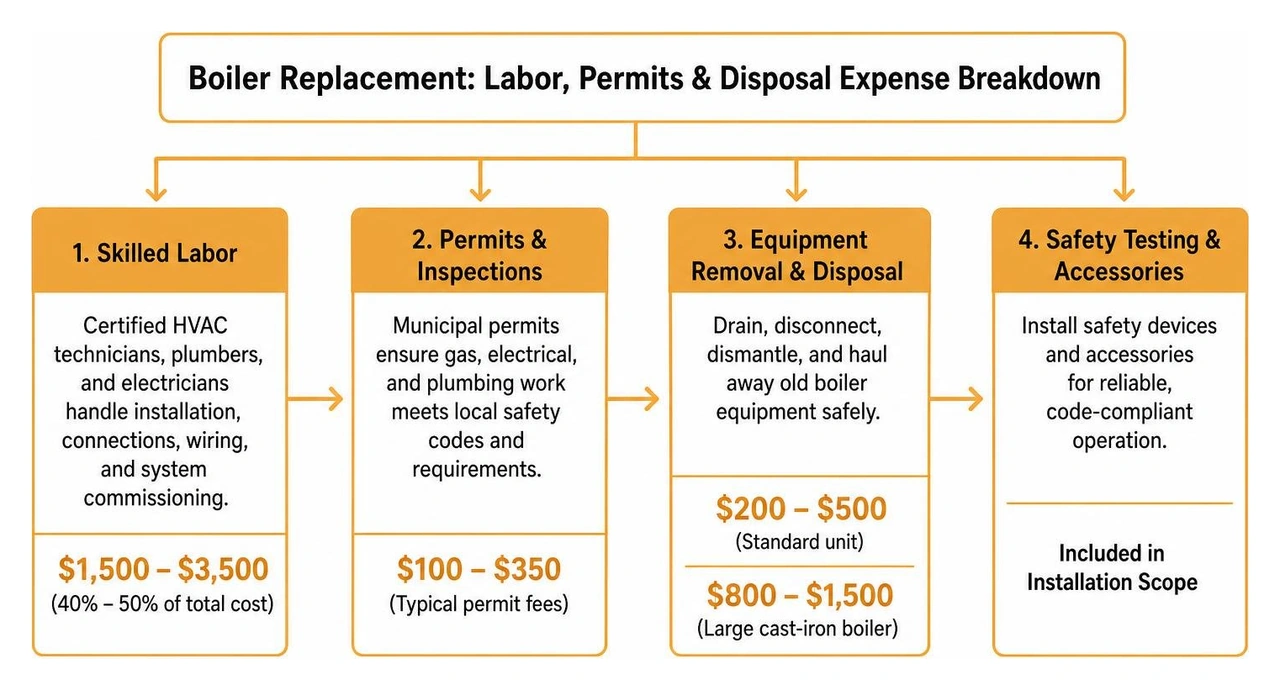
- Skilled Labor: Certified HVAC technicians, licensed plumbers, and electricians handle hydronic connections, gas lines, high-voltage wiring, and system commissioning. Labor accounts for roughly 40% to 50% of total project cost, translating to $1,500 to $3,500 on standard installations.
- Municipal Permits and Inspections: Local municipal building permits ensure that gas line modifications, electrical hookups, and plumbing connections comply with regional safety standards. Local permit fees across Southwestern PA, Ohio, and West Virginia communities typically range from $100 to $350.
- Old Equipment Demolition and Removal: Heavy cast-iron boilers require specialized equipment and labor to drain, disconnect, break down, and haul away safely. Standard unit removal costs $200 to $500, while large cast-iron steam boilers can cost $800 to $1,500 to demolish and extract.
- Safety Testing and Accessories: Installing proper safety devices, automatic water feeders, low-water cutoffs, backflow preventers, and fresh expansion tanks guarantees long-term protection. Learn more about routine safety verification through our detailed guide on Boiler Safety Valve Testing.
Repair vs Replace and Long Term ROI

Homeowners often wonder whether paying for another repair makes financial sense or if a complete replacement is the wiser investment. Following standard industry guidelines helps make a confident choice:
- The 15-Year Rule: Cast-iron boilers can last 20 to 30 years with diligent care, but modern condensing units average a 15-year lifespan. If your boiler is over 15 years old and experiencing recurring component failures, replacement is usually more economical than paying for repeated repairs.
- The 50 Percent Rule: If a single repair quote exceeds 50% of the cost of a brand-new installed unit, replacing the system is the smarter financial path.
- Rising Energy Bills: As boilers age, internal scale buildup and heat exchanger degradation reduce operating efficiency. If winter heating bills spike without a change in fuel rates, equipment efficiency has dropped significantly.
Upgrading an old 65% AFUE boiler to a modern 95% AFUE condensing unit delivers immediate utility bill reductions of 15% to 30%. For a home spending $2,800 annually on winter heating, upgrading can save $400 to $800 per year, yielding a full financial payback through energy savings in 6 to 8 years.
Additionally, replacing an outdated heating system increases property value by an estimated $8,000 to $20,000, while making homes more attractive to future prospective buyers. To contrast boiler equipment costs against forced-air alternatives, check our article on Furnace Replacement Cost.
Frequently Asked Questions About Boiler Replacement
How long does a boiler installation take?
A standard like-for-like replacement usually takes between 1 and 2 full working days (roughly 8 to 16 labor hours) for a team of experienced technicians. If your project involves converting fuel sources, relocating equipment, running new PVC venting, or rebuilding complex multi-zone distribution piping, installation can take 2 to 3 days.
How much value does a new boiler add to a home?
Installing a modern, high-efficiency boiler adds approximately $8,000 to $20,000 in home property value. Prospective buyers place strong value on reliable hydronic heating systems that promise low winter utility bills and decades of dependable comfort. Homes with freshly upgraded heating equipment also tend to sell faster during real estate transactions.
What are the signs a boiler needs replacement?
Key signs that your boiler is nearing the end of its useful lifespan include:
- A yellow or flickering burner flame instead of a crisp blue flame (indicating improper combustion and potential carbon monoxide risk).
- Strange metallic clunking, banging, or kettling noises caused by mineral buildup inside the heat exchanger.
- Frequent pressure drops or visible water leaks around internal valves and pipe joints.
- Uneven heating where specific radiators stay cold while others overheat.
- Rapidly rising monthly gas or oil bills despite normal winter temperatures.
Conclusion
Navigating a Boiler replacement cost investment does not have to feel overwhelming. By evaluating fuel options, matching unit capacity to your home's exact heating load, taking advantage of local utility rebates, and working with certified professionals, you can secure dependable warmth for decades to come.
At Smart Climate Solutions, we bring over 20 years of hands-on HVAC expertise to homeowners across Pittsburgh PA, South Hills PA, Burgettstown PA, Washington PA, Steubenville OH, St. Clairsville OH, and Weirton WV. Our certified technicians deliver fast, transparent estimates, 24/7 emergency support, and top-tier craftsmanship tailored to your home's unique hydronic heating requirements.
To get an accurate estimate or schedule your free system consultation, explore our full line of installation and maintenance offerings at Smart Climate Solutions Services today.

.png)
