
Why Pittsburgh Buildings Are Upgrading Their HVAC Systems Now
HVAC retrofit projects in Pittsburgh are one of the smartest investments a building owner can make right now -- whether you own a century-old row home in Lawrenceville or manage a large commercial property Downtown.
Quick answer: What does an HVAC retrofit project involve in Pittsburgh?
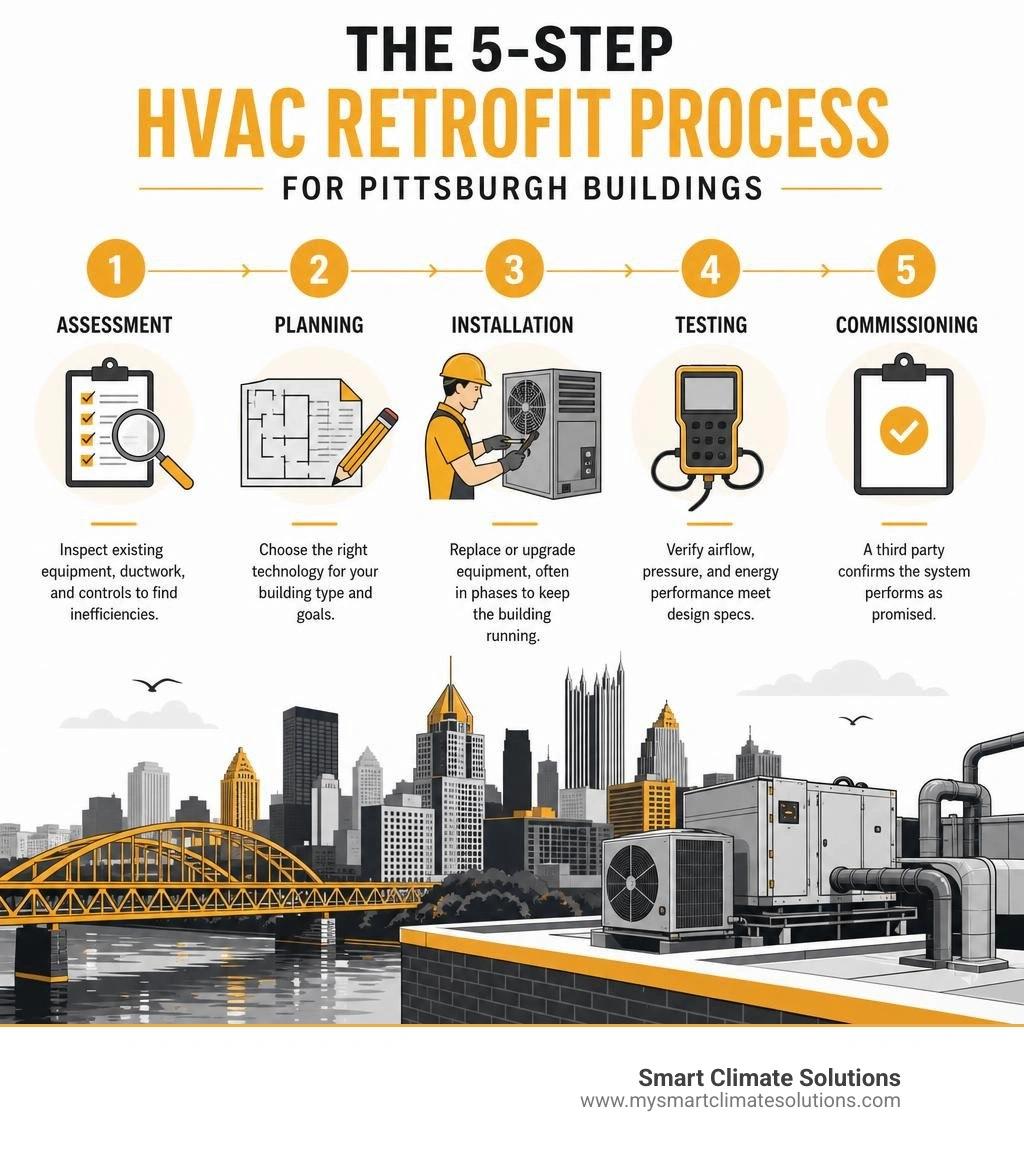
- Assessment - Inspect existing equipment, ductwork, and controls to find inefficiencies
- Planning - Choose the right technology (VFDs, heat pumps, energy recovery, smart controls) for your building type
- Installation - Replace or upgrade equipment, often in phases to keep the building running
- Testing - Verify airflow, pressure, and energy performance meet design specs
- Commissioning - A third party confirms the system performs as promised
Pittsburgh's building stock is aging. Many commercial and institutional buildings still run on equipment installed decades ago -- some dating back to the 1960s or earlier. That old equipment is expensive to run, hard to maintain, and increasingly out of step with modern energy codes and occupant expectations.
The good news? Retrofitting does not mean tearing a building apart. Real-world Pittsburgh projects -- from iconic skyscrapers to historic concert halls -- have proven that major efficiency gains are achievable with minimal disruption to daily operations.
I'm Bill Scott, General Manager of Smart Climate Solutions, and with over 20 years in the HVAC industry serving Pittsburgh and Southwestern PA, I've seen how the right HVAC retrofit project in Pittsburgh can slash energy bills, improve comfort, and extend a building's useful life. Let's walk through everything you need to know to plan your upgrade with confidence.
Hvac retrofit projects pittsburgh word roundup:
- emergency hvac service pittsburgh
- large scale mechanical contracting
- piping fabrication shop pittsburgh
Key Drivers for HVAC Retrofits in Pittsburgh Commercial Buildings
Several powerful factors are prompting commercial and institutional building owners across Southwestern Pennsylvania to upgrade their mechanical systems.
First is the regional push for decarbonization and energy efficiency. Local governments and corporate tenants are setting aggressive sustainability goals. Older, fossil-fuel-reliant heating systems are being phased out in favor of clean, electric heat pump systems. By reducing carbon footprints, property owners can future-proof their buildings against changing local environmental mandates.
Second, operating costs are rising. Older, inefficient pneumatic control systems and single-speed motors waste massive amounts of electricity and natural gas. With utility rates fluctuating, upgrading to modern equipment is a direct way to lower monthly operational overhead.
Third, tenant comfort and retention are critical. In a competitive real estate market, tenants expect precise temperature control and quiet operation. Modern decentralized zoning systems allow occupants to tailor their comfort levels on a zone-by-zone basis.
Finally, indoor air quality (IAQ) is more important than ever. Upgrading filtration, adding energy recovery ventilators, and ensuring proper ventilation rates are essential for occupant health and productivity. To find out where your building is losing energy and how to fix it, scheduling a comprehensive Home Energy Efficiency Audit or a commercial energy assessment is the best place to start. Combining this with practical Energy Saving HVAC Tips can set a solid baseline for your retrofit strategy.
Design-Build vs. Traditional Bid-Build for HVAC Retrofit Projects in Pittsburgh
Choosing how to deliver your retrofit project is just as important as choosing the equipment itself. The two primary methods are traditional design-bid-build and design-build.
In a traditional bid-build project, the owner hires an engineering firm to design the system, puts the design out for competitive bids, and then hires a mechanical contractor to install it. This approach often leads to communication gaps, finger-pointing when issues arise during installation, and costly change orders.
By contrast, the design-build delivery method provides a single point of contact for both the engineering and installation phases. The mechanical contractor acts as the sole source of responsibility, coordinating the entire project from initial concept through final commissioning.
According to a landmark study by Penn State University, design-build projects are delivered 33 percent faster and for less cost to the owner than traditional construction projects. Because the team installing the equipment is involved in the design phase, they can perform up-front field verification to catch potential space and structural constraints before any equipment is ordered.
| Feature | Design-Build Approach | Traditional Bid-Build Approach |
|---|---|---|
| Points of Contact | Single source of accountability | Multiple (Engineer and Contractor) |
| Delivery Speed | 33 percent faster on average | Standard timeline |
| Change Orders | Minimal (often guaranteed within scope) | Common due to design-to-field gaps |
| Cost Predictability | High up-front cost certainty | Variable based on bids and change orders |
| Field Verification | Completed early by the installation team | Done after design is finalized |
For complex commercial renovations, partnering with an experienced provider for Large Scale Mechanical Contracting using a design-build model ensures predictable pricing and a streamlined timeline.
High-Efficiency Technologies Transforming Pittsburgh Buildings
Modern HVAC retrofits rely on a suite of advanced technologies designed to maximize efficiency while maintaining precise comfort control.
Variable Frequency Drives (VFDs) and Affinity Laws
A VFD controls the speed of an AC motor by varying the frequency and voltage supplied to it. According to the affinity laws of fluid dynamics, fan and pump power consumption is proportional to the cube of the shaft speed. This means that reducing a motor speed by just 20 percent can cut its energy consumption by up to 50 percent. Retrofitting older single-speed fan and pump motors with VFDs yields some of the fastest payback periods in the industry.
Energy Recovery Ventilators (ERVs)
In older buildings, bringing in fresh outdoor air to meet modern IAQ standards can place a heavy load on heating and cooling plants. ERVs solve this by capturing the thermal energy (and humidity) of the outgoing exhaust air and transferring it to the incoming fresh air stream. This process tempers the outdoor air before it reaches the primary HVAC system, reducing the overall energy required to condition the space.
Smart Controls and Building Management Systems (BMS)
Integrating internet-of-things (IoT) sensors and AI-driven smart controls allows buildings to dynamically adjust heating, cooling, and ventilation based on real-time occupancy and environmental data. Integrating these technologies ensures your building operates at peak performance, which is why transitioning to High Efficiency Heating and Air Conditioning is a cornerstone of modern property management. For spaces with architectural limits, using an Energy Efficient Ductless Heating and Cooling System provides targeted zoning without the need for extensive ductwork.
Case Study: VFD and Modular Fan Upgrades at the U.S. Steel Tower
The U.S. Steel Tower, a 64-story landmark in Downtown Pittsburgh with 2.3 million square feet of leasable space, serves as a premier example of how phased retrofits deliver massive financial and environmental dividends.

Over a series of planned mechanical upgrades, the building installed more than 150 Danfoss VLT drives across its pumping and air-handling systems. The results were staggering:
- $1.1 million in documented annual energy savings.
- A reduction in annual electric consumption from 65 million kWh to 43 million kWh.
- A drop in peak electrical demand from 16-17 MW down to 10 MW.
- An overall 34 percent reduction in energy usage through the VFD retrofits alone.
In addition to VFDs, the building addressed a major operational risk when one of its original 1967 centrifugal fans serving 14 floors failed. A traditional replacement would have required cutting an access hole in the building exterior and using cranes in the middle of the city -- a process estimated to take two weeks.
Instead, the team installed a Q-PAC modular fan system. This system consists of an array of smaller, direct-drive fans that fit easily through standard 30-inch access doors. The entire modular retrofit was completed in less than 48 hours over a single weekend with zero disruption to tenants. The new modular array reduced the fan energy consumption by two-thirds compared to the original 6,000-pound centrifugal fan, proving that modern modular technology can solve difficult logisitical and efficiency challenges simultaneously.
Overcoming Historic Preservation Challenges in Western Pennsylvania
Western Pennsylvania is home to some of the nation's most beautiful historic architecture. However, retrofitting these structures with modern HVAC systems requires extreme care to preserve plaster walls, ornate woodwork, and exterior aesthetics.
When engineering retrofits for historic buildings, space constraints are the primary obstacle. These buildings were often designed before mechanical air conditioning existed, meaning there are no dedicated vertical duct shafts or ceiling plenums.
A prime example of balancing preservation with modern engineering is the renovation of the historic Pittsburgh Athletic Association - Allen + Shariff. This six-story, 138,585-square-foot building on Fifth Avenue was converted to a core-and-shell layout for office and restaurant use. The MEP engineering design utilized a highly efficient four-pipe chilled and hot water system connected to dedicated outdoor air systems (DOAS) on each floor. This design maximized usable floor space and allowed future tenants the flexibility to install their own air handlers without altering the building's historic facade.
Similarly, the iconic Carnegie Music Hall - Air-Conditioning of Historic Concert Hall - CJL Engineering project successfully integrated a 3,000-ton chilled water system into a 120-year-old facility. Previous attempts to add air conditioning had failed due to the building's original 100% outside air system design. By engineering a creative solution that reused existing fans and historic duct pathways, the project successfully brought modern climate control to the concert hall without compromising its architectural integrity or legendary acoustics.
Ductless Mini-Splits as Solutions for HVAC Retrofit Projects in Pittsburgh Row Homes
For residential properties in historic neighborhoods like Lawrenceville, South Side, or the Mexican War Streets, traditional ducted systems are often impractical. Lawrenceville row homes, typically only 15 to 20 feet wide, feature solid brick walls and plaster finishes that leave no room for ductwork.
Ductless mini-split systems have emerged as the premier solution for these historic residential properties.
These systems offer several distinct advantages:
- Minimal Intrusion: They require only a small 3-inch hole through the exterior wall to run refrigerant and electrical lines, keeping historic plaster walls completely intact.
- Extreme Efficiency: Modern ductless systems achieve SEER2 ratings of 20 to 30+, far exceeding standard window units. They also eliminate the 30% energy loss typically associated with leaky ductwork.
- Sub-Zero Heating: Utilizing advanced flash-injection compressor technology, modern heat pumps maintain full heating capacity down to 5 degrees Fahrenheit and continue operating efficiently at temperatures as low as -15 degrees Fahrenheit.
- Quiet Operation: Operating at whisper-soft levels of 19 to 30 decibels, they are ideal for dense urban neighborhoods.
If your home has existing, failing ductwork or if you are considering adding ductless zoning, understanding the Ductwork Installation Cost versus an Air Duct Replacement can help you weigh the best long-term option for your budget and comfort.
Financial Viability: Incentives, Rebates, and Tax Credits
Large-scale HVAC retrofits require an initial capital investment, but a variety of local, state, and federal incentives can dramatically lower upfront costs and shorten payback periods.
Pennsylvania Act 129
Enacted to reduce electricity consumption across the Commonwealth, Act 129 requires major electric utilities (such as Duquesne Light and West Penn Power) to offer substantial rebates for energy-efficiency upgrades. Commercial building owners can qualify for rebates by installing VFDs, high-efficiency chillers, smart building controls, and LED lighting. As seen in the U.S. Steel Tower case study, these rebates can reduce payback periods on major VFD upgrades to as little as one year.
Federal Tax Credits and the Inflation Reduction Act
The Inflation Reduction Act provides robust financial support for both residential and commercial efficiency upgrades:
- Section 179D Tax Deduction: Commercial building owners can claim a tax deduction of up to $5.00 per square foot for energy-efficient upgrades that reduce total energy and power costs by 25% or more compared to ASHRAE standards.
- Section 25C Tax Credit: For residential properties, homeowners can receive a tax credit of up to 30% of the cost (up to $2,000) for qualifying high-efficiency heat pumps.
Navigating these financial incentives is a key step in evaluating the overall Residential HVAC Installation Cost or commercial project budget, ensuring you capture every dollar available to maximize your return on investment.
Maintaining Operations and Integrating Legacy Systems
One of the biggest concerns building owners face during an HVAC retrofit is the fear of operational downtime. Offices, retail spaces, and transport hubs cannot simply close for weeks while mechanical systems are replaced.
Achieving a zero-downtime retrofit requires meticulous planning and a phased cutover strategy. This involves installing and pre-commissioning the new equipment alongside the active legacy system. Once the new system is fully tested, the final transition is performed during off-peak hours -- typically over a single weekend or night shift.
Integrating new, high-efficiency equipment with legacy building management systems requires open communication protocols, such as BACnet or Modbus. This ensures that new smart equipment can communicate seamlessly with existing infrastructure without requiring a complete, costly replacement of the entire control network.

A prime example of this integrated engineering approach is the modernization program at the Pittsburgh International Airport, detailed in Integrating the old with the new at Pittsburgh International Airport - Buro Happold. Designers integrated the airport's existing 1990s central utility plant with a brand-new 800,000-square-foot landside terminal.
By maintaining clear separation between legacy and new systems where appropriate, utilizing open protocols for BMS integration, and implementing a phased central plant replacement strategy based on refrigerant GWP and payback analysis, the airport maintained continuous, uninterrupted operations throughout the massive transition.
Medical-Grade Standards: Hospital and Lab Retrofits
While comfort and energy efficiency are the primary goals for commercial and residential retrofits, healthcare and laboratory facilities require a much higher standard of performance. In these environments, HVAC systems are critical tools for infection control and life safety.
Hospital HVAC systems must maintain precise pressurization gradients to prevent the spread of airborne pathogens. Operating rooms and protective environment rooms require positive pressure to keep contaminants out, while airborne infection isolation rooms require negative pressure to contain pathogens.
Furthermore, these facilities must meet strict air changes per hour (ACH) standards and maintain precise temperature and humidity levels to ensure sterile conditions.
The complexity of these requirements is highlighted in the construction of the UPMC Presbyterian hospital tower, as discussed in TESTING ADJUSTING AND BALANCING: Certifying Medical-Grade HVAC Performance in a New Hospital Tower. To meet medical-grade standards, the 17-story, 900,000-square-foot facility required years of coordination. Every single room had to be verified to ensure air and hydronic flows remained within 10% of design specifications, with special attention paid to Venturi valves, variable air volume (VAV) boxes, and critical pressurization zones.
Testing, Adjusting, and Balancing (TAB) for HVAC Retrofit Projects in Pittsburgh Healthcare Facilities
To certify that a retrofitted healthcare system meets these stringent medical standards, rigorous Testing, Adjusting, and Balancing (TAB) is required.
TAB contractors must hold specialized certifications, such as those from the Testing, Adjusting and Balancing Bureau (TABB). These certified professionals verify that air and water delivery systems are performing in exact accordance with design specifications.
Key aspects of healthcare TAB work include:
- Airflow Verification: Measuring and adjusting supply, return, and exhaust airflows to meet the required air changes per hour for each specific space.
- Pressurization Testing: Utilizing digital micromanometers to confirm that pressure differentials between rooms and corridors are maintained continuously.
- Fire Life Safety Systems: Testing stairwell pressurization fans and fire dampers to ensure they operate correctly during an emergency, allowing occupants to evacuate safely.
For healthcare facilities, integrating customized piping and ductwork from a local Piping Fabrication Shop Pittsburgh ensures that all specialized components fit perfectly within tight mechanical spaces. Following installation, establishing a strict Commercial HVAC PM schedule is essential to maintain these certified performance levels over time.
Frequently Asked Questions about Pittsburgh HVAC Upgrades
What is the average payback period for a commercial HVAC retrofit in Pittsburgh?
The average payback period for a commercial HVAC retrofit in Pittsburgh typically ranges from 2 to 7 years, depending on the scope of the project. Simple upgrades, such as retrofitting single-speed motors with variable frequency drives (VFDs) and leveraging PA Act 129 utility rebates, can achieve payback in as little as 1 to 3 years. Larger, comprehensive central plant replacements have longer payback periods but deliver substantial, compounding energy savings over a 15- to 20-year equipment lifespan.
How do contractors prevent operational disruptions during a major HVAC upgrade?
Contractors prevent disruptions by utilizing phased installation schedules, performing critical cutovers during off-peak hours (nights and weekends), and deploying modular HVAC technologies. Modular fan arrays and compact split systems can be transported through standard doorways and installed quickly, avoiding the need for heavy cranes or structural building modifications.
Can historic buildings in Pittsburgh achieve modern energy efficiency standards?
Yes. Historic buildings can achieve outstanding energy efficiency through a combination of passive house retrofits (such as EnerPHit standards) and modern mechanical engineering. By prioritizing insulation, high-performance window inserts, and air sealing first, the heating and cooling loads are significantly reduced. This allows for the installation of smaller, highly efficient systems like ductless mini-splits or four-pipe hydronic systems that preserve the building's historic character.
Conclusion
Embarking on an HVAC retrofit project in Pittsburgh is a powerful way to reduce operating costs, enhance occupant comfort, and achieve your organization's sustainability goals. From the towering commercial skyscrapers of Downtown to the historic row homes of Lawrenceville, modern mechanical technology makes it possible to upgrade your climate control systems without disrupting your daily life or business operations.
At Smart Climate Solutions, we bring over 20 years of local mechanical expertise, certified technicians, and 24/7 emergency support to every project across Pittsburgh, the South Hills, Washington, Steubenville, and Weirton. Whether you need a simple commercial system tune-up, a ductless mini-split installation, or a complete design-build system overhaul, we are committed to delivering fast, reliable service that keeps your property comfortable and resilient for years to come.
Ready to optimize your building's mechanical performance? Explore our professional HVAC services today to schedule a consultation with our expert team.

.png)
