
Why the Washington Office Climate Service Matters for Understanding Your Local Environment
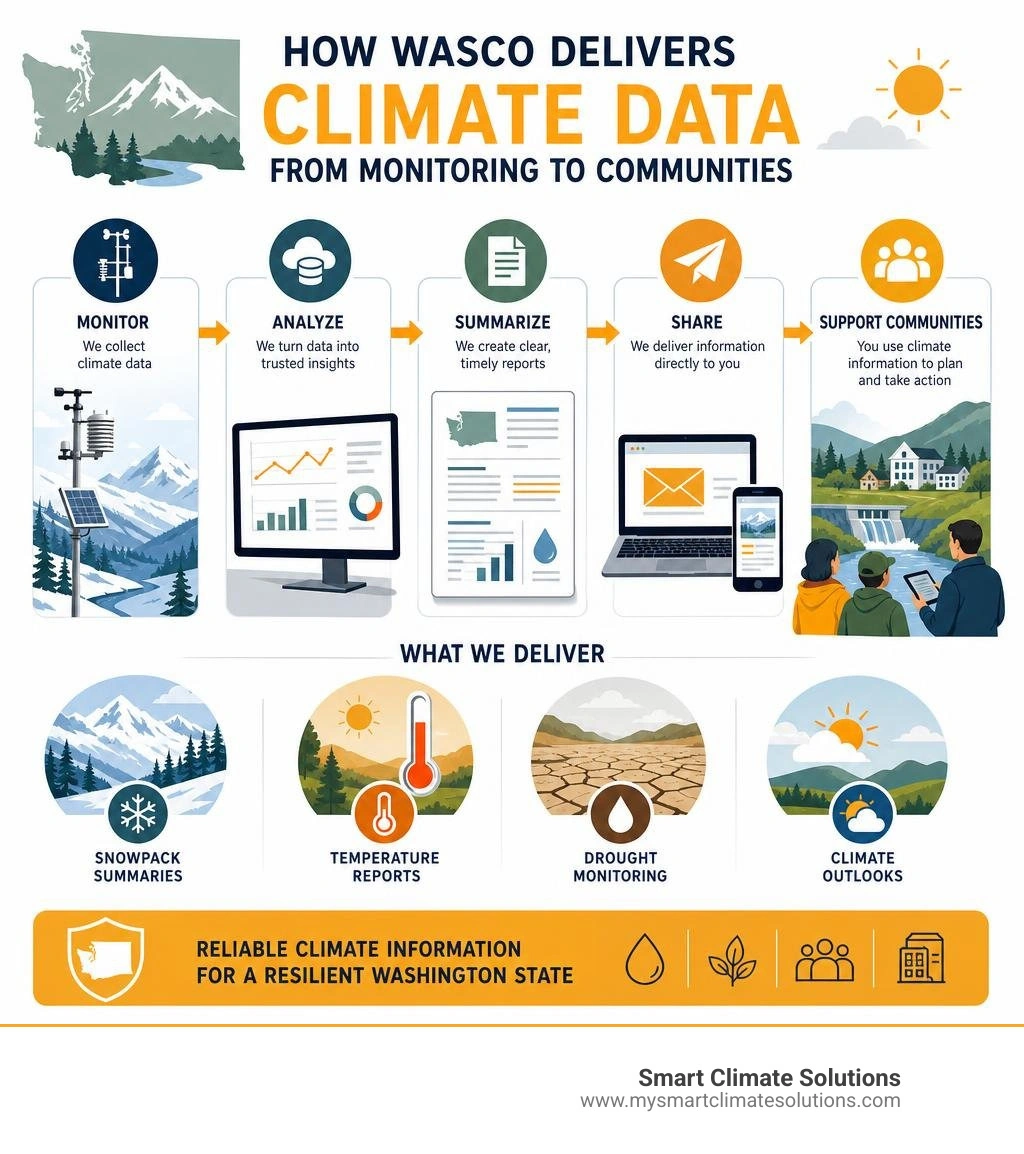
The Washington office climate service is your starting point for accessing official, up-to-date climate data for Washington State. Here is a quick overview of what it offers:
- What it is: The Washington State Climate Office (WASCO), established in 2003 and renamed in 2024, is the state's official source for climate information.
- Who it serves: Communities, decision-makers, farmers, water managers, and anyone who needs reliable climate data for Washington.
- What you can access: Statewide temperature and precipitation reports, snowpack and drought summaries, climate outlooks, training resources, and applied research.
- Where to find it: The WASCO website publishes monthly conditions, newsletters, and tools for tracking climate trends across the state.
Washington's climate is changing fast. In April 2026, statewide temperatures ran 2.1 degrees F above normal, and snowpack had dropped to just 19% of median by early June. These numbers are not just statistics - they affect water supply, wildfire risk, and everyday life across the state.
WASCO's tagline says it well: "Reliable climate information for a resilient Washington State." That mission drives everything the office produces.
I'm Bill Scott, general manager of Smart Climate Solutions and a 20-year HVAC industry veteran. While the Washington office climate service focuses on the Pacific Northwest, our team at Smart Climate Solutions serves Washington, PA, and the greater Pittsburgh tri-state area. We monitor climate services nationwide to understand broader weather patterns and apply these insights locally. Understanding regional climate data helps homeowners and businesses in our local communities make smarter decisions about their indoor comfort systems.
Simple guide to Washington office climate service:
- RTU replacement South Hills
- american standard commercial air conditioners
- american standard packaged rooftop units
Understanding the Washington Office Climate Service (WASCO)

The Washington State Climate Office (WASCO) serves as the primary gateway for climate data, monitoring, and research in the Pacific Northwest. To truly leverage these resources, it helps to understand how the office is structured and where it sits within the academic and state infrastructure.
WASCO is a member organization of EarthLab, a major institute housed within the University of Washington (UW) that focuses on solving environmental challenges through collaborative research. By partnering closely with the UW Climate Impacts Group, WASCO bridges the gap between complex academic research and practical, user-driven applications for local communities.
For a complete look at their history, organizational partnerships, and overall focus on current and past climate trends, you can explore the About Us | Washington State Climate Office page.
History and Mission of the Washington Office Climate Service
WASCO has a rich history of serving the public. The office was first established in 2003 to provide dedicated climate services to Washington State. In 2004, it received temporary support from the Washington State Department of Ecology, and by 2007, the state legislature officially established permanent state funding to secure its operations.
The office underwent a significant rebranding in 2024, changing its name from the Office of the Washington State Climatologist to the Washington State Climate Office (WASCO). This change reflected an expanded focus on training, capacity building, and applied research.
Today, the primary mission of WASCO is to deliver reliable climate information that supports a resilient Washington State. The office acts as a trusted advisor, helping stakeholders make sense of complex weather patterns, long-term warming trends, and changing water resources. You can learn more about their core mission on the official Washington State Climate Office homepage.
Key Staff and Leadership at WASCO
The high-quality data and actionable insights delivered by WASCO are driven by a team of dedicated climate scientists and engagement specialists. The key staff members at the office include:
- Guillaume Mauger (State Climatologist): Holding a PhD in Climate Science from the Scripps Institution of Oceanography, Dr. Mauger leads the office's research initiatives and strategic planning.
- Karin Bumbaco (Deputy State Climatologist): With a B.S. in Meteorology from Penn State and an M.S. in Atmospheric Science from Ohio State, Karin oversees daily climate monitoring, data analysis, and state reports.
- Jacob Genuise (Engagement Climatologist): Earning his B.S. from the University of Oklahoma School of Meteorology in 2021, Jacob focuses on community outreach, helping local stakeholders apply climate data to real-world challenges.
- Katie Boyd (Education and Evaluation Specialist): Katie designs training programs and educational resources to make climate science accessible to educators, students, and public officials.
- Nick Bond (Emeritus State Climatologist): Providing decades of historical expertise, Dr. Bond continues to support the office's long-term research goals.
To learn more about the team's academic backgrounds and ongoing research projects, check out the People | Washington State Climate Office directory.
How WASCO Fits into the National Climate Network

While WASCO focuses specifically on Washington State, it does not operate in a vacuum. It is an integral part of a larger, highly coordinated national climate services network. This network connects local state offices with regional hubs and federal agencies to ensure that consistent, high-quality data flows smoothly from national satellites down to local businesses.
At the federal level, the National Oceanic and Atmospheric Administration (NOAA) and the National Centers for Environmental Information (NCEI) manage the broader climate infrastructure. NCEI oversees six Regional Climate Centers (RCCs) that span the entire United States, integrating non-NOAA climate data with traditional government sources to create value-added, sector-specific products. To see how these regional centers cooperate across the country, you can visit the USRCC Home portal.
NOAA Regional Climate Centers and the NWS
The delivery of daily weather and long-term climate services relies on close collaboration between several key entities:
- The National Weather Service (NWS): Provides end-to-end services, from daily local observations to long-range predictions.
- The Climate Services Branch (CSB): Acts as the lead programmatic unit overseeing policy, training, and public outreach.
- The Climate Prediction Center (CPC): Delivers operational climate predictions covering timescales from one week to several seasons.
- Local NWS Forecast Offices: Serve as the primary point of entry for local communities requesting immediate weather and climate data.
For an in-depth breakdown of how these federal programs coordinate to protect life and property, read the official guide About Climate Services.
This national framework is incredibly important for our local clients in Pennsylvania, Ohio, and West Virginia. For example, the Northeast Regional Climate Center (NRCC) serves twelve states, including Pennsylvania and West Virginia. By using data from local weather stations, our team at My Smart Climate Solutions can track temperature shifts right here in our service areas, ensuring that local commercial and residential HVAC systems are perfectly calibrated for our region's specific climate demands.
Actionable Data and Services Provided by WASCO
WASCO is highly regarded for translating raw atmospheric data into actionable resources. Whether you are a city planner designing storm infrastructure, an agricultural producer managing irrigation, or a commercial building manager planning an HVAC upgrade, the office provides the technical support you need. For an overview of their active projects, publications, and outreach programs, visit the Our Work | Washington State Climate Office page.
Accessing the Washington Office Climate Service Tools and Publications
WASCO has developed a suite of interactive tools, data visualizations, and publications designed to make climate tracking simple. Some of their most popular resources include:
- Interactive Visualization Tools: Web-based dashboards that allow users to view historical temperature, precipitation, and snowpack data by county or watershed.
- Water Year Meetings: Annual collaborative gatherings hosted by WASCO that bring together meteorologists, hydrologists, and resource managers to review the previous water year and prepare for upcoming seasonal shifts.
- Monthly Climate Newsletters: Summaries that detail temperature departures, precipitation totals, and drought outlooks.
To explore these regional climate tools and find resources tailored to specific Pacific Northwest basins, you can check out the CAR-WASH Regional Climate Service Organizations database. For those interested in the mechanical side of climate control, utilizing precise local climate data is essential when designing modern heating and cooling systems to ensure maximum efficiency and comfort.
Recent Climate Conditions and Environmental Trends
To illustrate the types of data WASCO tracks, let's look at the actual climate conditions recorded in Washington State during the spring of 2026. The state experienced a combination of above-normal temperatures and significantly below-normal precipitation, leading to rapid snowmelt and early-season drought concerns.
| Climate Metric | Observed Value (Spring 2026) | Historical Normal / Median (1991-2020) | Percent of Normal or Departure |
|---|---|---|---|
| April Temperature | +2.1 degrees F | Baseline Normal | +2.1 degrees F Departure |
| April Precipitation | 2.8 inches | 3.9 inches | 72% of Normal |
| May 12th Snow Water Equivalent (SWE) | N/A | Baseline Median | 26% of Median |
| June 3rd Statewide Snowpack | N/A | Baseline Median | 19% of Median |
These dry, warm conditions were heavily influenced by an El Nino transition toward ENSO-neutral conditions. When snowpack drops to just 19% of the median by early June, reservoirs must work overtime to supply water throughout the dry summer months. For building operators, these prolonged warm periods mean that cooling systems must run longer and more efficiently to maintain comfortable indoor temperatures.
Addressing Emerging Environmental Challenges and Resilience
As climate change accelerates, Washington State faces emerging environmental challenges that threaten both natural ecosystems and human infrastructure. The state's lead agency on climate change, the Washington State Department of Ecology, works hand-in-hand with research groups like WASCO to implement the state's comprehensive Climate Resilience Strategy, which was published on September 30, 2024.
Key focus areas of this statewide strategy include:
- Reducing Greenhouse Gas Emissions: Enforcing the Climate Commitment Act, which targets the state's largest emission sources, alongside clean fuel and zero-emission vehicle standards.
- Reducing Flood Risks: Collaborating with FEMA on Risk MAP projects to provide communities with accurate flood risk data and planning grants.
- Reducing Wildfire and Water Impacts: Implementing proactive forest management and water conservation programs to mitigate summer drought risks.
- Combating Ocean Acidification: Supporting the country's first Ocean Acidification Blue Ribbon Panel to monitor and protect vulnerable marine ecosystems.
Climate Adaptation in the North Cascades and Beyond
Adapting to these changes requires concrete, science-based land management tactics. A prime example of this is the work done by the North Cascades Adaptation Partnership. Managing a region that includes over 16,000 km of roads, partner agencies have had to completely rethink infrastructure design due to projected warming trends.
Climate models project an average warming in the Pacific Northwest of 2.1 degrees C by the 2040s and 3.8 degrees C by the 2080s. In the North Cascades, this warming is shifting watersheds from snow-dominated to rain-dominated systems, leading to:
- Increased autumn and winter flooding.
- Higher peak stream flows that wash out traditional culverts.
- Severely reduced summer stream flows that threaten native fisheries.
To build resilience, land managers are now designing culverts based on projected future peak flows rather than historical data, restoring stream complexity to keep waters cool, and reducing forest density to minimize catastrophic wildfire risks.
Frequently Asked Questions about Washington Climate Services
What is the primary role of the Washington State Climatologist?
The primary role of the State Climatologist is to provide reliable, actionable climate information to the public, state agencies, and local communities. By conducting user-driven, collaborative research, the climatologist helps stakeholders understand both historical climate patterns and future projections, ensuring that state policies and local infrastructure projects are built to withstand changing environmental conditions.
How does WASCO collaborate with other state agencies?
WASCO collaborates extensively with a wide range of partners, including the Washington State Department of Ecology, the University of Washington Climate Impacts Group, and various tribal nations. This collaborative approach ensures that scientific data is directly integrated into state-level planning, such as water resource allocation, agricultural drought planning, and wildfire risk assessments.
Where can I find real-time drought and snowpack data for Washington?
Real-time drought, temperature, and snowpack data can be accessed directly on the WASCO website. The office publishes detailed monthly newsletters and statewide climate summaries.
For our local readers in Pennsylvania who are looking for similar real-time weather and climate monitoring in our own service areas, you can access localized data through the Pittsburgh, PA - National Weather Service page, or view the current local 7-Day Forecast 40.38N 80.37W - National Weather Service for the Washington, PA area.
Conclusion
While tracking the climate patterns of the Pacific Northwest is vital for West Coast communities, managing your own local climate is what keeps your business running smoothly day in and day out. Here in the tri-state area - spanning Pittsburgh, PA, the South Hills, Burgettstown, Washington, PA, Steubenville, OH, St. Clairsville, OH, and Weirton, WV - our weather brings its own unique set of challenges, from humid summer heatwaves to freezing winter drafts.
At My Smart Climate Solutions, we bring over 20 years of experience, certified technicians, and 24/7 emergency support to ensure your commercial property remains perfectly comfortable regardless of the outdoor weather. Whether you need a comprehensive HVAC Service Pittsburgh Complete Guide to plan your next upgrade, a customized Commercial HVAC Maintenance Plan to lower your utility bills, or expert assistance with complex HVAC Retrofit Projects Pittsburgh, we have you covered.
Our specialized commercial services include:
- Expert Commercial Heating System installation and repair.
- Comprehensive Large Scale Mechanical Contracting for major renovations.
- Customized Commercial Air Handler Replacement and Commercial Ductwork Installation.
- Precision custom work from our local Piping Fabrication Shop Pittsburgh.
- Top-tier equipment guides, including our detailed Bryant Commercial Air Conditioners Guide 2026.
Ready to optimize your building's indoor climate and protect your bottom line? Explore our full range of commercial heating, cooling, and ventilation services on our Services Page or contact My Smart Climate Solutions today to schedule a consultation with our local experts.



.png)
